
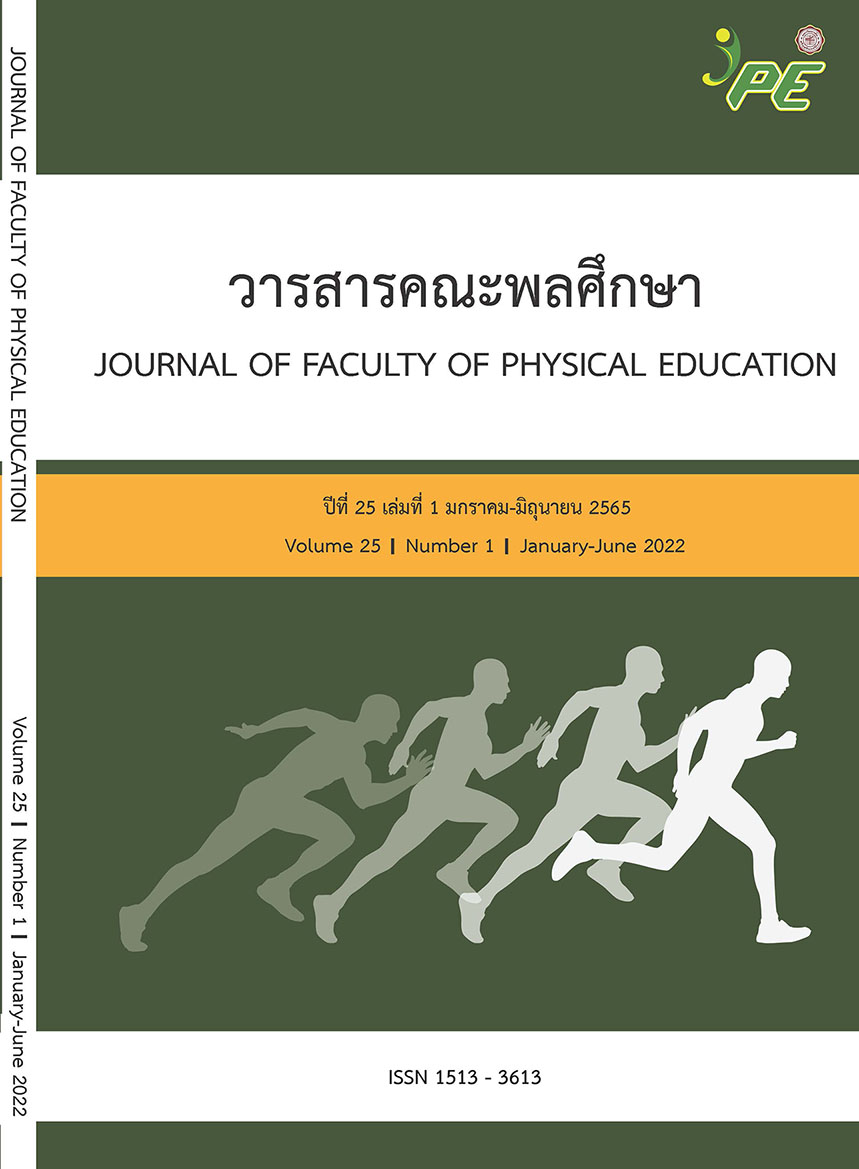
การพัฒนาสื่อวีดิทัศน์ทักษะการวิ่งระยะสั้น สำหรับนักศึกษามหาวิทยาลัยการกีฬาแห่งชาติ
Article Sidebar
Main Article Content
บทคัดย่อ
วัตถุประสงค์: 1) เพื่อสร้างและหาประสิทธิภาพของสื่อวีดีทัศน์ที่มีต่อทักษะการวิ่งระยะสั้น 2) เพื่อพัฒนา
ผลสัมฤทธิ์ทางการเรียนของนักศึกษา 3) เพื่อศึกษาคะแนนการเปลี่ยนแปลงสัมพัทธ์ของความสามารถด้านทักษะการวิ่ง
ระยะสั้น และ 4) เพื่อศึกษาความพึงพอใจของผู้เรียน การวิจัยนี้เป็นการวิจัยและพัฒนา (Research and development)
เครื่องมือในการวิจัย ได้แก่ แบบสัมภาษณ์สำหรับผู้เชี่ยวชาญด้านเนื้อหาและด้านสื่อวีดิทัศน์, สื่อวีดิทัศน์ทักษะการวิ่งระยะ
สั้น, แบบประเมินคุณภาพเครื่องมือด้านสื่อวีดิทัศน์, แบบประเมินคุณภาพเครื่องมือด้านเนื้อหา, แบบทดสอบวัดผลสัมฤทธิ์
ทางการเรียน ซึ่งมีความเชื่อมั่นของแบบทดสอบเท่ากับ 0.91, แบบประเมินการเรียนรู้ทักษะการวิ่งระยะสั้น และ
แบบสอบถามความพึงพอใจของผู้เรียน กลุ่มตัวอย่างเลือกสุ่มแบบเจาะจง จากนั้นใช้วิธีอาสาสมัคร สุ่มให้เหลือ 30 คน
ใช้เวลาทดลอง 1 ชั่วโมง 30 นาที จำนวน 2 ครั้ง สถิติที่ใช้ในการวิจัย ค่าเฉลี่ย ( X ) ค่าส่วนเบี่ยงเบนมาตรฐาน (S.D) สถิติ
ที่แบบไม่อิสระ (t-test Dependent) ค่าความเชื่อมั่นของแบบทดสอบวัดผลสัมฤทธิ์ทางการเรียน โดยใช้สูตร KR-20 ของ
Kuder–Richardson หาประสิทธิภาพของสื่อวีดิทัศน์ด้วยสูตร E1/E2 และสถิติการวัดความเปลี่ยนแปลงสัมพัทธ์
ผลการวิจัย พบว่า
1) สื่อวีดิทัศน์มีประสิทธิภาพ เท่ากับ 82.00/83.16
2) ผลสัมฤทธิ์ทางการเรียนหลังเรียนสูงกว่าก่อนเรียน อย่างมีนัยสำคัญทางสถิติที่ระดับ .05
3) ผลแสดงคะแนนการเปลี่ยนแปลงสัมพัทธ์การเรียนภาคปฏิบัติ ก่อนเรียนคิดเป็นร้อยละ 6.13 หลังเรียนคิด
เป็นร้อยละ 14.00
4) กลุ่มตัวอย่างมีความพึงพอใจภาพรวมอยู่ในระดับมากที่สุด ( X =4.59)
Article Details

อนุญาตภายใต้เงื่อนไข Creative Commons Attribution-NonCommercial-NoDerivatives 4.0 International License.
บทความและข้อคิดเห็นใดๆ ในวารสาร เป็นทัศนะของผู้เขียน คณะพลศึกษาไม่จำเป็นต้องเห็นชอบด้วยเสมอไปผู้ใดประสงค์จะนำข้อความไปตีพิมพ์หรือเผยแพร่ต้องได้รับอนุญาตจากผู้เขียนโดยตรง
เอกสารอ้างอิง
Baikub, P., & Teach, S. (2015). The Study of scores on the development of the research ability of
student teachers at Phibunsongkhram Rajabhat University, Phitsanulok Province. Humanities
and Social Sciences Journal of
Phibunsongkhram Rajabhat University, 9(2), 29-50.
Bonk, C. J., & Graham, C. R. (2004). Handbook of blended learning global perspectives. San Francisco:
CA Pfeiffer publishing.
Boonseng, A. (2008). Documents for teaching athletics 1. Suphanburi: Institute of Physical Education
Suphanburi Campus.
Brahmawong, C. h. (2013) Evaluating the effectiveness of teaching media packages. Silpakorn
Education Research Journal, 5(1), 5-20.
Didbunjong, K., Thaesungnern, A., & Boonseng, N. (2017). Development of hurdle skills via video media
for students of the institute of physical education. Rampai Pannee Research Journal, 12(3),
-114.
Khamputhon, C. h., & Klaikaew, L. (2018). Research and creation of video media for teaching and
learning gymnastics for young children through cheerleading. (Bangkok: Graduate School,
Research No.: 13) Rangsit University.
Phuengsri, A. (2018) Development of online video lessons in photography subject: advance flash
photography (dissertation). Phitsanulok, Naresuan University.
Sararat, Th., & Saelee S. (2017). Development of 3D animation media using 360-degree motion capture
techniques for learning cheerleading. Academic journal, Architectural art, Naresuan University,
(1), 110-124.
Singthong, J. (2007). A double-dimensioned five-way change measurement study. under different test
length conditions and the sample size is not the same. Doctorate of Education Department of
Testing and Evaluation Faculty of Education Srinakharinwirot University.
Sirssurepakdee, P., Techataipop, T. h., (2018). Shobtamdee B. The development of multimedia
computer media on the principle of computer operation for students in grade 7. Wat
Phutthaisawan School. Journal of Learning
Innovation, 4(1), 49-62.
Srisaard, B. (2017). Preliminary research. 10th ed. Bangkok: Suwiriyasan.
Yuneyong, J., & Soodsang, N. A. (2017). Study of learning achievement according to the constructivist
concept of principles of design through the computer lessons of undergraduate students.
Academic journal, Architectural art, Naresuan University, 8(1), 1-11.
