
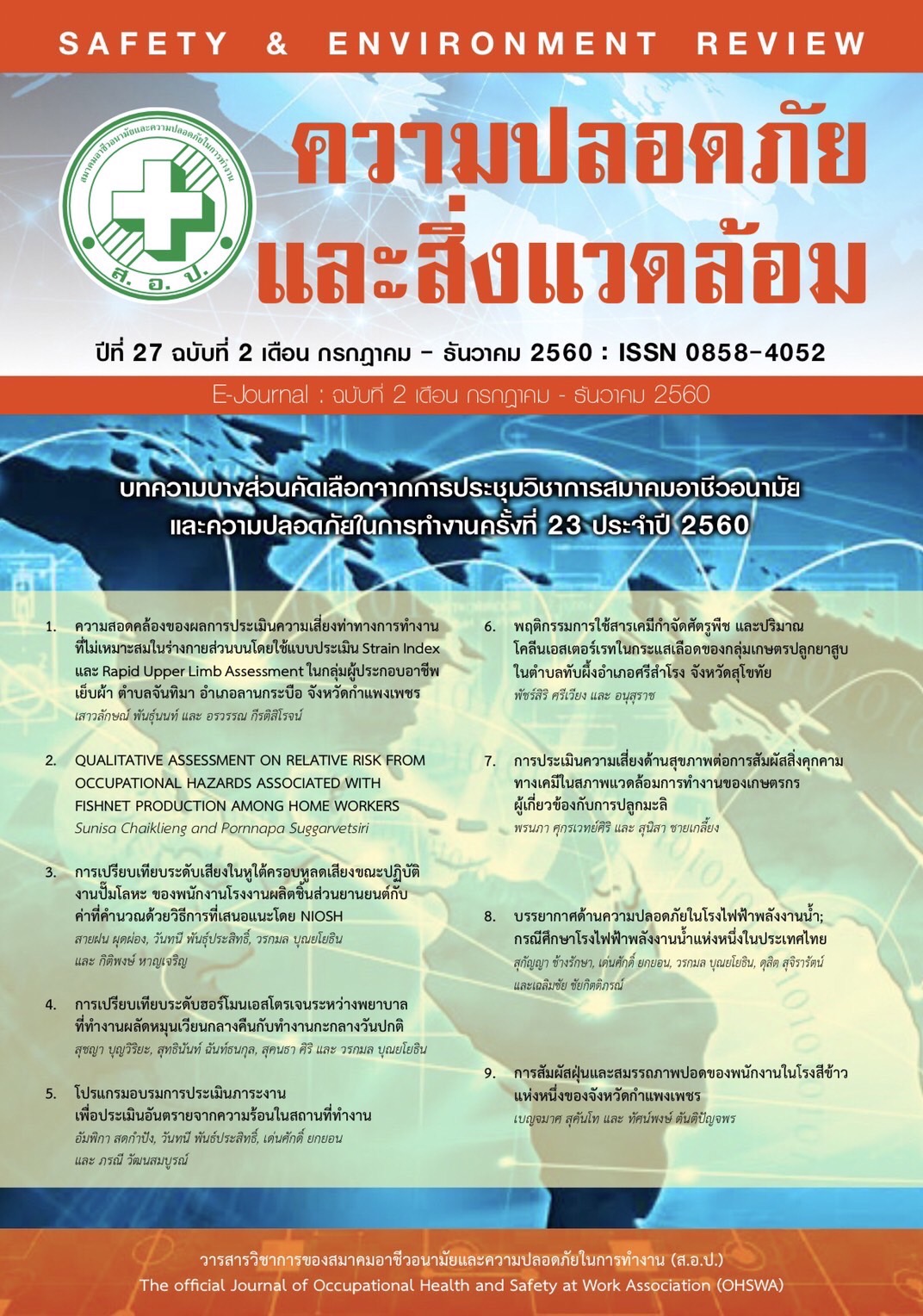
QUALITATIVE ASSESSMENT ON RELATIVE RISK FROM OCCUPATIONAL HAZARDS ASSOCIATED WITH FISHNET PRODUCTION AMONG HOME WORKERS
Keywords:
Home Workers, Fishnet, Ergonomics, Risk Assessment, HazardsAbstract
This survey research aimed to identify the potential hazards and determine the relative risk on exposure to occupational hazards in fishnet home workers by a case study in Khon Kaen province, Thailand. Home-based process of the fishnet production were classified into three types: material handling (n=42), sinker made of lead attachment (n=42), and float attachment (n=42). Data were collected with a structured questionnaire, a survey form, and observations. The potential hazards were identified and risk was characterized by considering of 3 x 3 risk matrix (likelihood x severity). The final score indicated risk in five ranking levels. Ergonomic factors were identified at the high risk for the highest proportion of workers involved in the process of material handling, sinker attachment and float attachment for 54%, 57%, and 66%, respectively. The following factor was sharp instruments or materials identified the highest proportion of 24%, 21%, and 8% for material handling, sinker attachment, and float attachment, respectively. Chemical (lead) contamination through skin identified in process of material handling (22%) and sinker attachment (10%) at high risk. Personal protective equipment (PPE) was used by 10% of workers. Therefore, fishnet home workers should be aware of occupational hazards, by using PPE for better protection. The support of trainings on occupational safety and health, and PPE are suggested for the employers in compliance with the home workers protection act 2010.
References
National Statistical Office, Thailand. The report of informal employment survey. Bangkok: Ministry of information and communication technology; 2011.
Homenet. Homeworkers in Thailand: A Study on Their Legal Problems, Available at: http://caw.jinbo.net/popups/articleswindow.php?id=44, accessed August 31, 2011.
Laungaramsri P. Home workers in Thailand: an assessment. A paper submitted to the Friedrich-Ebert-Stiftung. Chiang mai: Chiangmai University, 2005.
The ministry of Labour. Home workers protection act 2010. Available at http://thailaws.com/body_thaiacts_a03.htm, accessed August 31, 2012.
Chaiklieng S and Homsombat T. Ergonomic risk assessment by RULA among informal sector workers of Rom Suk broom weaving. Srinagarind Med. J. 2011; 26:9-14.
Bernard BP. Musculoskeletal disorders and workplace factors. A critical review of epidemiological evidence for work-related musculoskeletal disorders of the neck, upper extremity and low back. USA: Department of health and human services (NIOSH); 1997.
Sungkhabut W and Chaiklieng S. Musculoskeletal disorders among informal sector workers of hand-operated rebar bender: a pilot study. Srinagarind Med. J. 2011; 26(3): 45-50.
Chaiklieng S. Work-related back pain. KKU Journal of Public Health Research 2009; 2(3):49-58.
Chaiklieng S. Industrial toxicology. Khon Kaen: Khon Kaen University printing, Thailand, 2002.
Haynes S and Williams K. Socio-economic differences in the prevalence of acute, chronic and disabling chronic pain among ageing employees. Pain 2008; 114, 364–71.
Linton SJ. A review of psychosocial risk factors in back and neck pain. Spine 2000; 25, 1148-56.
Department of Labor Protection and Welfare, Ministry of Labor, Thailand. Regulation on the standard of management of safety, occupational health and work environment; heat, light and sound, version 2006. Available at http://www.labour.go.th/law/index.htm, accessed March 20, 2010.
Chaiklieng S, Suggaravetsiri P, Boonprakob Y. Work ergonomic hazards for musculoskeletal pain among university office workers. Walailak J Sci & Tech. 2010; 7(2), 169-76.
Downloads
Published
Issue
Section
License

This work is licensed under a Creative Commons Attribution-NonCommercial-NoDerivatives 4.0 International License.
This article is published under a Creative Commons Attribution-NonCommercial-NoDerivatives 4.0 International License (CC BY-NC-ND 4.0), which allows others to share the article with proper attribution to the authors and prohibits commercial use or modification. For any other reuse or republication, permission from the journal and the authors is required.


