
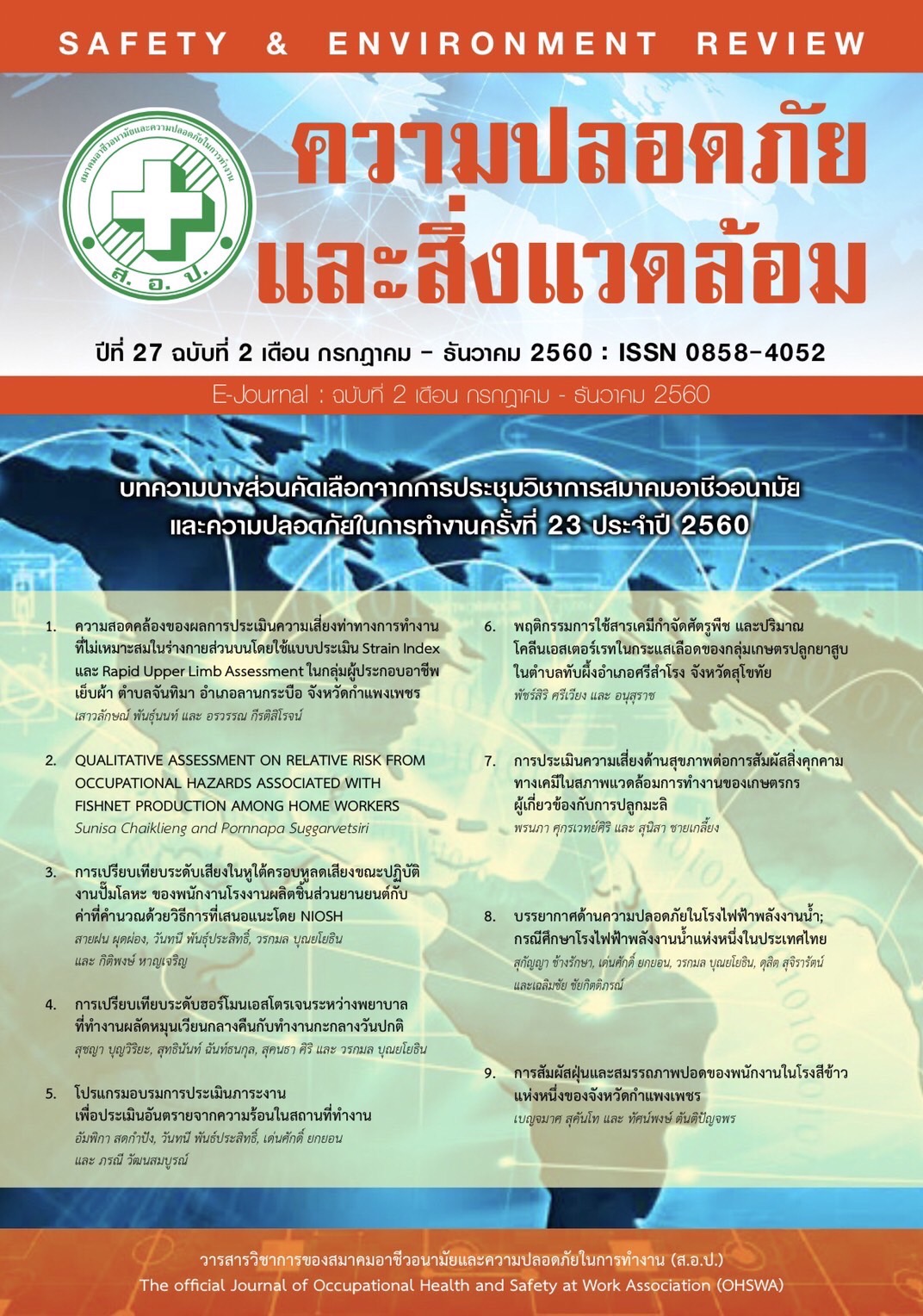
THE COMPARATIVE OF ESTROGEN LEVEL IN NIGHT AND DAY ROTATING SHIFT NURSES
Keywords:
Nurse, night rotating shift, day rotating shift, estrogen levelsAbstract
This study aims to compare the estrogen levels in the nurse who working in rotating night shift and day rotating shift by blood test. Nurses who interested to join this project through screening criteria were 40 persons each group, with age 25-40 years old. The data collections were blood collected from vein in day 2-5 of the menstrual cycle and questionnaire for personal characteristic and pattern of shift. It was found that the median estrogen levels of the night rotating shift group and the day rotating shift group were 126.00 pmol/L (IQR 87.70-151.50) and 103.00 (IQR 72.20-133.00) pmol/L, Mann-whitney U test showed statistically significant difference at p-value 0.036. Pattern of shift was categorized in 8 hours/shift, 12 hours/shift and both. The estrogen of participants who had different hours per month of working the night rotating shift and different hours per month of working the day rotating shift were both statistically significant difference at p-value < 0.001. In addition, this study showed the association between number of hours per month of working the night rotating shift , number of hours per month of working the day rotating shift and estrogen level were statistically significant difference at p-value <0.001 and 0.026 ,respectively, analyzed by univariate linear regression. The result of this study was consistent with the hypothesis that the estrogen levels of nurses in the night rotating shift group more than the day rotating shift as well as the higher number of night rotating shift, the higher estrogen levels.
References
Straif K, Baan R, Grosse Y. Carcinogenicity of shiftwork, painting, and firefighting. Lancet Oncol 2007; 8:1065e6.
กลุ่มงานเทคโนโลยีสารสนเทศ สถาบันมะเร็งแห่งชาติ. ทะเบียนมะเร็งระดับโรงพยาบาล พ.ศ. 2558 HOSPITAL BASED CANCER REGISTRY 2015,[online] 2015 [cited 2016Apr1] ;69[94screens]. Available at http://www.nci.go.th/th/File_download/NciCancerRegistry/HOSPITALBASED2015.pdf.
Alfred J. Lewy, Saeeduddin Ahmed, Jeanne M. Latham Jackson, Robert L. Sack. Melatonin Shifts Human Circadian Rhythm According to a Phase-Response Curve. Chronobiology International 1992; 9(5):380-392.
Helena Schock. Hormone Concentrations during Pregnancy and Maternal Risk of Epithelial Ovarian Cancer. [Internet]. Print & Media [cited 2016 Jan 12] Available from: https://www.diva-portal.org/smash/get/diva2: 806991/FULLTEXT01.pdf.
Gomez-Acebo I, Dierssen-Sotos T, Papantoniou K, García-Unzueta MT, Santos-Benito MF, Llorca J. Association between exposure to rotating night shift versus day shift using levels of 6-sulfatoxymelatonin and cortisol and other sex hormones in women. Chronobiol Int, 2015; 32(1):128-35.
Paola Ferri, Matteo Guadi, Luigi Marcheselli, Sara Balduzzi, Daniela Magnani,Rosaria Di Lorenzo. The impact of shift work on the psychological and physical health of nurses in a general hospital: a comparison between and Healthcare Policy 2016; 9:203–211.
Kate Sparks and Cary Cooper,Yitzhak Fried, Arie Shirom. The effects of hours of work on health: A metaanalytic review. Journal of Occupational an Organizational Psychology 1997; 70:391-408.
Anders Knutsson. IN-DEPTH REVIEW: SHIFT WORK, Health disorders of shift workers. Occupational Medicine 2003; 53:103–108.
Anna Merklinger-Gruchala , Peter T. Ellison , Susan F. Lipson , Inger Thune and Grazyna Jasienska. Low estradiol levels in women of reproductive age having low sleep variation. European Journal of Cancer Prevention 2008, 17:467–472.
Downloads
Published
Issue
Section
License

This work is licensed under a Creative Commons Attribution-NonCommercial-NoDerivatives 4.0 International License.
This article is published under a Creative Commons Attribution-NonCommercial-NoDerivatives 4.0 International License (CC BY-NC-ND 4.0), which allows others to share the article with proper attribution to the authors and prohibits commercial use or modification. For any other reuse or republication, permission from the journal and the authors is required.


