
การประเมินความเสี่ยงฝุ่นระเบิดของแป้งข้าว แป้งข้าวเหนียว และแป้งมันสำปะหลัง ที่ความเข้มข้นที่แตกต่างกัน
Keywords:
Starch, Dust Explosion, ConcentrationAbstract
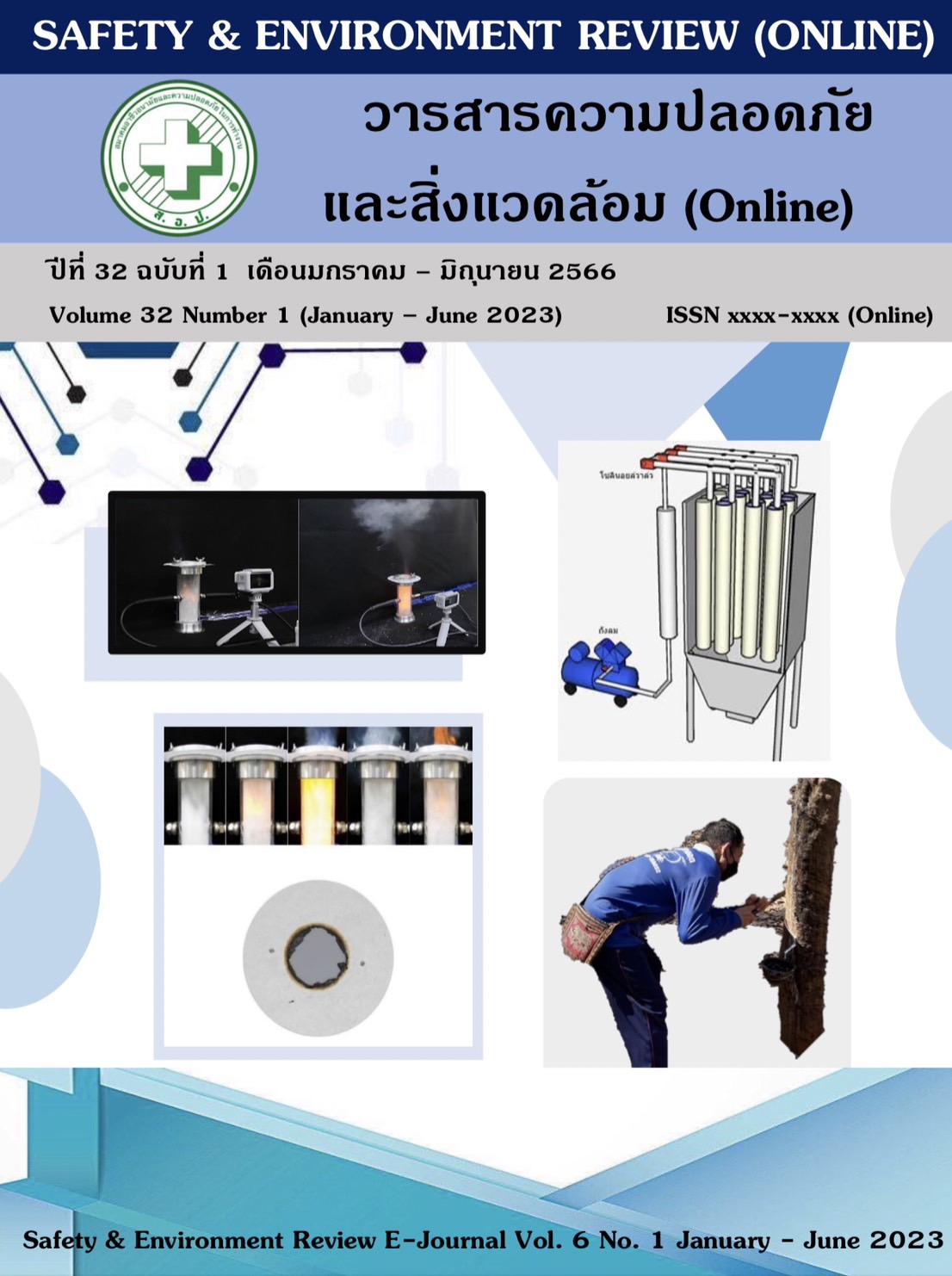
Starch is the primary ingredient for food processing, by blending with other ingredients inside the mixer. This experimental study carried out to observe the explosibility of rice, glutinous rice, and tapioca starches, the common ingredients for Thai and Chinese foods. The series of experiment on set inside 1.2 L Hartmann cylindrical, observed and filmed by high-speed camera. The results of these experiments indicated that these three agricultural-food starches exploded violently at the concentration between 747 – 962 g/m3. Since there was no regulatory requirement for dust explosion prevention for food processing industry in Thailand, obvious urgent need to inform food-starch processors to aware of potential hazards and convince the authorities to mandate dust explosion prevention system in food-starch processing facilities.
References
Kasikorn Bank. KSME Analysis, Thai Rice Innovation – Value added Products of SMEs. 2018. https://www.kasikornbank.com/th/business/sme/KSMEKnowledge/article/KSMEAnalysis/Pages/Thai-Rice_Innovation.aspx Access 20 Feb 2021. Accessed 1 May 2021.
Krugsi Research. Thailand Industrial Outlook 2020-2022. Cassava Industry. 2020. https://www.krungsri.com/en/research/industry/industry-outlook/Agriculture/Cassava/IO/io-cassava-20 Accessed 1 May 2021.
Abbasi T, Abbasi SA. Dust explosions–Cases, causes, consequences, and control. Journal of Hazardous Materials. 2007;140(1):7-44.
G.Li, X.Yang C, M. Yuan R, K. Eckhoff. A Catastrophic Aluminium-alloy Dust Explosion in China. 2015. Journal of Loss Prevention in the Process Industries, Vol 39, p121-130. 2015. https://doi.org/10.1016/j.jlp.2015.11.013 Accessed 27 March 27, 2021.
Color Play Asia fire claims another life, after five months. Taipei Times. 30 November 2015. Accessed 27 March 27, 2021. http://www.taipeitimes.com/News/taiwan/archives/2015/11/30/2003633680
Tuas fire: The explosive danger of potato powder, sugar, flour and other dust particles. Channel News Asia. 25 February 2021. https://www.channelnewsasia.com/news/singapore/tuas-fire-explosion-3-workers-dead-5-critical-condition-14279894?cid=h3_referral_inarticlelinks_24082018_cna Access 27 March 2021
Department of Industrial Works. Dust explosion in industry. Bangkok: Thawiphat; 2011. 96 p.
National Fire Protection Association. NFPA 654, Standard for the Prevention of Fire and Dust Explosions from the Manufacturing, Processing, and Handling of Combustible Particulate Solids 2017. Available from: https://www.nfpa.org/codes-andstandards/all-codes-and-standards/list-of-codes-and standards/.
National Fire Protection Association. NFPA 652: Standard on the Fundamentals of Combustible Dust. National Fire Protection Association; 2016.
ASTM International. ASTM E2019 - 03, Standard Test Method for Minimum Ignition Energy of a Dust Cloud in Air. 2003.
European Committee for Standardization. Potentially Explosive Atmospheres, Determination of Minimum Ignition Energy of Dust/air Mixtures, European Standard EN 13821. 2002.
Tanthapanichkoon W, Chongvisal V, Charinpanitkul T, Taepaisitphongse V. Dust Explosive Limit Tester. Bangkok: Chulalongkorn university; 1996.
Downloads
Published
Issue
Section
License

This work is licensed under a Creative Commons Attribution-NonCommercial-NoDerivatives 4.0 International License.
This article is published under a Creative Commons Attribution-NonCommercial-NoDerivatives 4.0 International License (CC BY-NC-ND 4.0), which allows others to share the article with proper attribution to the authors and prohibits commercial use or modification. For any other reuse or republication, permission from the journal and the authors is required.


