
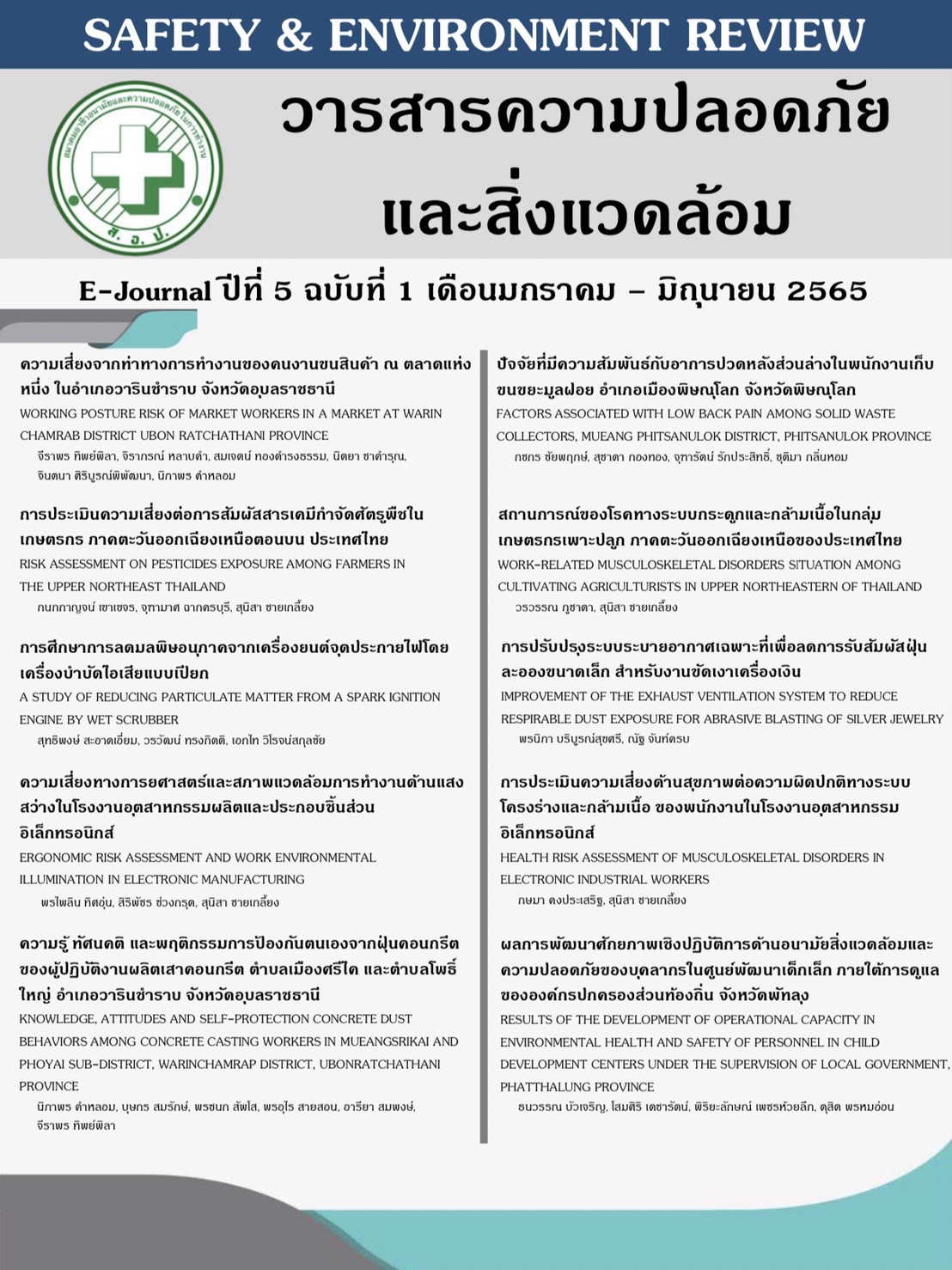
Ergonomic risk assessment and work environmental illumination in electronic manufacturing
Keywords:
ergonomic, fatigue, RULA, ROSA, lightingAbstract
The electronics manufacturing has a process consisting of work procedure requiring employees to sit or stand for long periods of time, as well as inappropriate illumination environments for working that require visual inspection leading to musculoskeletal disorders. This cross-sectional descriptive study in the one electronic manufacturing in Northern Thailand aimed to assess the ergonomics risks of employees across the organization in a total of 26 working similar exposure groups. Data were obtained using an ergonomic risk assessment form using Rapid Upper Limbs Assessment (RULA), Rapid Entire Body Assessment (REBA) and Rapid Office Strain Assessment (ROSA) as appropriate for the job. The lighting intensity in working environment was measured for area and spot measurement. Data were analyzed using descriptive statistics. Ergonomics risk assessment by RULA found that 53.66% of those works had moderate risk level that required further investigation and change may be needed for postures with alternating arms or hands twisted and the body forward bending while working. Ergonomics risk assessment by REBA found that 66.67% had a level of high risk (further investigate and require implementation) from a working posture that required standing all the time and a posture that had to raise arms, wrist rotation and exertion force to pull the wire. Ergonomics risk assessment by ROSA found that the office work was acceptable risk. The results of the light intensity measurement found that 90.00% of area measurements did not meet the standard and 27.22% of the spot measurements did not meet the standard that mostly found in the non-machine wire winding process (57.69%). Most workers in this process had predominantly body discomfort on hand and wrist (71.43%), followed by back area (57.14%), respectively. The Subjective Workload Index (SWI) assessment indicated that all workers of non-machine wire winding process had a very high discomfort. The high ergonomics risk and inappropriate lighting affected the physical discomfort and mental workload of employees are interesting to further study onfactors associated with the musculoskeletal disorders (MSDs) and the ergonomics designed workstations with proper illumination to prevent MSDs and the work stress of workers.
References
Keawnual A, Lohapoontagoon B, Pochana K. Prevalence of Work-related Musculoskeletal Disorders in various occupations. Public Health of Burapha Univ 2017; 12(2): 53-64.
Chaiklieng S. Work Physiology and Ergonomics. Khon Kean: Khon Kean University printing house; 2019
Duangprom N, Chaiklieng S. Recognition of Musculoskeletal Disorders among workers of the electronic industry in Udon Thani Province. KKU Research J; 18(5): 88-91.
Chaiklieng S, Pannak A. Health risk assessment of shoulder pain among electronic workers. J Public Health 2017; 47(2): 212-20.
McAtemney L, Corlett EN. RULA: survey method for the investigation of work-related upper limb disorder. Appl Ergon 1993;24(2): 91-9.
Hignett S, McAtemney L. Rapid Entire Body Assessment (REBA). Appl Ergon 2000; 31(2): 201-05.
Krusan M, Chaiklieng S. Ergonomic risk assessment in University office workers. KKU Res J 2014; 43: 697-707.
Chaiklieng S. Health risk assessment on musculoskeletal disorders among potato-chip processing workers. PLoS ONE 2019; 14 (12): e0224980. doi: 10.1371/journal.
Labour Legislation. Ministerial regulation on the prescribing of standard for administration and management of occupational safety, health and environment in relation to heat, light and noise B.E. 2016. Government Gazette 2016; 133(91): 7.
Nilvarangkul K, Wongprom J, Tumnong C, Supornpun A, Surit P, Srithongchai N. Strengthening the self-care of women working in the informal sector: the fabric weaving women of Khon Kean (Phase 2). The Faculty of Nursing: Khon Kean University; 2004.
Chutiwatpongstron S, Chaiklieng S. Ergonomics risk assessment and ergonomic factors among computer users in Tambon health promoting hospital, Nongkhai province. KKU J Public Health Res 2015; 8(3):72-64.
Chaiklieng S, Suggaravetsiri P, Poochada W. Risk factors associated with shoulder pain among assembly electronic workers. J Med Tech Phy Ther 2019; 31(3): 150-61.
Taptagaporn S. Health effects from ergonomics problem: ergonomics subject book. 2nd ed. Bangkok: Sukhothaithammathirat University press; 2009.
Chidnaee S, Chidnaee J, Kuariyakul A. Risk factors for computer visual syndrome and prevalence of vision problems in nursing students at Borommarajonani College of nursing Uttaradit. J Nursing Public Health Education 2015; 16(2): 13-22.
Downloads
Published
Versions
- 2022-08-26 (2)
- 2022-07-22 (1)
Issue
Section
License

This work is licensed under a Creative Commons Attribution-NonCommercial-NoDerivatives 4.0 International License.
This article is published under a Creative Commons Attribution-NonCommercial-NoDerivatives 4.0 International License (CC BY-NC-ND 4.0), which allows others to share the article with proper attribution to the authors and prohibits commercial use or modification. For any other reuse or republication, permission from the journal and the authors is required.


