
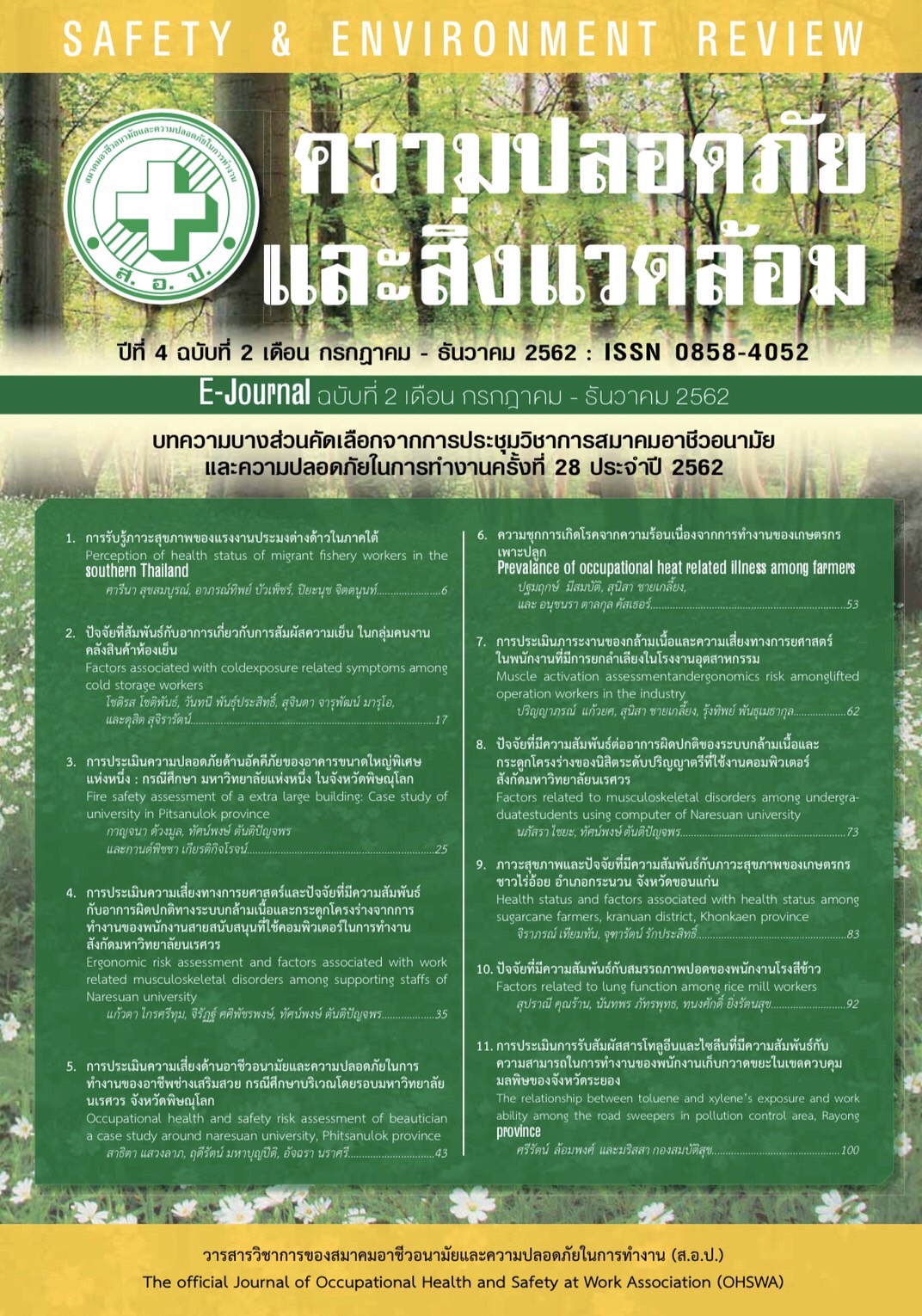
Factors associated with cold exposure related symptoms among cold storage workers
Keywords:
Cold Exposure Related Symptoms, Cold Storage Workers, Duration Of Cold ExposureAbstract
This cross-sectional study aimed to investigate the relationship between personal factors, duration of cold exposure
and workwear with cold exposure related symptoms among cold storage workers. The study data including environment
data, e.g. air temperature, wind speed, and relative humidity and interviewed and observed data, e.g. personal and work
history, work characteristics, cold exposure related symptoms, and workwear. The participants were 163 volunteer workers
from 10 factories in the Central region of Thailand. The results showed that an average air temperature was -18.4°C in cold
storage warehouse area and, -7.6°C in the loading area, the average wind speed was 0.8 m/s and 1.0 m/s, the average relative
humidity was 29.6% and 45.8%, respectively. The characteristics of the participants associated with respiratory symptoms
were statistically significant, i.e. age (p-value = 0.039) and duration of work (p-value = 0.015). The participants with the aged
of over 38 years whose the duration of work exceeded 1 years have higher prevalence rate of respiratory symptoms. The
duration of cold exposure was significantly associated with respiratory symptoms (p-value = 0.040) and finger pain (p-value =
0.003). The participants who work in cold environment longer than 4 hours a day have higher prevalence rate of having
respiratory symptoms and finger pain than who work in cold environment lower than 4 hours a day. While sex, smoking,
alcohol consumption, and workwear were not significantly associated with cold exposure related symptoms (p-value > 0.05).
References
ภาพรวมการส่งออกของไทย [อินเทอร์เน็ต]. กรุงเทพฯ: สำนักงานนโยบายและยุทธศาสตร์การค้า กระทรวงพาณิชย์; 2561 [เข้าถึงเมื่อ 25 มี.ค. 2562]. เข้าถึงได้จาก: https://www.ditp.go.th/contents_attach/236374/236374.pdf.
กรมโรงงานอุตสาหกรรม. จำนวนโรงงาน ประเภท 092, 00402, 00602, 00802, 01211 กรุงเทพฯ [อัพเดต 22 มี.ค 2562; เข้าถึงเมื่อ 26 มี.ค. 2561]. เข้าถึงได้จาก: http://www.diw.go.th/.
Oliveira AVM, Gaspar AR, Raimundo AM, Quintela DA. Evaluation of occupational cold environment: field measurements and subjective analysis. Ind Health. 2014; 52:262-74.
Chen F, Li T, Huang H, Holmér I. A field study of cold effects among cold store workers in China. Arctic Med Res. 1991:99-103.
Morioka I, Ishii N, Miyai N, Yamamoto H, Minami Y, Wang T, et al. An occupational health study on workers exposed to a cold environment in a cold storage warehouse. Environment Ergonomics. 2005; 3:199-204.
Cold Stress [Internet]. Infrastructure Health & Safety Association. 2013 [cited 2018 Sep 10]. Available from: https://www.ihsa.ca/rtf/health_safety_manual/pdfs/health/Cold_Stress.pdf
Thetkathuek A, Yingratanasuk T, Jaidee W, Ekburanawat W. Cold exposure and health effects among frozen food processing workers in eastern Thailand. Saf Health Work. 2015; 6(1):56-61.
Stocks J, Taylor N, Tipton M, Greenleaf J. Human physiological responses to cold exposure. Aviat Space Environ Med. 2004; 75(5):444-57.
Holmér I, Hassi J, Ikaheimo TM, Jaakkola JJK. Cold Stress: Effects on Performance and Health. 2012.
ISO 7726. Ergonomics of the thermal environment -- Instruments for measuring physical quantities. Geneva: International Organization for Standardization; 1998.
National Health Survey Finrisk. Cold And Heat Inquiry. The National Public Health Institute of Finland; 2007.
ISO 15743. Ergonomics of the thermal environment -- Cold workplaces -- Risk assessment and Management. Geneva: International Organization for Standardization; 2008.
ISO9920. Ergonomics of the thermal environment -- Estimation of thermal insulation and water vapour resistance of a clothing ensemble. Geneva: International Organization
for Standardization; 2007.
ISO11079. Ergonomics of the thermal environment -- Determination and Interpretation of Cold Stress When Using Required Clothing Insulation (IREQ) and Local Cooling Effects. Geneva: International Organization for Standardization; 2007.
Cochran WG. Sampling Techniques 3rd ed. John Wiley and Sons Inc., New York. 1977.
Sormunen E, Remes J, Hassi J, Pienimaki T, Rintamaki H. Factors associated with self-estimated work ability and musculoskeletal symptoms among male and female workers
in cooled food-processing facilities. Ind Health. 2009; 47: 271-48.
Koskela H. Cold air-provoked respiratory symptoms: the mechanisms and management. Int J Circumpolar Health. 2007; 66(2):91-100.
ปารยะ อาศนะเสน. การปรับอุณหภูมิและความชื้นของอากาศที่หายใจเข้าไป [อินเทอร์เน็ต]. กรุงเทพฯ: สาขาวิชาโรคจมูกและโรคภูมิแพ้ ภาควิชาโสต นาสิก ลาริงซ์วิทยา คณะแพทยศาสตร์ศิริราชพยาบาล; 2558 [เข้าถึงเมื่อ 27 เม.ย. 2562]. เข้าถึงได้จาก: http://www.si.mahidol.ac.th/sidoctor/e-pl/articledetail.asp?id=1165.
Castellani JW, Young AJ. Human physiological responses to cold exposure - Acute responses and acclimatization to prolonged exposure. Auton Neurosci. 2016; 196:63-74.
Downloads
Published
Issue
Section
License

This work is licensed under a Creative Commons Attribution-NonCommercial-NoDerivatives 4.0 International License.
This article is published under a Creative Commons Attribution-NonCommercial-NoDerivatives 4.0 International License (CC BY-NC-ND 4.0), which allows others to share the article with proper attribution to the authors and prohibits commercial use or modification. For any other reuse or republication, permission from the journal and the authors is required.


