
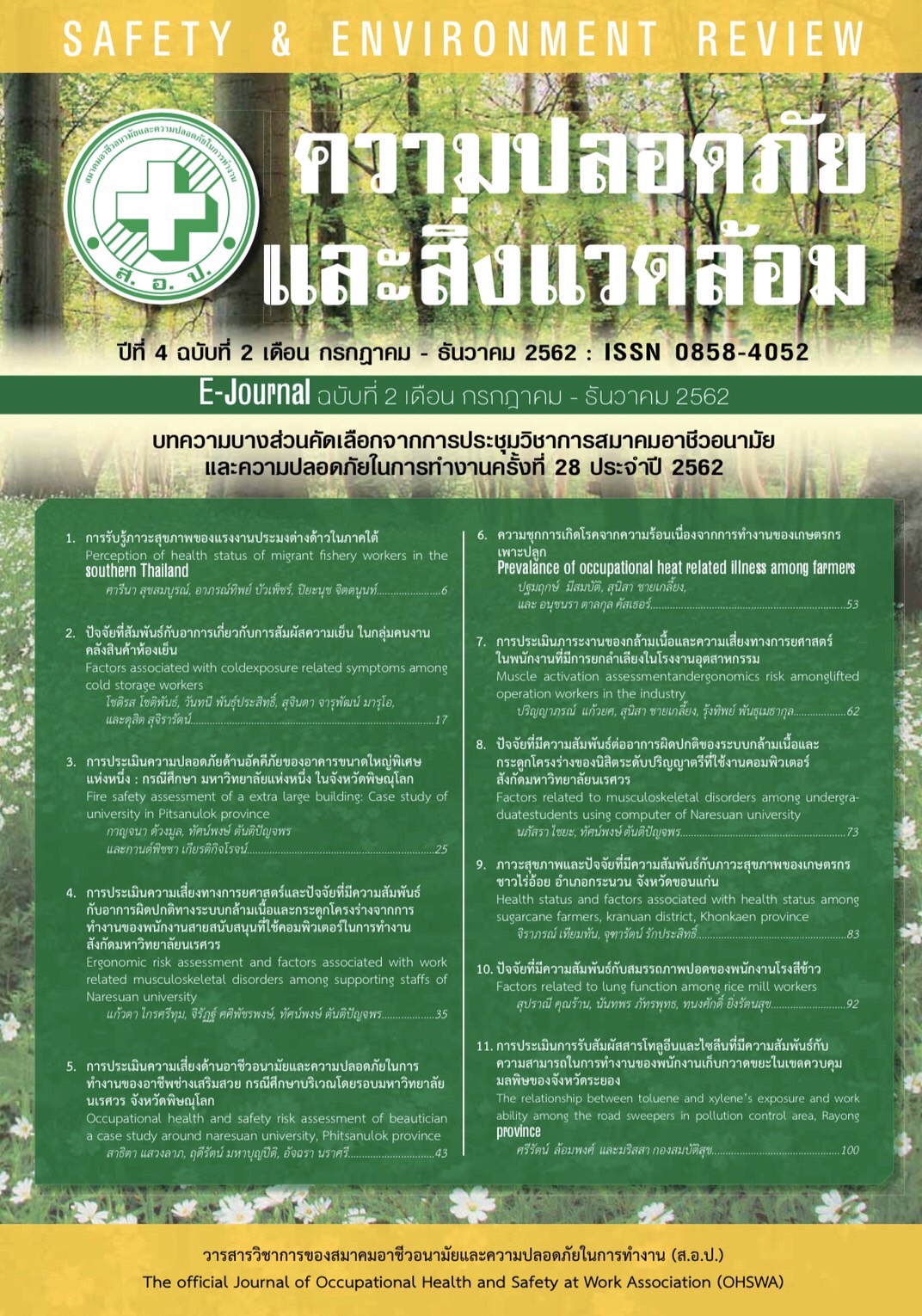
Muscle activation assessmentandergonomics risk amonglifted operation workers in the industry
Keywords:
Lifting, REBA, NIOSH lifting, Electromyography (EMG)Abstract
Majority of workers in industry who have behavior that lead to musculoskeletal disorders, particularly in forceful
movements, lifting task with convey machinesand inappropriate ergonomics postures can cause of injury at the back.The
purpose of study to assess the muscle activation and ergonomics risk. This cross-sectional descriptive study was conducted in
12 industrial workers who responsible for continuously handling at least 1 hour per day by working with the conveymachine,
and data were collected with an interview questionnaire and measured muscle activation by electromyography (EMG) for
musclefatigue and maximum voluntary contraction (%MVC), and the use of the Rapid Entire Body Assessment (REBA) and NIOSH
lifting. The resultsfrommuscles fatigue were divided into 2 groups, fatigue and non-fatigue group, and identified bythe mean
MF/timeslope of electromyogram founded -11.2 and 2.18, respectively. The results of %MVC showed that average %MVC of workers who fatigue and non-fatigue was 48 and 54.25 respectively. And theresults from MSDs self-assessment by workers found 25.00% of them had complaint of back area at low and high level. The ergonomics risks from REBA were mostly found to be high risk level while lifting and medium risk level while lowering in 2 groups. NIOSH results indicated that 2 groupswere exposed to very high risk while lifting and low level while lowering.These findings identified thathad ergonomics risk in industrial workers who responsible for continuously handling at least 1 hour per day by working with machines from muscle fatigue. It is suggested that should promote workers to avoid inappropriate posture especially, raise the arms high above the head, more trunk flexion and trunk rotationthat may affect to be musculoskeletal disorders in acute and chronic phaseby operating levels of conveyer to fit to individual anthropometry.
References
Plamondon A, Lariviere C, Denis D, Mecheri H, Nastasia I, IRSST MMH research group. Difference between male and female workers lifting the same relative load when palletizing boxes. ApplErgon 2017; 60: 93-102.
ธนารักษ์ หีบแก้ว,ณัฐพล พุฒยางกูร. การศึกษาความเสี่ยงด้านการยศาสตร์สำหรับการยกของด้วยแรงกายด้วยสมการยกของ NIOSH. ใน: การสัมมนาและประชุมวิชาการทางการยศาสตร์แห่งชาติ ประจำปี 2559; 15-17 ธันวาคม 2559. หน้า 45-55.
สุนิสา ชายเกลี้ยง.สรีรวิทยาการทำงานและการยศาสตร์. ขอนแก่น: โรงพิมพ์มหาวิทยาลัยขอนแก่น. 2557
สำนักงานประกันสังคม. ข้อมูลสถิติกองทุนเงินทดแทน [ออนไลน์] 2561 [อ้างเมื่อ 3 เมษายน 2562], จากhttps://www.sso.go.th/wpr/assets/upload/files_storage/sso_th/d3789f5205a06fa221f1-feaf85bf76b7. pdf.
Varrecchia T, Cristiano DM, Rinaldi M, Draicchio F, Serrao M, Schmid M, et al. Lifting activity assessment using surface electromyographic features and neural networks. International Journal of Industrial Ergonomics 2018; 66(1): 1-9.
อรรถพล แก้วนวล, บรรพตโลหะพูนตระกูล, กลางเดือนโพชนา. ความชุกของความผิดปกติของระบบกล้ามเนื้อและกระดูกโครงร่างที่เกี่ยวเนื่องจากการทำงานในอาชีพต่างๆ. วารสารสาธารณสุขมหาวิทยาลัยบูรพา 2560; 12(2): 53-64.
จันจิราภรณ์ วิชัย, สุนิสา ชายเกลี้ยง.การประเมินความเสี่ยงทางการยศาสตร์ ในพนักงานที่มีการยกเคลื่อนย้ายวัสดุ.วารสารวิจัย มข.2557; 19(5): 708-19.
Ahmad I, Kim JY. Assessment of whole body and local muscle fatigue using electromyography and a perceived exertion scale for squat Lifting. International Journal of Environmental Research and Public Health 2018; 15(4).doi: 10.3390/ijerph15040784.
อรุณจิรวัฒน์กุล. ชีวสถิติสำหรับงานวิจัยทางวิทยาศาสตร์สุขภาพ. พิมพ์ครั้งที่ 3. ขอนแก่น: คลังนานาวิทยา; 2551.
สุนิสา ชายเกลี้ยง, จันทิมา ดรจันทร์ใต้, จันจิราภรณ์ วิชัย. การประเมินความเสี่ยงต่อการปวดหลังส่วนล่างจากการทำงานของพนักงานยกเคลื่อนย้ายวัสดุ. วารสารความปลอดภัยและสิ่งแวดล้อม2559;25(1): 8-17.
สุนิสา ชายเกลี้ยง, พรนภา ศุกรเวทย์ศิริ, วิภารัตน์ โพธิ์ขี. รายงานการวิจัยฉบับสมบูรณ์ปัจจัยเสี่ยง ความเสี่ยงทางการยศาสตร์และความชุกของการปวดหลังของพนักงานในโรงงานอุตสาหกรรมอิเลคทรอนิกส์. ขอนแก่น: มหาวิทยาลัยขอนแก่น; 2558.
Hignett S, McAtammney L. Rapid entire body assessment. ApplErgon 2000; 31(2): 201-5.
Hlavenka TM, Christner, VFK, Gregory DE. Neck posture during lifting and its effect on trunk muscle activation and lumbar spine posture. ApplErgon2017; 62(1): 28-33.
สุธีรา เตชะธนะวัฒน์, และธิดา ตังตระกูลไพศาล. การศึกษาเปรียบเทียบภาพคลื่นไฟฟ้ากล้ามเนื้อของกล้ามเนื้อทราพีเซียสบนขณะปฏิบัติงานทางทันตกรรมระหว่างทันตแพทย์ที่มีอาการและไม่มีอาการปวดบริเวณกล้ามเนื้อหลังส่วนบน. ว.ทันต.มศว. 2555; 5(1):77-85.
Spyropoulos E, Chroni E, Athanassiou G. Muscle fatigue estimation in repetitive lifting task using surface electromyography-based analysis.Journal of Ergonomics 2015; 5(2). doi: 10.4172/2165-7556.1000139.
Halim I, Omar AR, Saman AM, Othman I. Assessment of Fatigue Associated with Prolonged Standing in the Workplace. Safety and Health at Work 2012; 3(1): 31-42.
Wan JJ, Qin Z, Wang PY, Sun Y, Liu X. Muscle fatigue: general understanding and treatment. Journal of the Korean Society for Biochemistry and Molecular Biology 2017; 49.doi: 10.1038/emm.2017.194.
Bonato P, Ebenbichler GR, Roy SH, Lehr S, Posch M, Kollmitzer J, et al.Muscle fatigue and fatigue-related biomechanical changes during a cyclic lifting task. Spine 2003; 28(16): 1810-20.
Berchicci M, Menotti F, Macaluso A, Di Russo F. The neurophysiology of central and peripheral fatigue duing sub-maximal lower limb isometric contractions. Front. Hum. Neurosci 2013; 7(135). doi: 10.3389/fnhum.2013.00135.
de Looze MP, Boeken-Kruger MC, Steenhuizen S, Baten CT, Kingma I, van Dieen JH. Trunk muscle activation and low back loading in lifting in the absence of load knowledge. Ergonomics 2000; 43(3):333-44.
Yi C, Li KW, Tang F, Zuo H, Ma L, Hu H. Pulling strength, muscular fatigue, and prediction of maximum endurance time for simulated pulling tasks. Plos one 2018; 13(12):e0207283. https://doi.org/10.1371/journal.pone.0207283.
Torres Y, Vina S.Evaluation and redesign of manual material handling in a vaccine production centre’s warehouse. Work 2012; 41(1): 2487-91.
Downloads
Published
Issue
Section
License

This work is licensed under a Creative Commons Attribution-NonCommercial-NoDerivatives 4.0 International License.
This article is published under a Creative Commons Attribution-NonCommercial-NoDerivatives 4.0 International License (CC BY-NC-ND 4.0), which allows others to share the article with proper attribution to the authors and prohibits commercial use or modification. For any other reuse or republication, permission from the journal and the authors is required.


