
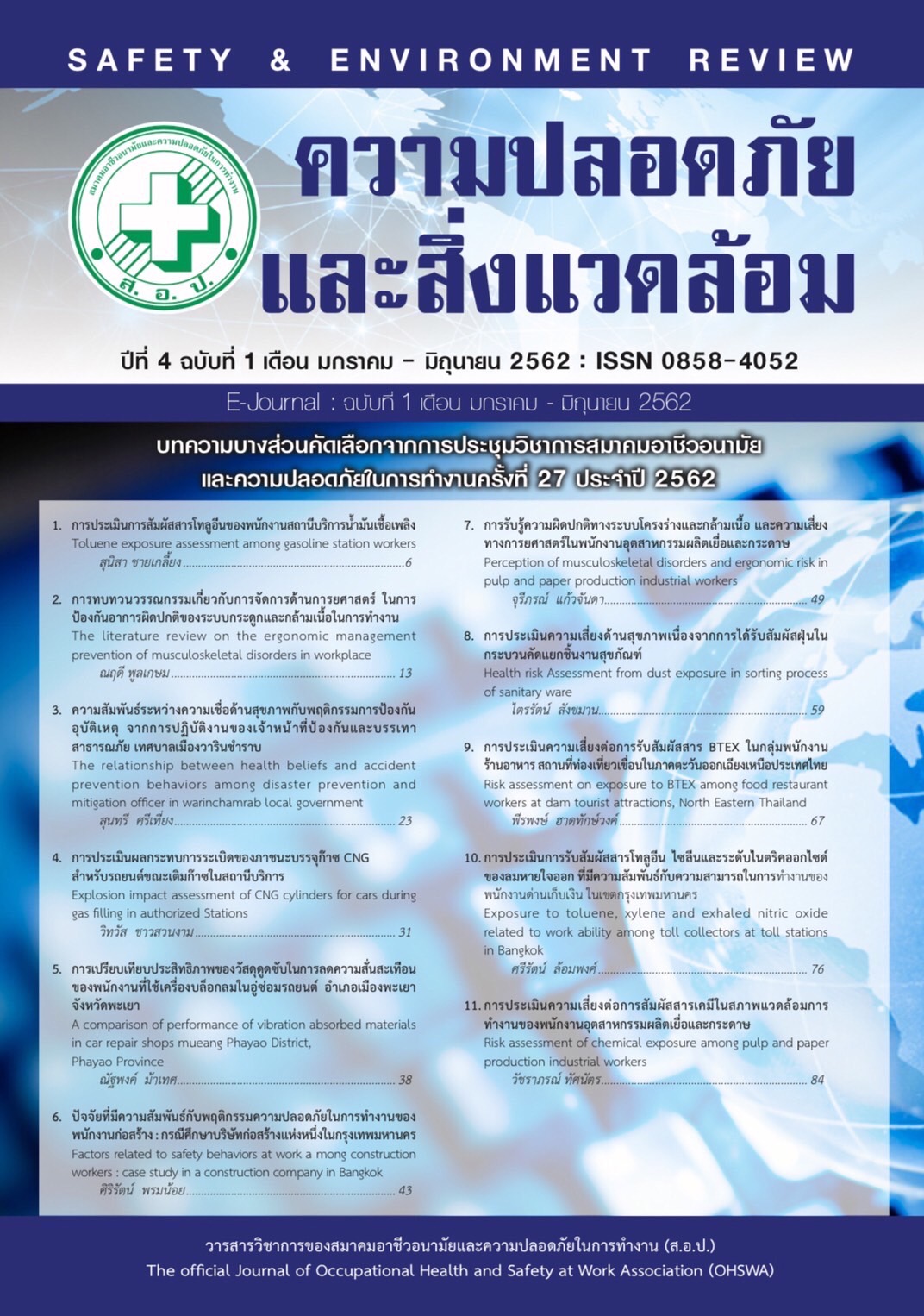
Risk Assessment of Chemical Exposure among pulp and paper production industrial workers
Keywords:
Health risk assessment, exposure surveillance, Chlorine, Methyl mercaptanAbstract
Pulp production uses a variety of hazardous chemicals in process. Exposure to those industrial chemicals in working
environments might be occurred through inhalation or skin and eye contact and subsequently caused adverse health
effects of workers. This study aimed to assess health risk of chemical exposure among Pulp and Paper industrial workers
by using the secondary data of one Pulp and Paper factory. Secondary data ofchemical monitoringin working environments
and frequent exposure to chemicalsfrom the last two yearsrecoding of the production process were used. The results
showed that chemicals used in the production process are 96 andthere wereeightchemicals in working environment. Those
finding chemicals compose of gases: Chlorine, Carbon monoxide, Hydrogen sulphide, and Hydrogen chloride,the acid solvent group: sulfuric acid and vaporized solvent group: Methyl mercaptan,Dimethyl sulphide, Acetoneanddust.Theresults
of last 2 yearsmonitoringshowed that all of eight chemicals concentrations were under occupational exposure limited
standard of Thai labor regulation (OEL).The results of health risk assessments from employee’s exposure to certain
chemicals found that there were higher risk than the acceptable risk level; Chlorine, Methyl mercaptan. Considering
secondary data, exposures to Sulfuric acid and Respirabledust were acceptable health risk levelHowever, there are
hazardous chemicals for instance carcinogens,mutagen or teratogen required industrial exposure monitoring and health
risk assessment, for instance, Benzene and Formaldehyde. Therefore, there should be planning for exposure surveillance
and health risk assessments among workersexposed to hazardous chemicals following the legislation.
References
สุนิสา ชายเกลี้ยง. พิษวิทยาสาธารณสุข. ขอนแก่น: โรงพิมพ์ มหาวิทยาลัยขอนแก่น; 2557
ราชกิจจานุเบกษา. ประกาศกระทรวงอุตสาหกรรมเรื่อง กำหนดมาตรฐานผลิตภัณฑ์อุตสาหกรรม การประเมินความเสี่ยงด้าน สารเคมีต่อสุขภาพผู้ปฏิบัติงานในโรงงานอุตสาหกรรม [อินเทอร์เน็ต] 2555.[เข้าถึงเมื่อ 2561เมษายน 26]. เข้าถึงได้จากhttp://www.summacheeva.org/documents/share_law_industry_risk.PDF
National Research Council. Acute Exposure Guide¬line Levels for Selected Airborne Chemicals Volume 15. Washington (DC): National Academy of Sciences; 2013
โยธิน เบญจวัง และวิลาวัณย์ จึงประเสริฐ. มาตรฐานการ วินิจฉัยโรคจากการทำงานฉบับเฉลิมพระเกียรติ เนื่องในโอกาสมหา มงคลเฉลิมพระชนมพรรษา ๘๐ พรรษา ๕ ธันวาคม ๒๕๕๐. กรุงเทพฯ: สำนักงานประกันสังคม; 2550
Carl W W, James G M. Chlorine Gas Inhalation Hu¬man Clinical Evidence of Toxicity and Experience in Animal Models. ATSJournals 2001; 7(4): 257-263
กระทรวงสาธารณสุข. แนวทางการเฝ้าระวังพื้นที่เสี่ยง จากมลพิษทางอากาศ กรณีฝุ่นละอองขนาดเล็ก. [อินเทอร์เน็ต] 2557. [เข้าถึงเมื่อ 2561พฤษภาคม 17]. เข้าถึงได้จากhttp://enhealthplan. anamai.moph.go.th/ewt_dl_link.php?nid=24
Chaiklieng S, Pimpasaeng C, Thapphasaraphong S. Benzene exposure at gasoline stations - health risk assess¬ment. Human and Ecological Risk Assessment: An Interna¬tional Journal 2015; 21(8): 2213-22
Downloads
Published
Issue
Section
License

This work is licensed under a Creative Commons Attribution-NonCommercial-NoDerivatives 4.0 International License.
This article is published under a Creative Commons Attribution-NonCommercial-NoDerivatives 4.0 International License (CC BY-NC-ND 4.0), which allows others to share the article with proper attribution to the authors and prohibits commercial use or modification. For any other reuse or republication, permission from the journal and the authors is required.


