
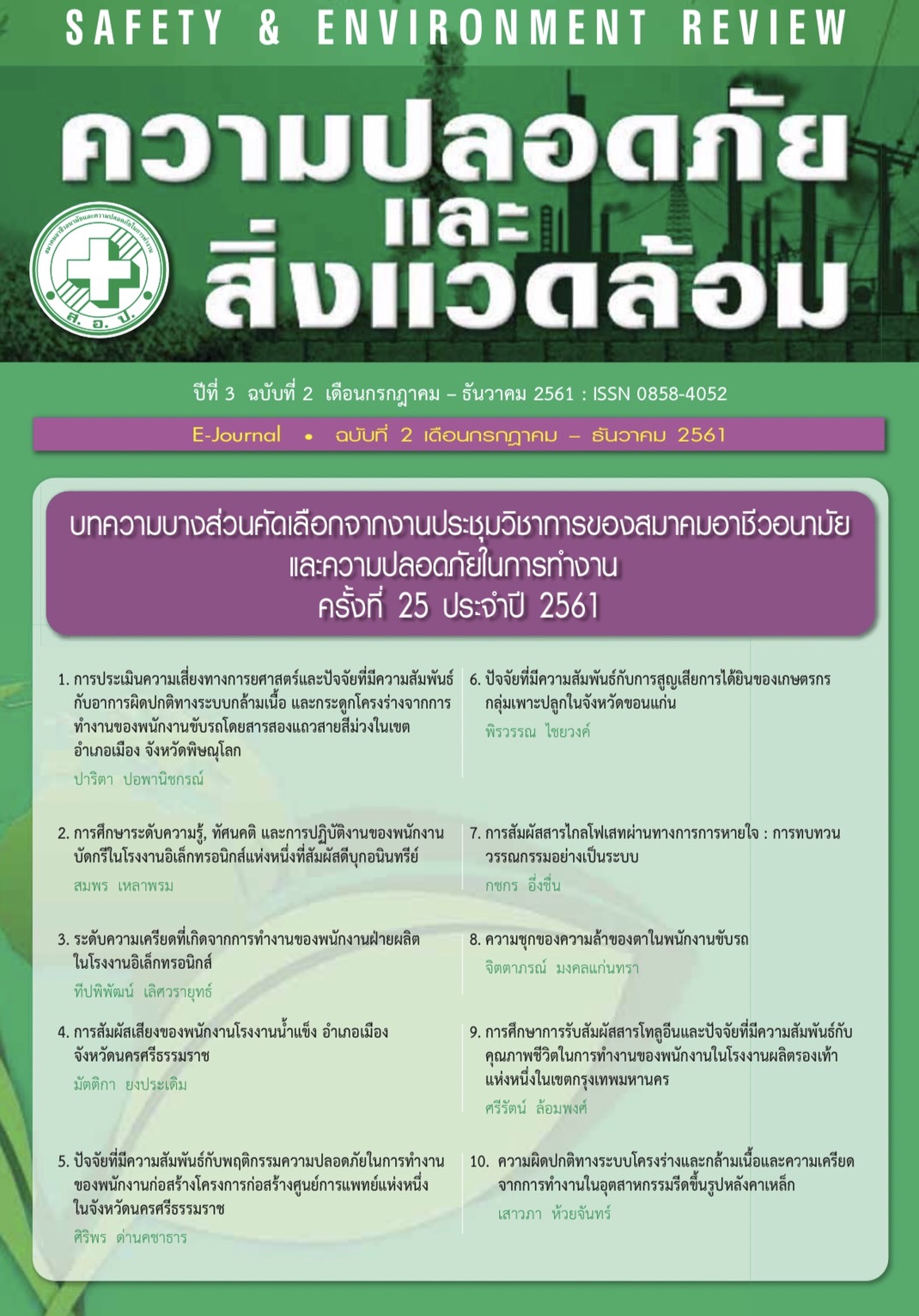
FACTOR RELATED TO BEHAVIOR SAFETY AMONG CONSTRUCTION WORKERS OF MEDICAL CENTER CONSTRUCTION PROJECT IN NAKHON SI THAMMARAT PROVINCE
Keywords:
Safety behaviors, Construction workers, Construction safetyAbstract
Currently, the construction industry in Thailand reports the highest frequency of industrial accident. The
purpose of this analytical cross-sectional study was to determined factors related to behavior safety among
construction workers of medical center construction project. A total of 138 construction workers were sampled
for the study. Data were collected by questionnaire which had been confirmed both content validity and
reliability yielded values .72 - .84. and processed for analysis of descriptive statistic and Chi-square. The result
of the study showed that the majority of the construction workers were male 53.4%. There were 30.8% of the
construction workers over the age of 41 years. There were 41.3 % of the construction workers who worked between
1-5 years in the construction site. The result revealed that behavior safety among construction workers related to
three factor (1) Personal factor that sex (r=.132 p-value=.005), work experience (r=.252 p-value=.031), overtime
(r=.192 p-value=.029). (2) Environmental factor that housekeeping (r=.132 p-value=.005), Machine and tools
certified (r=.056 p-value=.017). (3) Safety Management factors that access to benefit safety resources (r=.052
p-value=.015). and safety communication (r=.122 p-value=.004). (4) There was no significant correlation between
Knowledge factor and accident prevention behaviors among construction workers. The result of this study could
recommend that construction sites should improve occupational and safety management and apply measures
thoroughly. Safety signs and labels training is one of effective method to improve worker safe behaviors and work
site environment. This findings can be used as preliminary data to develop additional safety programs for construction
workers.
References
อนามัย (ธีรวิโรจน์) เทศกะทึก. อาชีวอนามัยและความปลอดภัย (พิมพ์ครั้งที่ 4). กรุงเทพฯ: โอเดียนสโตร์; 2553.
กองทุนเงินทดแทน.สถิติของผู้ประสบอันตรายหรือเจ็บป่วยเนื่องจากการทำงาน. รายงานการดำเนินงานกองทุนเงินทดแทน. กระทรวงแรงงานและสวัสดิการสังคม. สำนักงานประกันสังคม;2558
Health and Safety Executive. (n.d.).Work related injuries and ill health in construction. Ret rived on April 9, 2018, from http://www.hse.gov.uk/statistics/pdf/fatalinjuries.pdf
บุญชัย สอนพรหม. การศึกษาทัศนคติของคนงานก่อสร้างต่อสาเหตุการเกิดอุบัติเหตุในอุตสาหกรรมก่อสร้าง : กรณีศึกษา บริษัท เอส ดับบลิว ที เทคโนโลยี แอนด์ คอนสตรัคชั่น จำกัด (วิศวกรรมศาสตรมหาบัณฑิต). นครราชสีมา: มหาวิทยาลัยเทคโนโลยีสุรนารี; 2555.
สถาบันความปลอดภัยในการทำงาน กรมสวัสดิการและคุ้มครองแรงงาน กระทรวงแรงงาน. 2550. คู่มือการฝึกอบรมเจ้าหน้าที่ความปลอดภัยระดับหัวหน้างาน.กรุงเทพ: เรียงสามกราฟฟิกดีไซด์ จำกัด.
ธีรวุฒิ เอกะกุล.ระเบียบวิธีวิจัยทางพฤติกรรมศาสตร์และสังคมศาสตร์. อุบลราชธานี: สถาบันราชภัฎอุบลราชธานี;2543.
วิทิต กมลรัตน์. (2552). ศึกษาพฤติกรรมความปลอดภัยในการปฏิบัติงานของพนักงานฝ่ายปฏิบัติการบริษัท อดิตยา บอร์ล่า เคมีคัลส์ (ประเทศไทย) จากัด (ฟอสเฟต ดีวิชั่น). งานนิพนธ์วิทยาศาสตรมหาบัณฑิต (การจัดการสิ่งแวดล้อม), คณะพัฒนาสังคมและสิ่งแวดล้อม. สถาบันบัณฑิตพัฒนบริหารศาสตร์.
วิฑูรย์ สิมะโชคดีและวีรพงษ์ เฉลิมจิระรัตน์. (2553).วิศวกรรมและการบริหารความปลอดภัยในโรงงาน.กรุงเทพ: คลองเตยเหนือ เขตวัฒนา
Edwin S, Shamil N, Daniel F. Factors affecting safety performance on construction sites. International journal of project management 1999; 17(5): 309-315.
Fang DP, Huang XY, Li H, Xie F. Factor analysis base studies on construction workplace safety Management in china. International journal of project management 2004; 22: 43-49.
Downloads
Published
Issue
Section
License

This work is licensed under a Creative Commons Attribution-NonCommercial-NoDerivatives 4.0 International License.
This article is published under a Creative Commons Attribution-NonCommercial-NoDerivatives 4.0 International License (CC BY-NC-ND 4.0), which allows others to share the article with proper attribution to the authors and prohibits commercial use or modification. For any other reuse or republication, permission from the journal and the authors is required.


