
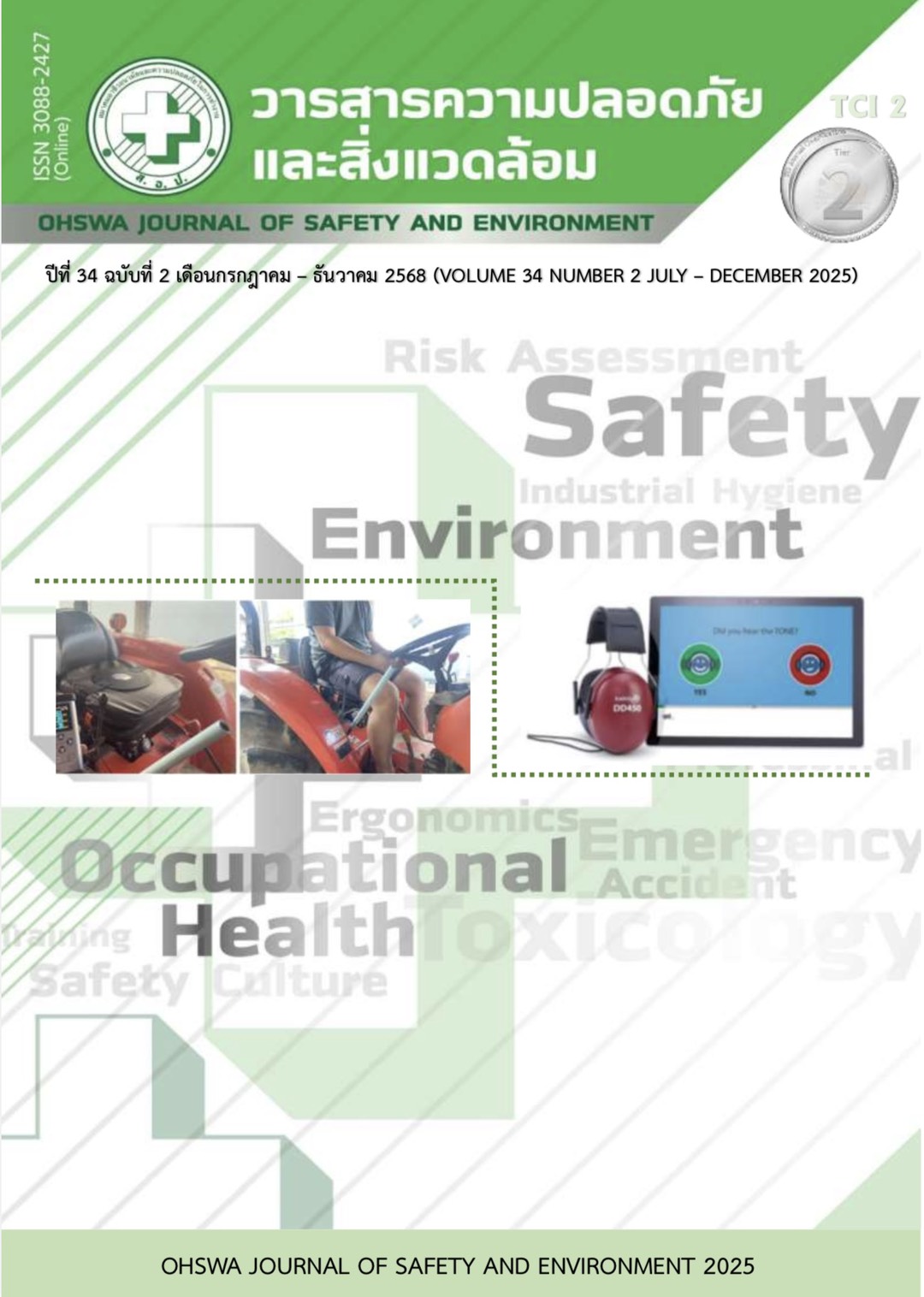
COMPARATIVE STUDY OF AUTOMATED AND MANUAL AUDIOMETRY: A SYSTEMATIC REVIEW
Keywords:
Automated Audiometry, Manual Audiometry, Noise-Induced Hearing LossAbstract
One of the significant global health issues is hearing loss. Consequently, the demand for hearing tests has increased substantially for both diagnostic and preventive purposes, such as monitoring noise-exposed workers. However, conventional manual audiometry, which requires trained healthcare professionals to conduct hearing assessments, may not adequately meet this growing demand. As a result, automated audiometry has been developed to allow hearing tests to be conducted automatically. This literature review found that automated audiometry provides comparable accuracy to manual audiometry, with differences in hearing threshold levels generally within 10 decibels. The sensitivity and specificity for diagnosing hearing loss range from 95–100% and 60–82%, respectively, depending on the test frequency and the device used. However, some studies reported statistically significant differences at higher frequencies, such as 4,000–8,000 Hz. The findings suggest that automated audiometry could be applied to health surveillance, especially in occupational health settings, to improve efficiency, reduce the workload of healthcare professionals and maintain validity of test results.
References
Olusanya BO, Neumann KJ, Saunders JE. The global burden of disabling hearing impairment: a call to action. Bull World Health Organ. 2014;92(5):367-73.
WHO. Deafness and hearing loss Online: World Health Organization; 2024 [updated 2 February 2024; cited 2024 September, 14th]. Available from: https://www.who.int/news-room/fact-sheets/detail/deafness-and-hearing-loss.
Diseases BoOaE. Report on the Situation of Occupational and Environmental Diseases and Health Hazards, 2016. Department of Disease Control: Department of Disease Control, Health Mo; 2017.
Diseases BoOaE. Report on the Situation of Occupational and Environmental Diseases and Health Hazards, 2015. Department of Disease Control: Department of Disease Control, Health Mo; 2017.
Diseases BoOaE. Report on the Situation of Occupational and Environmental Diseases and Health Hazards, 2017. Department of Disease Control: Department of Disease Control, Health Mo; 2018.
Office SS. Situation of Occupational injury and diseases, 2019-2023. Bangkok: Contribution Rate Determination Division, Workmen’s Compensation Fund Office, under the Social Security Office, Ministry of Labour, Thailand; 2024. 20 p.
Natarajan N, Batts S, Stankovic KM. Noise-Induced Hearing Loss. J Clin Med. 2023;12(6).
Liberman MC. Noise-Induced Hearing Loss: Permanent Versus Temporary Threshold Shifts and the Effects of Hair Cell Versus Neuronal Degeneration. Adv Exp Med Biol. 2016;875:1-7.
Mazurek B, Olze H, Haupt H, Szczepek AJ. The more the worse: the grade of noise-induced hearing loss associates with the severity of tinnitus. Int J Environ Res Public Health. 2010;7(8):3071-9.
Guidelines in Physical Examination for Chemical and Physical Occupational Health Risk Factors in Workplace, (2012).
Margolis RH, Morgan DE. Automated Pure-Tone Audiometry: An Analysis of Capacity, Need, and Benefit. American Journal of Audiology. 2008;17(2):109-13.
audstudent. The Hughson-Westlake Method of Obtaining Threshold2015 March 30. Available from: http://audsim.com/docs/h-w.shtml.
Carhart R, Jerger JF. Preferred method for clinical determination of pure-tone thresholds. Journal of speech and hearing disorders. 1959;24(4):330-45.
Thailand TAoOaEDo. Guideline for Standardization and Interpretation of Audiometry in Occupational Health Setting 2018 Edition 2018. Available from: https://drive.google.com/file/d/1cvNF8pGiF2Ki8wSuNGKJcoWk0M49xlkb/view?usp=sharing.
Govender SM, Mars M. Validity of automated threshold audiometry in school aged children. International Journal of Pediatric Otorhinolaryngology. 2018;105:97-102.
Békésy Gv. A New Audiometer. Acta Oto-Laryngologica. 1947;35(5-6):411-22.
Margolis RH, Glasberg BR, Creeke S, Moore BCJ. AMTAS®: Automated method for testing auditory sensitivity: Validation studies. Int J Audiol. 2010;49(3):185-94.
Mahomed F, Swanepoel DW, Eikelboom RH, Soer M. Validity of Automated Threshold Audiometry: A Systematic Review and Meta-Analysis. Ear Hear. 2013;34(6):745-52.
Whitton JP, Hancock KE, Shannon JM, Polley DB. Validation of a Self-Administered Audiometry Application: An Equivalence Study. Laryngoscope. 2016;126(10):2382-8.
Eksteen S, Launer S, Kuper H, Eikelboom RH, Bastawrous A, Swanepoel W. Hearing and vision screening for preschool children using mobile technology, South Africa. Bull World Health Organ. 2019;97(10):672-80.
Sienko A, Thirunavukarasu AJ, Kuzmich T, Allen L. An Initial Validation of Community-Based Air-Conduction Audiometry in Adults With Simulated Hearing Impairment Using a New Web App, DigiBel: Validation Study. JMIR Form Res. 2024;8:e51770.
grason-stadler. GSI AMTAS Flex Tablet Automated Audiometry 2023 [Available from: https://www.grason-stadler.com/products/audiometers/gsi-amtas-flex.
Occupational Safety and Health Administration. Occupational noise exposure [Internet] [cited 2024 Nov 20]. Available from: https://www.osha.gov/lawsregs/regulations/standardnumber/1910/1910.95.
Margolis RH, Frisina R, Walton JP. AMTAS®: automated method for testing auditory sensitivity: II. air conduction audiograms in children and adults. Int J Audiol. 2011;50(7):434-9.
Margolis RH, Moore BCJ. AMTAS®: Automated method for testing auditory sensitivity: III. Sensorineural hearing loss and air-bone gaps. Int J Audiol. 2011;50(7):440-7.
Eikelboom RH, Swanepoel DW, Motakef S, Upson GS. Clinical validation of the AMTAS automated audiometer. Int J Audiol. 2013;52(5):342-9.
Yeo Kai Hui H, Chua Wei De K, Kamath SH, Lee SLH. A pilot study to validate AMTAS in a specialist outpatient clinic at a public restructured hospital in Singapore. Proc Singapore Healthcare. 2023;32.
Mahomed-Asmail F, Swanepoel de W, Eikelboom RH. Diagnostic Hearing Assessment in Schools: Validity and Time Efficiency of Automated Audiometry. J Am Acad Audiol. 2016;27(1):42-8.
Swanepoel DW, Biagio L. Validity of Diagnostic Computer-Based Air and Forehead Bone Conduction Audiometry. Journal of Occupational and Environmental Hygiene. 2011;8(4):210-4.
Liu H, Fu X, Li M, Wang S. Comparisons of air-conduction hearing thresholds between manual and automated methods in a commercial audiometer. Front Neurosci. 2023;17:1292395.
Brennan-Jones CG, Eikelboom RH, Swanepoel DW, Friedland PL, Atlas MD. Clinical validation of automated audiometry with continuous noise-monitoring in a clinically heterogeneous population outside a sound-treated environment. Int J Audiol. 2016;55(9):507-13.
Liu H, Du B, Liu B, Fu X, Wang Y. Clinical comparison of two automated audiometry procedures. Front Neurosci. 2022;16:1011016.
Guo Z, Yu G, Zhou H, Wang X, Lu Y, Meng Q. Utilizing True Wireless Stereo Earbuds in Automated Pure-Tone Audiometry. Trends Hear. 2021;25:23312165211057367.
Szudek J, Ostevik A, Dziegielewski P, Robinson-Anagor J, Gomaa N, Hodgetts B, Ho A. Can Uhear me now? Validation of an iPod-based hearing loss screening test. J Otolaryngol Head Neck Surg. 2012;41 Suppl 1:S78-84.
Abu-Ghanem S, Handzel O, Ness L, Ben-Artzi-Blima M, Fait-Ghelbendorf K, Himmelfarb M. Smartphone-based audiometric test for screening hearing loss in the elderly. Eur Arch Otorhinolaryngol. 2016;273(2):333-9.
Yeung JC, Heley S, Beauregard Y, Champagne S, Bromwich MA. Self-administered hearing loss screening using an interactive, tablet play audiometer with ear bud headphones. Int J Pediatr Otorhinolaryngol. 2015;79(8):1248-52.
Downloads
Published
Issue
Section
License
Copyright (c) 2025 OHSWA Journal of Safety and Environment

This work is licensed under a Creative Commons Attribution-NonCommercial-NoDerivatives 4.0 International License.
This article is published under a Creative Commons Attribution-NonCommercial-NoDerivatives 4.0 International License (CC BY-NC-ND 4.0), which allows others to share the article with proper attribution to the authors and prohibits commercial use or modification. For any other reuse or republication, permission from the journal and the authors is required.


