
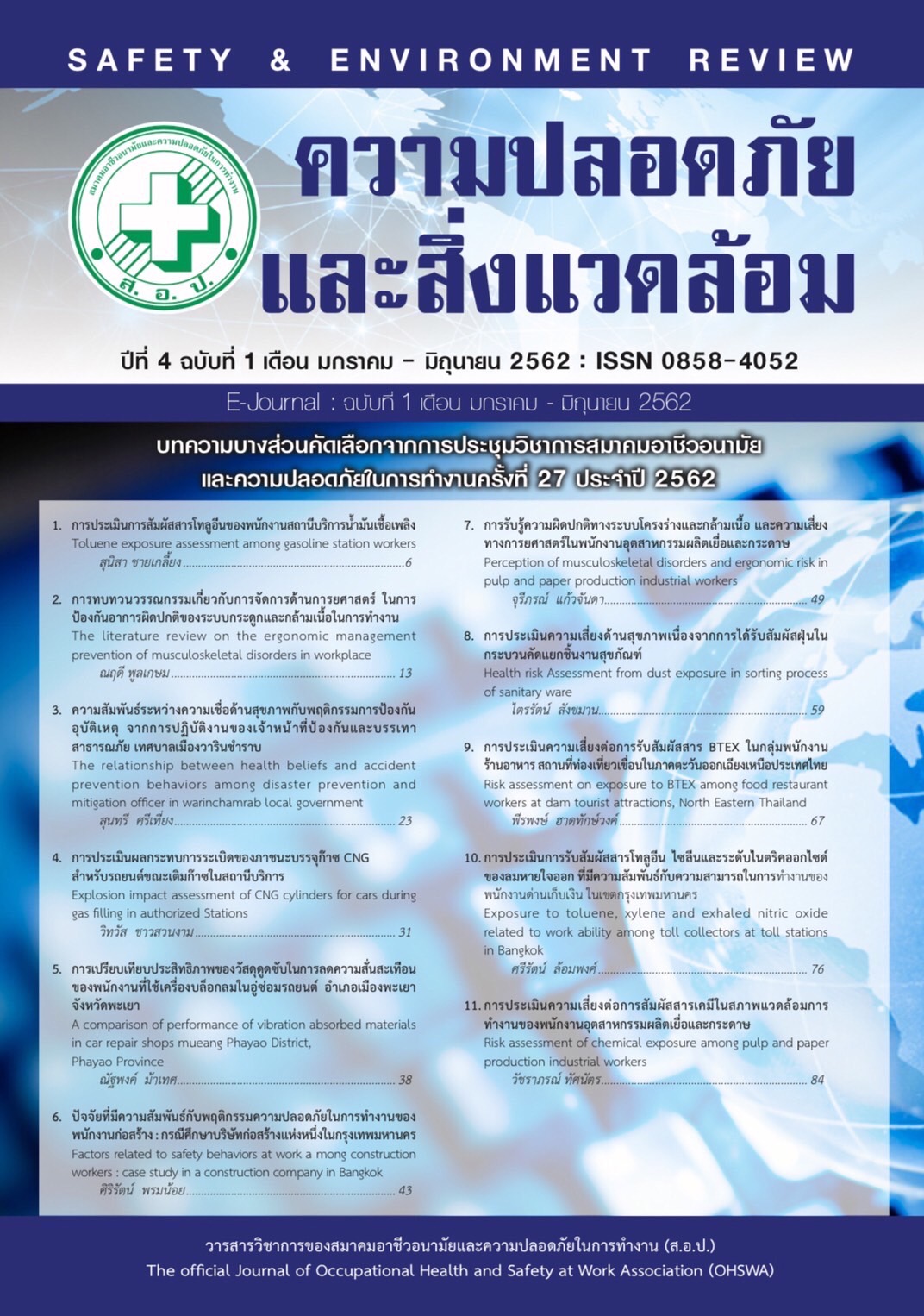
Exposure to Toluene, Xylene and Exhaled Nitric Oxide Related to Work Ability among Toll Collectors at Toll Stations in Bangkok
Keywords:
Toluene, Xylene, Exhaled nitric oxide, Work ability, Toll collectorAbstract
The objective was to evaluate toluene, xylene and exhaled nitric oxide related to work ability among toll collectors
at toll stations in Bangkok. This research was a cross sectional study. We sampled 220 persons; 90 cases who worked as
toll collectors at toll stations in Bangkok and 130 as a controllers. The assessment tools were as follows: questionnaires and in collecting the air samples a personal “Organic Vapor Monitor (3M 3500)”
was attached to the lapel of each sample groups. The NIOX MINO for measuring exhaled nitric oxide of sample groups.
Mean age of the study group was 36.86 years old and the control group was 32.97 years old. 63.3 % of the study group
worked 8 hours per day, 5 days per week (83.3 %). 10% always used respiratory protection; however, most of them used
only cotton masks (59.3 %). Most of them about work ability had moderate level (58.9 %). The study group (n=90) showed average toluene 28.93 (± 32.048) ppb and xylene 68.17 (± 8.591) ppb. Exhaled nitric oxide (n=82) was low level (<25 ppb)
(89.0%) and average 15.98 (± 8.712) ppb. The average comparison of concentration of toluene and xylene was significantly
different between the study and control groups at level 0.05 (p < 0.001, p<0.001, respectively). The exhaled nitric oxide
was significantly different between the study and control groups at level 0.05 (p =0.002). However, the
relationship between toluene, xylene, hippuric acid, methylhippuric acid, exhaled nitric oxide and work ability of study
group were not significant. The subjects of this study were toll collectors at tolling stations in Bangkok; nevertheless we
should be concerned about their exposure to toluene, xylene and exhaled nitric oxide while working. The author
recommends that the study group should get the knowledge and understanding the hazard and the protection and the
use of the correct and suitable respiration protective equipment.
References
วชร โอนพรัตน์วิบูลและอดุลย์ บัณฑุกุล. สารตัวทำละลายอินทรีย์. ตำราอาชีวเวชศาสตร์ text books of occupational medicine. กรุงเทพมหานคร: โรงพยาบาลนพรัตนราชธานี กรมการแพทย์ กระทรวงสาธารณสุข. 2554.
Dennison JE, Bigelow PL, Mumtaz MM, Anderson ME, Dobrev ID, Yang RS. Evaluation of potential toxicity from co-exposure to three CNS depressants (toluene, ethylbenzene and xylene) under resting and working conditions using PBPK. J Occup Environ Hyg 2005; 2(3): 127- 35.
Chang FK, Chen ML, Cheng SF, Shih TS, Mao IF. Dermal absorption of solvents as a major source of exposure among shipyard spray painters. J Occup Environ Med 2007; 49: 430- 6.
ศรีรัตน์ ล้อมพงศ์. การประเมินผลกระทบต่อสุขภาพจากการสัมผัสสาร Organic Solvent ในกลุ่มปฏิบัติงานกับรถโดยสารธรรมดา. คณะสาธารณสุขศาสตร์ มหาวิทยาลัยบูรพา. 2553.
Jimenez-Garza O, Marquez-Gamino S, Albores A, Caudillo-Cisneros C, Carrieri M, Bartolucci GB, Manno M. CYP2E1 phenotype in Mexican workers occupationally exposed to low levels of toluene. Toxicol Lett 2012; 210 (2): 254 – 63.
Ongwandee M, Chavalparit O. Commuter exposure to BTEX in public transportation modes in Bangkok, Thailand. J Environ Sci (China) 2010; 22 (3): 397 – 404.
Anna-Carin O, Annika R, Lauren L, Bjorn B, Kjell T. FCCP, height, age, and atopy are associated with farction of exhaled nitric oxide in a large adult general population sample, chest. 2006; 130(5): 1319-25.
Bohadana AB, Hannhart B , Ghezzo H, Teculescu D, Zmirou-Navier D. Exhaled nitric oxide and spirometry in respiratory health surveillance. Occup Med 2011; 61:108-14.
Baur X, Barbinova L. Latex allergen exposure increases exhaled nitric oxide in symptomatic healthcare. Eur Respir J 2005; 25:309-16.
Mauro M, Luigi G, Aniello G, Jon ON. Lundberg Matteo S. Increase in exhaled nitric oxide in shoe and leather workers at the end of the work- shift. Occup Med 2004; 54: 404-7.
อรวรรณ แก้วบุญชู. คู่มือประเมินความสามารถในการทำงาน. ภาควิชาการพยาบาลสาธารณสุข คณะสาธารณสุขศาสตร์ มหาวิทยาลัยมหิดล. 2550.
บุญธรรม กิจปรีดาบริสุทธิ์. ระเบียบวิธีการวิจัยทางสังคม. พิมพ์ครั้งที่ 10. กรุงเทพมหานคร: จามจุรีโปรดักส์; 2551.
ACGIH. Threshold limit values for the chemical substances and physical agents and biological exposure indicies. American Conference of Governmental Industrial Hygienists, Cincinnati, Ohio, USA. 2011.
Mandiracioglu A, Akgur S, Kocabiyik N, Sener U. Evaluation of neuropsychological symptoms and exposure to benzene, toluene and xylene among two different furniture worker groups in lzmir. Toxico Ind Health 2011; 27(9): 802-9.
Karita K, Yano E, Jinsart W, Boudoung D, Tamura K. Respiratory symptoms and pulmonary function among traffic police in Bangkok, Thailand. Arch Environ Health 2001; 56(5): 467-70.
Tamura K, Jinsart W, Yano E, Karita K, Boudoung D. Particulate air pollution and chronic respiratory symptoms among traffics policemen in Bangkok. Arch Environ Health 2003; 58(4): 201-7.
Hoffmeyer F, Raulf-Heimsoth M, Bruning T. Exhaled breathe condensate and airway inflammation. Curr Opin Allergy Clin Immunol 2009; 9 (1): 16-22.
Jimenez G, Marquez G, et.al. CYP2E1 phenotype in Mexican workers occupationally exposed to low levels of toluene. Toxicol Lett 2012; 210 (2): 254-63.
Alexander MT, Magne B, Simon DM, Bente EM. Fractionnal exhaled nitric oxide among cement factory workers: a cross sectional study. Occup Environ Med 2013; 70(5): 289-95.
Downloads
Published
Issue
Section
License

This work is licensed under a Creative Commons Attribution-NonCommercial-NoDerivatives 4.0 International License.
This article is published under a Creative Commons Attribution-NonCommercial-NoDerivatives 4.0 International License (CC BY-NC-ND 4.0), which allows others to share the article with proper attribution to the authors and prohibits commercial use or modification. For any other reuse or republication, permission from the journal and the authors is required.


