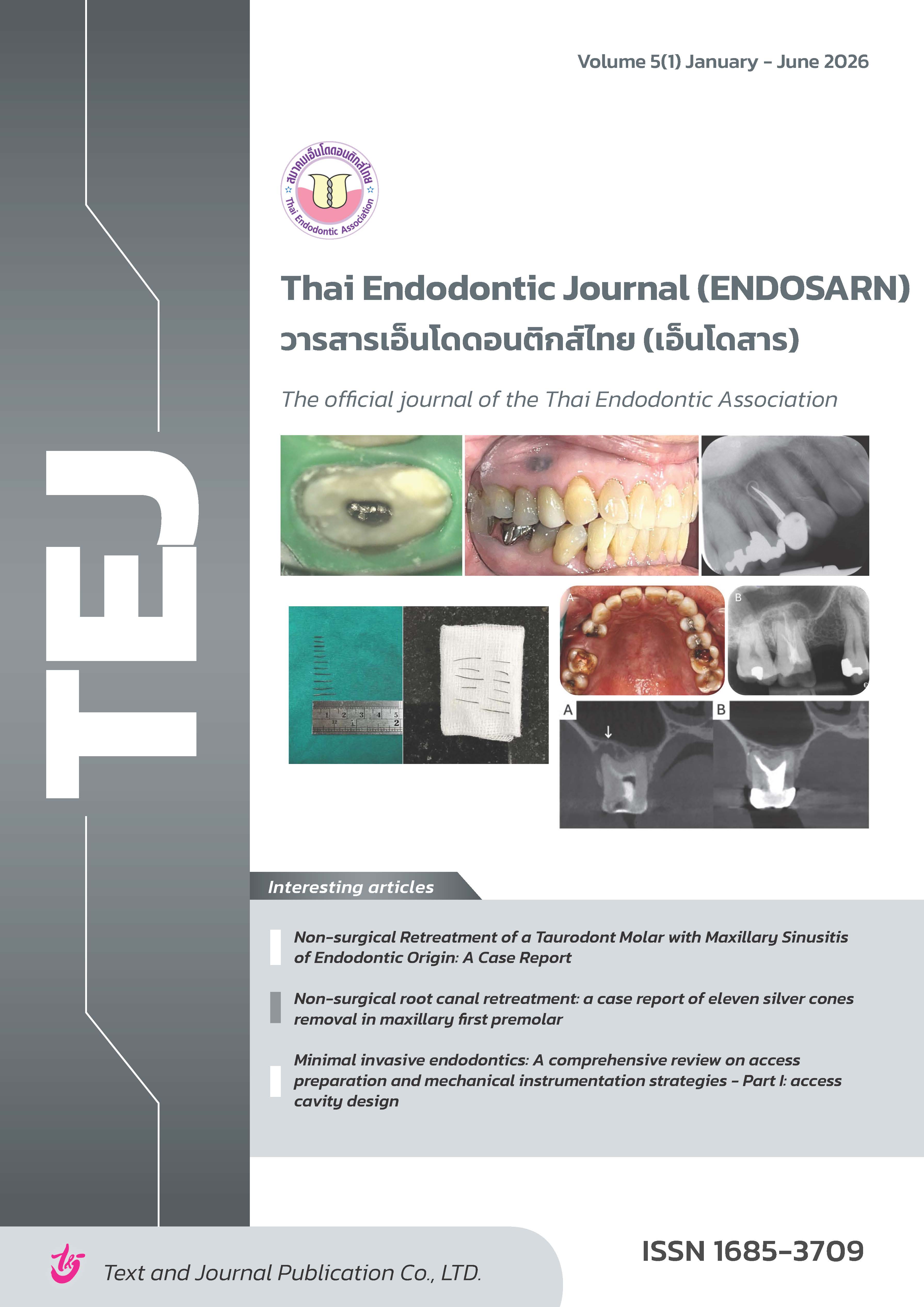
Non-surgical Retreatment of a Taurodont Molar with Maxillary Sinusitis of Endodontic Origin: A Case Report
Keywords:
additional canal, maxillary molar, maxillary sinusitis, non-surgical retreatment, taurodontismAbstract
Taurodontism is a dental anomaly characterized by an apically displaced pulpal floor and an elongated pulp chamber, which complicates root canal treatment due to its atypical root morphology. This case report presents the nonsurgical root canal retreatment of a taurodont maxillary first molar with an additional mesiobuccal canal associated with maxillary sinusitis of endodontic origin (MSEO). A 57-year-old male patient presented with dull pain at tooth 16, which had previously undergone root canal therapy. Clinical examination revealed dislodgement restoration with gutta-percha exposure, tenderness to percussion, and radiographic evaluation demonstrated underfilled root canals with periapical radiolucencies around the mesiobuccal and distobuccal roots. Cone-beam computed tomography (CBCT) confirmed the taurodont morphology, detected an additional canal, and revealed Periapical Osteoperiostitis (PAO). Under a dental operating microscope, all five canals (MB1, MB2, MB3, DB, and P) were negotiated, cleaned, and shaped using rotary instrumentation and supplemental irrigation. Calcium hydroxide was placed as an intracanal medicament, and obturation was performed using a hydraulic condensation technique with a bioceramic sealer. The patient remained asymptomatic after retreatment, and 2-year follow-up radiographs demonstrated complete periapical and sinus healing. This case highlights the importance of CBCT and magnification in identifying complex root canal morphology and achieving favorable outcomes in the retreatment of taurodont teeth with MSEO.
References
Keith A. Problems relating to the teeth of the earlier forms of prehistoric man. Proc R Soc Med. 1913;6(Odontol Sect):103-24.
Terezhalmy GT, Riley CK, Moore WS. Clinical images in oral medicine and maxillofacial radiology. Taurodontism. Quintessence Int. 2001;32(3):254-5.
Yeh SC, Hsu TY. Endodontic treatment in taurodontism with Klinefelter's syndrome: a case report. Oral Surg Oral Med Oral Pathol Oral Radiol Endod. 1999;88(5):612-5.
Durr DP, Campos CA, Ayers CS. Clinical significance of taurodontism. J Am Dent Assoc. 1980;100(3):378-81.
Sert S, Bayrl G. Taurodontism in six molars: a case report. J Endod. 2004;30(8):601-2.
Jafarzadeh H, Azarpazhooh A, Mayhall JT. Taurodontism: a review of the condition and endodontic treatment challenges. Int Endod J. 2008;41(5):375-88.
Hamner JE, 3rd, Witkop CJ, Jr., Metro PS. Taurodontism; report of a case. Oral Surg Oral Med Oral Pathol. 1964;18:409-18.
Shifman A, Chanannel I. Prevalence of taurodontism found in radiographic dental examination of 1,200 young adult Israeli patients. Community Dent Oral Epidemiol. 1978;6(4):200-3.
Hayashi Y. Endodontic treatment in taurodontism. J Endod. 1994;20(7):357-8.
Kiarudi AH, Eghbal MJ, Safi Y, Aghdasi MM, Fazlyab M. The applications of cone-beam computed tomography in endodontics: a review of literature. Iran Endod J. 2015;10(1):16-25.
Scarfe WC, Levin MD, Gane D, Farman AG. Use of cone beam computed tomography in endodontics. Int J Dent. 2009;2009:634567.
Maxillary sinusitis of endodontic origin: AAE position statement; American Association of Endodontists [Internet]. 2018 [cited 20 september 2025]. Available from: https://www.aae.org/specialty/wp-content/uploads/sites/2/2018/04/AAE_PositionStatement_MaxillarySinusitis.pdf
Worth HM, Stoneman DW. Radiographic interpretation of antral mucosal changes due to localized dental infection. J Can Dent Assoc (Tor). 1972;38(3):111-6.
Lofthag-Hansen S, Huumonen S, Gröndahl K, Gröndahl HG. Limited cone-beam CT and intraoral radiography for the diagnosis of periapical pathology. Oral Surg Oral Med Oral Pathol Oral Radiol Endod. 2007;103(1):114-9.
Low KM, Dula K, Bürgin W, von Arx T. Comparison of periapical radiography and limited cone-beam tomography in posterior maxillary teeth referred for apical surgery. J Endod. 2008;34(5):557-62.
Karapinar-Kazandag M, Basrani BR, Friedman S. The operating microscope enhances detection and negotiation of accessory mesial canals in mandibular molars. J Endod. 2010;36(8):1289-94.
Jabali AH, Chourasia HR, Wasli AS, Alkhayrat AM, Mahnashi HM, Kamly MJ, et al. Taurodontism in maxillary and mandibular molars using cone beam computed tomography in a dental center in Saudi Arabia. Ann Saudi Med. 2021;41(4):232-7.
McCabe PS, Dummer PM. Pulp canal obliteration: an endodontic diagnosis and treatment challenge. Int Endod J. 2012;45(2):177-97.
Tsesis I, Shifman A, Kaufman AY. Taurodontism: an endodontic challenge. Report of a case. J Endod. 2003;29(5):353-5.
Gomes A, Bueno C, De Martin A, Stringheta C, Fontana C, Pedro D, et al. Association of maxillary sinus reactions and periapical pathology in the maxillary posterior teeth: evaluation using cone beam computed tomography. Braz Dent J. 2024;35.
Matsumoto Y, Ikeda T, Yokoi H, Kohno N. Association between odontogenic infections and unilateral sinus opacification. Auris Nasus Larynx. 2015;42(4):288-93.
Al-Haddad A, Che Ab Aziz ZA. Bioceramic-based root canal sealers: a review. Int J Biomater. 2016;2016:9753210.
Pawar SS, Pujar MA, Makandar SD. Evaluation of the apical sealing ability of bioceramic sealer, AH plus & epiphany: An in vitro study. J Conserv Dent. 2014;17(6):579-82.
Candeiro GT, Correia FC, Duarte MA, Ribeiro-Siqueira DC, Gavini G. Evaluation of radiopacity, pH, release of calcium ions, and flow of a bioceramic root canal sealer. J Endod. 2012;38(6):842-5.
Chybowski EA, Glickman GN, Patel Y, Fleury A, Solomon E, He J. Clinical outcome of non-surgical root canal treatment using a single-cone technique with endosequence bioceramic sealer: a retrospective analysis. J Endod. 2018;44(6):941-5.
Li J, Chen L, Zeng C, Liu Y, Gong Q, Jiang H. Clinical outcome of bioceramic sealer iRoot SP extrusion in root canal treatment: a retrospective analysis. Head Face Med. 2022;18(1):28.
Zhang W, Li Z, Peng B. Ex vivo cytotoxicity of a new calcium silicate-based canal filling material. Int Endod J. 2010;43(9):769-74.
Chang SW, Lee SY, Kang SK, Kum KY, Kim EC. In vitro biocompatibility, inflammatory response, and osteogenic potential of 4 root canal sealers: Sealapex, Sankin apatite root sealer, MTA Fillapex, and iRoot SP root canal sealer. J Endod. 2014;40(10):1642-8.
Bidar M, Sadeghalhoseini N, Forghani M, Attaran N. Effect of the smear layer on apical seals produced by two calcium silicate-based endodontic sealers. J Oral Sci. 2014;56(3):215-9.
Gandhi B, Halebathi-Gowdra R. Comparative evaluation of the apical sealing ability of a ceramic based sealer and MTA as root-end filling materials - An in-vitro study. J Clin Exp Dent. 2017;9(7):e901-e5.
Downloads
Published
How to Cite
Issue
Section
License
Copyright (c) 2026 Thai Endodontic Journal

This work is licensed under a Creative Commons Attribution-NonCommercial-NoDerivatives 4.0 International License.
Thai Endod Journal is licensed under a Creative Commons Attribution-NonCommercial-NoDerivatives 4.0 International (CC BY-NC-ND 4.0) license, unless otherwise stated. Please read our Policies in Copyright for more information.