
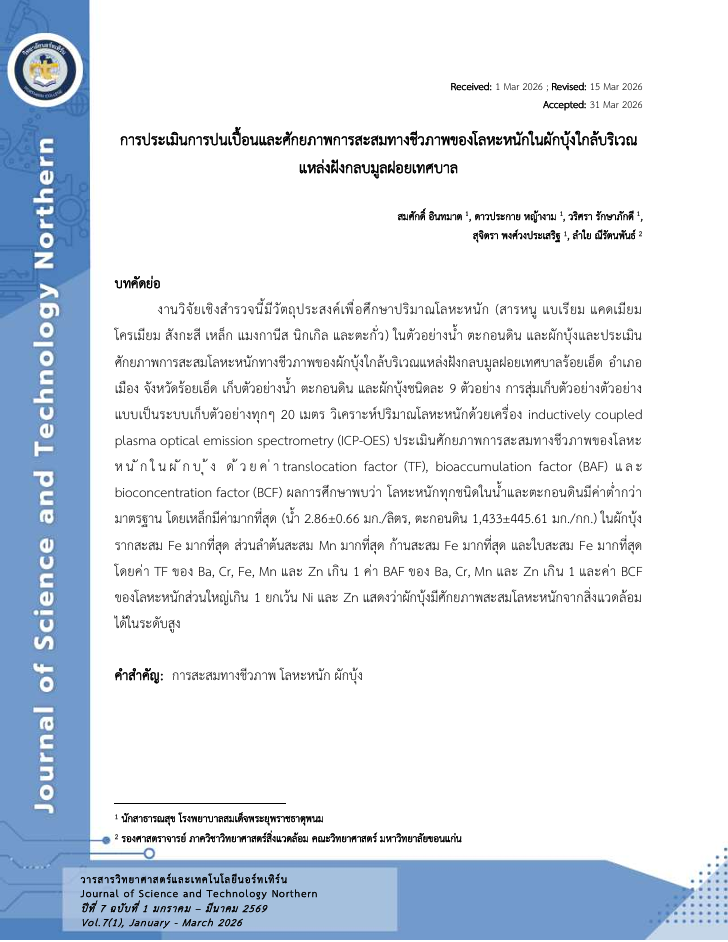
การประเมินการปนเปื้อนและศักยภาพการสะสมทางชีวภาพของโลหะหนักในผักบุ้งใกล้บริเวณ แหล่งฝังกลบมูลฝอยเทศบาล
คำสำคัญ:
การสะสมทางชีวภาพ, โลหะหนัก, ผักบุ้งบทคัดย่อ
บทคัดย่อ
งานวิจัยเชิงสำรวจนี้มีวัตถุประสงค์เพื่อศึกษาปริมาณโลหะหนัก (สารหนู แบเรียม แคดเมียม โครเมียม สังกะสี เหล็ก แมงกานีส นิกเกิล และตะกั่ว) ในตัวอย่างน้ำ ตะกอนดิน และผักบุ้งและประเมินศักยภาพการสะสมโลหะหนักทางชีวภาพของผักบุ้งใกล้บริเวณแหล่งฝังกลบมูลฝอยเทศบาลร้อยเอ็ด อำเภอเมือง จังหวัดร้อยเอ็ด เก็บตัวอย่างน้ำ ตะกอนดิน และผักบุ้งชนิดละ 9 ตัวอย่าง การสุ่มเก็บตัวอย่างตัวอย่างแบบเป็นระบบเก็บตัวอย่างทุกๆ 20 เมตร วิเคราะห์ปริมาณโลหะหนักด้วยเครื่อง inductively coupled plasma optical emission spectrometry (ICP-OES) ประเมินศักยภาพการสะสมทางชีวภาพของโลหะหนักในผักบุ้ง ด้วยค่าtranslocation factor (TF), bioaccumulation factor (BAF) และ bioconcentration factor (BCF) ผลการศึกษาพบว่า โลหะหนักทุกชนิดในน้ำและตะกอนดินมีค่าต่ำกว่ามาตรฐาน โดยเหล็กมีค่ามากที่สุด (น้ำ 2.86±0.66 มก./ลิตร, ตะกอนดิน 1,433±445.61 มก./กก.) ในผักบุ้ง รากสะสม Fe มากที่สุด ส่วนลำต้นสะสม Mn มากที่สุด ก้านสะสม Fe มากที่สุด และใบสะสม Fe มากที่สุด โดยค่า TF ของ Ba, Cr, Fe, Mn และ Zn เกิน 1 ค่า BAF ของ Ba, Cr, Mn และ Zn เกิน 1 และค่า BCF ของโลหะหนักส่วนใหญ่เกิน 1 ยกเว้น Ni และ Zn แสดงว่าผักบุ้งมีศักยภาพสะสมโลหะหนักจากสิ่งแวดล้อมได้ในระดับสูง
เอกสารอ้างอิง
เอกสารอ้างอิง
กรมควบคุมมลพิษ. (2567). รายงานสถานการณ์มลพิษของประเทศไทย ปี 2567 (ออนไลน์). สืบค้นเมื่อวันที่ 5 สิงหาคม 2568
ธีรนาถ สุวรรณเรือง. (2563) โลหะหนักปนเปื้อนในสิ่งแวดล้อมและผลกระทบต่อสุขภาพ. วารสารวิจัยและ พัฒนาระบบสุขภาพ, 13(1), 76-82.
พรชนก มนแก้ว. (2562). กรณีศึกษาภาวะพิษจากสารหนู. สมาคมเภสัชกรรมโรงพยาบาล (ประเทศไทย), 29(2), 103-117.
สมคิด ตันเก็ง และ ศิรภัสสร พันธะสา. (2567). การเปรียบเทียบปริมาณโลหะหนักทั้งหมดในน้ำชะขยะก่อน และหลังบำบัดของระบบบ่อผึ่ง ณ สถานที่กำจัดขยะมูลฝอยชุมชน จังหวัดพระนครศรีอยุธยา. วารสารวิชาการซายน์เทค มรภ.ภูเก็ต, 8(2), 39-52.
Adesokan, M.D., Adie, G.U. & Osibanjo, O. (2016). Soil Pollution by Toxic Metals near E-waste Recycling Operations in Ibadan, Nigeria. Journal of Health and Pollution, 6(11), 26-33.
Aladesanmi, O.T., Oroboade, J.G., Osisiogu, C.P. & Osewole, A.O. (2019). Bioaccumulation Factor of Selected Heavy Metals in Zea mays. Journal of Health and Pollution, 9(24), 1-19.
Alejandro, S., Höller, S., Meier, B. & Peiter, E. (2020). Manganese in Plants: From Acquisition to Subcellular Allocation. Frontiers in Plant Science, 11, 1-23.
Bai, L., Peng, X., Liu, Y., Sun, Y., Zheng, L., Liu, Z., Wan, K., Wang, J., Zhao, J. & Qiu Z. (2020). Association between acute severe mercury poisoning and multiple organ failure. American Journal of Translational Research, 12(8), 4347-4353.
Behtash, F., Abedini, F., Ahmadi, H., Mosavi, S.B., Aghaee, A., Morshedloo, M.R. & Lorenzo, J.M. (2022). Zinc Application Mitigates Copper Toxicity by Regulating Cu Uptake, Activity of Antioxidant Enzymes, and Improving Physiological Characteristics in Summer Squash. Antioxidants (Basel), 11(9),1-14.
Leonardi, C., Toscano, V., Genovese, C., Mosselmans, J.F.W., Ngwenya, B.T. & Raccuia, S.A. (2021). Evaluation of cadmium and arsenic effects on wild and cultivated cardoon genotypes selected for metal phytoremediation and bioenergy purposes. Environmental Science and Pollution Research, 28(39), 55102-55115.
Li G, Cai Z, Huang S, Song Z, Zhang Y, Zheng Z, Luo R and Wang S (2024), Heavy metal
accumulation and health risk assessment in S. alterniflora Loisel. and native plant Suaeda salsa (L.) Pall. in Dongtai Tiaozini wetland. Frontiers in Environmental Science, 12, 1-12.
Melake, B.A., Endalew, S.M., Alamirew, T.S. & Temesegen, L.M. (2023). Bioaccumulation and Biota-Sediment Accumulation Factor of Metals and Metalloids in Edible Fish: A Systematic Review in Ethiopian Surface Waters. Environmental Health Insights, 17, 1- 10.
Mountouris, A., Voutsas, E. & Tassios, D. (2002). Bioconcentration of heavy metals in aquatic environments: the importance of bioavailability. Marine Pollution Bulletin, 44(10), 1136-1141.
Qi, W., Bai, J., Yu, H. & Han, G. (2025). Physiological Adaptations of Vigna radiata to Heavy Metal Stress: Soluble Sugar Accumulation and Biomass Enhancement. Plants (Basel), 14, 1-14.
Speer, R.M., Zhou, X., Volk, L.B., Liu, K.J. & Hudson, L.G. (2023). Arsenic and cancer: Evidence and mechanisms. Advances in Pharmacology, 96, 151-202.
Schneider, J.S. (2023). Neurotoxicity and outcomes from developmental lead exposure: persistent or permanent? Environmental Health Perspectives, 131(8), 1-5.
Shi, Y.Z., Ruan, J.Y., Ma, L.F., Han, W.Y. & Wang, F. (2008). Accumulation and distribution of arsenic and cadmium by tea plants. Journal of Zhejiang University-SCIENCE B, 9(3), 265-70.
Uzakov, Z. & Uzakov, Z. (2023). Accumulation of heavy metals in the soil and agricultural crops. BIO Web of Conferences, 71,1-11.
Wang, J., Tao, L., Ren, H., Xue, X., Yang, Z., Jiang, Y. & Ren, J. (2025). Assessment of surface sediment properties and heavy metal contamination in typical urban areas of the Yellow River, China. Scientific Reports, 15, 1-10.
Zaitsev, G.A., Dubrovina, O.A. & Shainurov, R.I. Iron and manganese migration in “soil–plant” system in Scots pine stands in conditions of contamination by the steel plant’s emissions. Scientific Reports, 10, 1-11.
Zinia, S.S., Yang, K.H., Lee, E.J., Lim, M.N., Kim, J., Kim, W.J., & Ko-CHENS Study group. (2023). Effects of heavy metal exposure during pregnancy on birth outcomes. Scientific Reports, 13(1), 1-10.
ดาวน์โหลด
เผยแพร่แล้ว
รูปแบบการอ้างอิง
ฉบับ
ประเภทบทความ
สัญญาอนุญาต

อนุญาตภายใต้เงื่อนไข Creative Commons Attribution-NonCommercial-NoDerivatives 4.0 International License.