
Evaluation of heavy metals contamination and bioaccumulation in water spinach (Ipomoea Aquatica) near municipal landfill
Keywords:
bioaccumulation, Heavy metals, water spinach (Ipomoea Aquatica)Abstract
Abstract
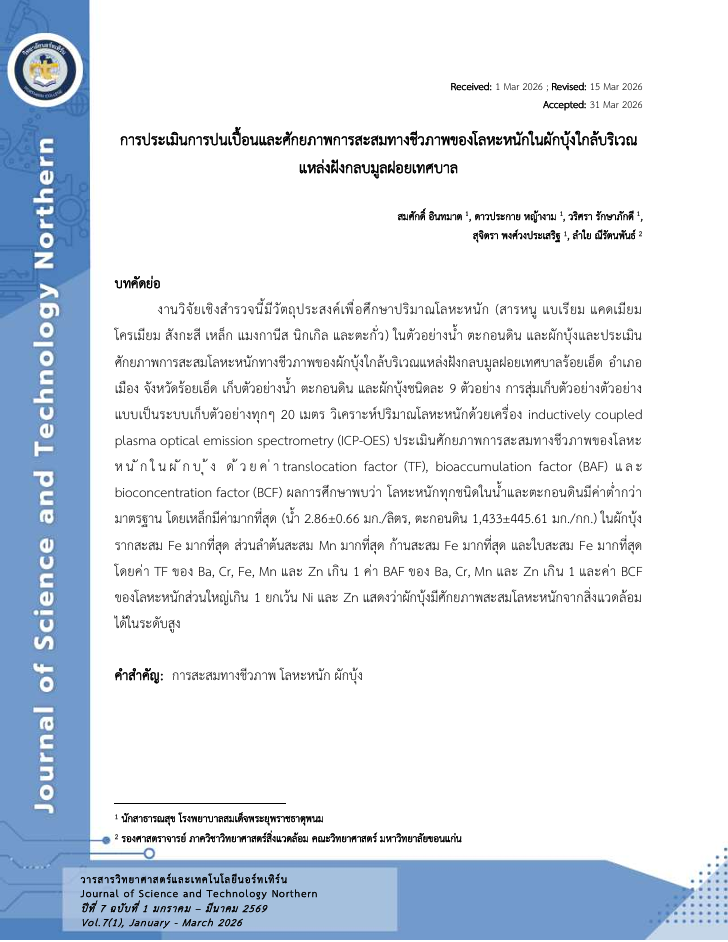
This survey research was conducted to assess heavy metals (arsenic, barium, cadmium, chromium, zinc, iron, manganese and led) in water, sediment and water spinach samples near Roi-et municipal landfill in Maung district, Roi-et province. 9 samples of water, sediment and water spinach samples were collected. The systematic sampling which collected every 20 meters was conducted. The samples were analyzed for heavy metals using inductively coupled plasma optical emission spectrometry (ICP-OES). Bioaccumulation of heavy metals in water spinach was assessed through the translocation factor (TF), bioaccumulation factor (BAF) and bioconcentration factor (BCF). The study found that all heavy metals in water and sediment were below the standard limits, with iron having the highest concentration (water: 2.86±0.66 mg/L, sediment: 1,433±445.61 mg/kg). In water spinach, the roots accumulated the highest amount of Fe, the stems accumulated the highest amount of Mn, the petioles accumulated the highest amount of Fe, and the leaves accumulated the highest amount of Fe. The translocation factor (TF) values for Ba, Cr, Fe, Mn, and Zn exceeded 1. The bioaccumulation factor (BAF) values for Ba, Cr, Mn, and Zn also exceeded 1. Furthermore, the bioconcentration factor (BCF) values of most heavy metals were above 1, except for Ni and Zn. These results indicate that water spinach has a high potential to accumulate heavy metals from the environment.
References
เอกสารอ้างอิง
กรมควบคุมมลพิษ. (2567). รายงานสถานการณ์มลพิษของประเทศไทย ปี 2567 (ออนไลน์). สืบค้นเมื่อวันที่ 5 สิงหาคม 2568
ธีรนาถ สุวรรณเรือง. (2563) โลหะหนักปนเปื้อนในสิ่งแวดล้อมและผลกระทบต่อสุขภาพ. วารสารวิจัยและ พัฒนาระบบสุขภาพ, 13(1), 76-82.
พรชนก มนแก้ว. (2562). กรณีศึกษาภาวะพิษจากสารหนู. สมาคมเภสัชกรรมโรงพยาบาล (ประเทศไทย), 29(2), 103-117.
สมคิด ตันเก็ง และ ศิรภัสสร พันธะสา. (2567). การเปรียบเทียบปริมาณโลหะหนักทั้งหมดในน้ำชะขยะก่อน และหลังบำบัดของระบบบ่อผึ่ง ณ สถานที่กำจัดขยะมูลฝอยชุมชน จังหวัดพระนครศรีอยุธยา. วารสารวิชาการซายน์เทค มรภ.ภูเก็ต, 8(2), 39-52.
Adesokan, M.D., Adie, G.U. & Osibanjo, O. (2016). Soil Pollution by Toxic Metals near E-waste Recycling Operations in Ibadan, Nigeria. Journal of Health and Pollution, 6(11), 26-33.
Aladesanmi, O.T., Oroboade, J.G., Osisiogu, C.P. & Osewole, A.O. (2019). Bioaccumulation Factor of Selected Heavy Metals in Zea mays. Journal of Health and Pollution, 9(24), 1-19.
Alejandro, S., Höller, S., Meier, B. & Peiter, E. (2020). Manganese in Plants: From Acquisition to Subcellular Allocation. Frontiers in Plant Science, 11, 1-23.
Bai, L., Peng, X., Liu, Y., Sun, Y., Zheng, L., Liu, Z., Wan, K., Wang, J., Zhao, J. & Qiu Z. (2020). Association between acute severe mercury poisoning and multiple organ failure. American Journal of Translational Research, 12(8), 4347-4353.
Behtash, F., Abedini, F., Ahmadi, H., Mosavi, S.B., Aghaee, A., Morshedloo, M.R. & Lorenzo, J.M. (2022). Zinc Application Mitigates Copper Toxicity by Regulating Cu Uptake, Activity of Antioxidant Enzymes, and Improving Physiological Characteristics in Summer Squash. Antioxidants (Basel), 11(9),1-14.
Leonardi, C., Toscano, V., Genovese, C., Mosselmans, J.F.W., Ngwenya, B.T. & Raccuia, S.A. (2021). Evaluation of cadmium and arsenic effects on wild and cultivated cardoon genotypes selected for metal phytoremediation and bioenergy purposes. Environmental Science and Pollution Research, 28(39), 55102-55115.
Li G, Cai Z, Huang S, Song Z, Zhang Y, Zheng Z, Luo R and Wang S (2024), Heavy metal
accumulation and health risk assessment in S. alterniflora Loisel. and native plant Suaeda salsa (L.) Pall. in Dongtai Tiaozini wetland. Frontiers in Environmental Science, 12, 1-12.
Melake, B.A., Endalew, S.M., Alamirew, T.S. & Temesegen, L.M. (2023). Bioaccumulation and Biota-Sediment Accumulation Factor of Metals and Metalloids in Edible Fish: A Systematic Review in Ethiopian Surface Waters. Environmental Health Insights, 17, 1- 10.
Mountouris, A., Voutsas, E. & Tassios, D. (2002). Bioconcentration of heavy metals in aquatic environments: the importance of bioavailability. Marine Pollution Bulletin, 44(10), 1136-1141.
Qi, W., Bai, J., Yu, H. & Han, G. (2025). Physiological Adaptations of Vigna radiata to Heavy Metal Stress: Soluble Sugar Accumulation and Biomass Enhancement. Plants (Basel), 14, 1-14.
Speer, R.M., Zhou, X., Volk, L.B., Liu, K.J. & Hudson, L.G. (2023). Arsenic and cancer: Evidence and mechanisms. Advances in Pharmacology, 96, 151-202.
Schneider, J.S. (2023). Neurotoxicity and outcomes from developmental lead exposure: persistent or permanent? Environmental Health Perspectives, 131(8), 1-5.
Shi, Y.Z., Ruan, J.Y., Ma, L.F., Han, W.Y. & Wang, F. (2008). Accumulation and distribution of arsenic and cadmium by tea plants. Journal of Zhejiang University-SCIENCE B, 9(3), 265-70.
Uzakov, Z. & Uzakov, Z. (2023). Accumulation of heavy metals in the soil and agricultural crops. BIO Web of Conferences, 71,1-11.
Wang, J., Tao, L., Ren, H., Xue, X., Yang, Z., Jiang, Y. & Ren, J. (2025). Assessment of surface sediment properties and heavy metal contamination in typical urban areas of the Yellow River, China. Scientific Reports, 15, 1-10.
Zaitsev, G.A., Dubrovina, O.A. & Shainurov, R.I. Iron and manganese migration in “soil–plant” system in Scots pine stands in conditions of contamination by the steel plant’s emissions. Scientific Reports, 10, 1-11.
Zinia, S.S., Yang, K.H., Lee, E.J., Lim, M.N., Kim, J., Kim, W.J., & Ko-CHENS Study group. (2023). Effects of heavy metal exposure during pregnancy on birth outcomes. Scientific Reports, 13(1), 1-10.
Downloads
Published
How to Cite
Issue
Section
License

This work is licensed under a Creative Commons Attribution-NonCommercial-NoDerivatives 4.0 International License.