
การพัฒนารูปแบบการดำเนินงานการตรวจทางห้องปฏิบัติการอย่างสมเหตุผล (RLU) ในโรงพยาบาลเชียงแสนด้วย Six Sigma
คำสำคัญ:
การตรวจทางห้องปฏิบัติการอย่างสมเหตุผล, Six Sigma, DMAIC, โรงพยาบาลชุมชน, ผลลัพธ์ขัดแย้งบทคัดย่อ
บทคัดย่อ
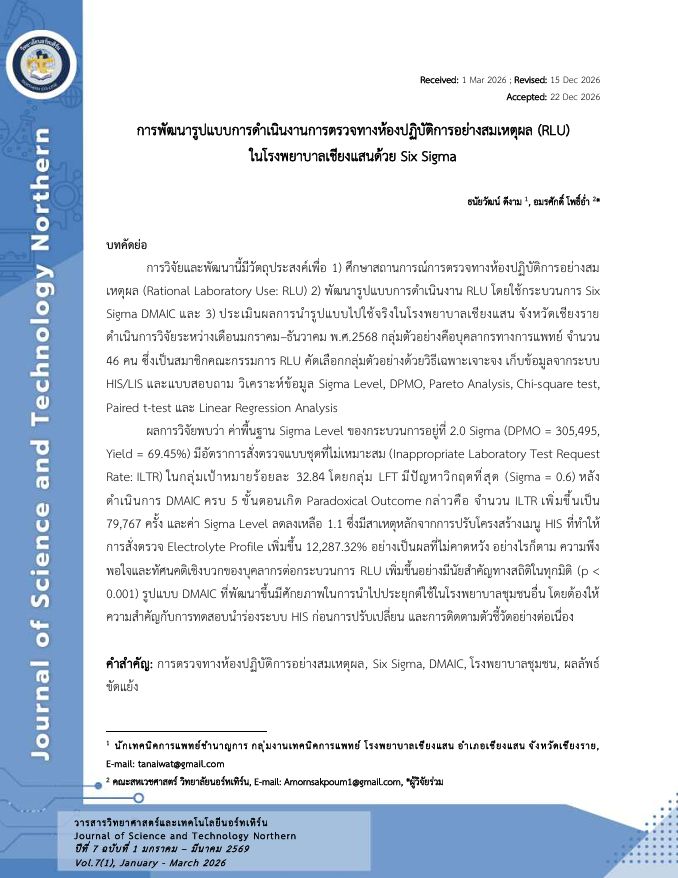
การวิจัยและพัฒนานี้มีวัตถุประสงค์เพื่อ 1) ศึกษาสถานการณ์การตรวจทางห้องปฏิบัติการอย่างสมเหตุผล (Rational Laboratory Use: RLU) 2) พัฒนารูปแบบการดำเนินงาน RLU โดยใช้กระบวนการ Six Sigma DMAIC และ 3) ประเมินผลการนำรูปแบบไปใช้จริงในโรงพยาบาลเชียงแสน จังหวัดเชียงราย ดำเนินการวิจัยระหว่างเดือนมกราคม–ธันวาคม พ.ศ.2568 กลุ่มตัวอย่างคือบุคลากรทางการแพทย์ จำนวน 46 คน ซึ่งเป็นสมาชิกคณะกรรมการ RLU คัดเลือกกลุ่มตัวอย่างด้วยวิธีเฉพาะเจาะจง เก็บข้อมูลจากระบบ HIS/LIS และแบบสอบถาม วิเคราะห์ข้อมูล Sigma Level, DPMO, Pareto Analysis, Chi-square test, Paired t-test และ Linear Regression Analysis
ผลการวิจัยพบว่า ค่าพื้นฐาน Sigma Level ของกระบวนการอยู่ที่ 2.0 Sigma (DPMO = 305,495, Yield = 69.45%) มีอัตราการสั่งตรวจแบบชุดที่ไม่เหมาะสม (Inappropriate Laboratory Test Request Rate: ILTR) ในกลุ่มเป้าหมายร้อยละ 32.84 โดยกลุ่ม LFT มีปัญหาวิกฤตที่สุด (Sigma = 0.6) หลังดำเนินการ DMAIC ครบ 5 ขั้นตอนเกิด Paradoxical Outcome กล่าวคือ จำนวน ILTR เพิ่มขึ้นเป็น 79,767 ครั้ง และค่า Sigma Level ลดลงเหลือ 1.1 ซึ่งมีสาเหตุหลักจากการปรับโครงสร้างเมนู HIS ที่ทำให้การสั่งตรวจ Electrolyte Profile เพิ่มขึ้น 12,287.32% อย่างเป็นผลที่ไม่คาดหวัง อย่างไรก็ตาม ความพึงพอใจและทัศนคติเชิงบวกของบุคลากรต่อกระบวนการ RLU เพิ่มขึ้นอย่างมีนัยสำคัญทางสถิติในทุกมิติ (p < 0.001) รูปแบบ DMAIC ที่พัฒนาขึ้นมีศักยภาพในการนำไปประยุกต์ใช้ในโรงพยาบาลชุมชนอื่น โดยต้องให้ความสำคัญกับการทดสอบนำร่องระบบ HIS ก่อนการปรับเปลี่ยน และการติดตามตัวชี้วัดอย่างต่อเนื่อง
เอกสารอ้างอิง
เอกสารอ้างอิง
กรมวิทยาศาสตร์การแพทย์. (2566). รายงานสถิติการตรวจทางห้องปฏิบัติการ โรงพยาบาลสังกัดสำนักงาน ปลัดกระทรวงสาธารณสุข ปีงบประมาณ 2564. กรุงเทพมหานคร: กรมวิทยาศาสตร์การแพทย์.
โรงพยาบาลเชียงแสน. (2567). รายงานประจำปีกลุ่มงานเทคนิคการแพทย์ ปีงบประมาณ 2565–2567. เชียงราย: โรงพยาบาลเชียงแสน.
Antony, J., Snee, R., & Hoerl, R. (2018). Lean Six Sigma: yesterday, today and tomorrow. International Journal of Quality & Reliability Management, 35(1), 36–51. https://doi.org/10.1108/IJQRM-03-2017-0054
Bates, D. W., Kuperman, G. J., Wang, S., Gandhi, T., Kittler, A., Volk, L., Wald, J. S., & Middleton, B. (2003). Ten commandments for effective clinical decision support: making the practice of evidence-based medicine a reality. Journal of the American Medical Informatics Association, 10(6), 523–530. https://doi.org/10.1197/jamia.M1376
Borg, W. R., & Gall, M. D. (1989). Educational Research: An Introduction (5th ed.). New York: Longman.
Born, K., Levinson, W., & Sharpe, N. (2019). How the Choosing Wisely Campaign is improving care in Canada. BMJ, 364, l849. https://doi.org/10.1136/bmj.l849
Cadamuro, J., Ibarz, M., Cornes, M., Nybo, M., Haschke-Becher, E., von Meyer, A., Lippi, G., Vermeersch, P., Mrazek, C., Hanon, E., Brugnoni, D., & Simundic, A. M. (2019). Managing inappropriate requesting in laboratory diagnostics. Diagnosis, 6(3), 273–281. https://doi.org/10.1515/dx-2019-0024
Choosing Wisely. (2012). Choosing Wisely: An initiative of the ABIM Foundation. Philadelphia: American Board of Internal Medicine Foundation.
DelliFraine, J. L., Langabeer, J. R., & Nembhard, I. M. (2010). Assessing the evidence of Six Sigma and Lean in the health care industry. Quality Management in Healthcare, 19(3), 211–225. https://doi.org/10.1097/QMH.0b013e3181e2e10c
Edmondson, A. C. (1999). Psychological safety and learning behavior in work teams. Administrative Science Quarterly, 44(2), 350–383. https://doi.org/10.2307/2666999
Fryer, A. A., & Smellie, W. S. B. (2013). Managing demand for laboratory tests: a laboratory toolkit. Journal of Clinical Pathology, 66(1), 62–72. https://doi.org/10.1136/jclinpath- 2011-200524
Kelley, K., & Preacher, K. J. (2012). On effect size. Psychological Methods, 17(2), 137–152. https://doi.org/10.1037/a0028086
Kotter, J. P. (1996). Leading Change. Boston: Harvard Business School Press.
Levinson, W., Kallewaard, M., Bhatia, R. S., Wolfson, D., Shortt, S., & Kerr, E. A. (2015). ‘Choosing Wisely’: a growing international campaign. BMJ Quality & Safety, 24(2), 167–174. https://doi.org/10.1136/bmjqs-2014-003552
Lundberg, G. D. (1994). The need for an outcomes research agenda for clinical laboratory testing. JAMA, 272(22), 1762.
Patton, M. Q. (2015). Qualitative Research & Evaluation Methods (4th ed.). Thousand Oaks, CA: SAGE Publications.
Plebani, M. (2006). Errors in clinical laboratories or errors in laboratory medicine? Clinical Chemistry and Laboratory Medicine, 44(6), 750–759. https://doi.org/10.1515/CCLM.2006.109
Prochaska, J. O., & DiClemente, C. C. (1983). Stages and processes of self-change of smoking: toward an integrative model of change. Journal of Consulting and Clinical Psychology, 51(3), 390–395. https://doi.org/10.1037/0022-006X.51.3.390
Pyzdek, T., & Keller, P. (2014). The Six Sigma Handbook (4th ed.). New York: McGraw-Hill.
Rohr, U. P., Binder, C., Dieterle, T., Giusti, G., Messina, C. G. M., Toerien, E., Wiesner, L. J., & Schmitz, S. F. H. (2016). The value of in vitro diagnostic testing in medical practice: a status report. PLOS ONE, 11(3), e0149856. https://doi.org/10.1371/journal.pone.0149856
Salinas, M., López-Garrigós, M., Flores, E., & Leiva-Salinas, C. (2018). Laboratory test inappropriate use worldwide: a systematic review. Clinical Biochemistry, 62, 1–17. https://doi.org/10.1016/j.clinbiochem.2018.07.011
Thaler, R. H., & Sunstein, C. R. (2008). Nudge: Improving decisions about health, wealth, and happiness. New Haven: Yale University Press.
van der Sijs, H., Aarts, J., Vulto, A., & Berg, M. (2006). Overriding of drug safety alerts in computerized physician order entry. Journal of the American Medical Informatics Association, 13(2), 138–147. https://doi.org/10.1197/jamia.M1809
van Walraven, C., & Naylor, C. D. (1998). Do we know what inappropriate laboratory utilization is? A systematic review of laboratory clinical audits. JAMA, 280(6), 550–558. https://doi.org/10.1001/jama.280.6.550
Westgard, J. O., & Westgard, S. A. (2006). The quality of laboratory testing today: an assessment of sigma metrics for analytic quality using performance data from proficiency testing surveys and the CLIA criteria for acceptable performance. American Journal of Clinical Pathology, 125(3), 343–354. https://doi.org/10.1309/U7GYQ84PDJY4KBAH
Zhi, M., Ding, E. L., Theisen-Toupal, J., Whelan, J., & Arnaout, R. (2013). The landscape of inappropriate laboratory testing: a 15-year meta-analysis. PLOS ONE, 8(11), e78962. https://doi.org/10.1371/journal.pone.0078962
ดาวน์โหลด
เผยแพร่แล้ว
รูปแบบการอ้างอิง
ฉบับ
ประเภทบทความ
สัญญาอนุญาต

อนุญาตภายใต้เงื่อนไข Creative Commons Attribution-NonCommercial-NoDerivatives 4.0 International License.