
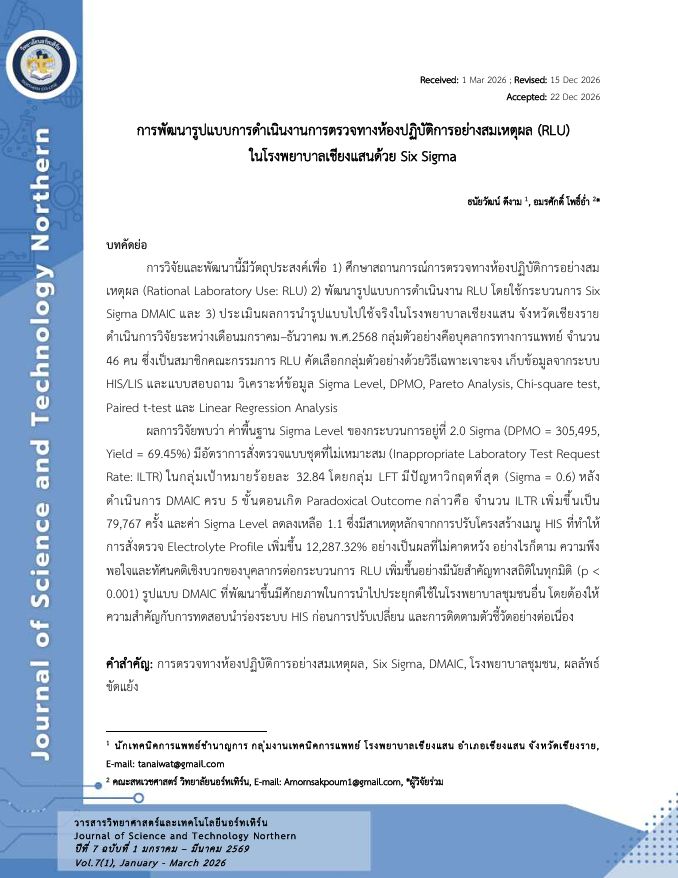
Development of a Rational Laboratory Use (RLU) operating model in Chiang Saen Hospital by using Six Sigma.
Keywords:
Rational Laboratory Use, Six Sigma, DMAIC, Community Hospital, Paradoxical OutcomeAbstract
Abstract
This research and development study aimed to (1) assess the baseline situation of rational laboratory use (RLU), (2) develop an RLU operational model using the Six Sigma DMAIC process, and (3) evaluate implementation outcomes at Chiang Saen Hospital, Chiang Rai Province. The study was conducted from January to December 2025. A purposive sample of 46 medical personnel from the RLU committee participated. Data were collected from HIS/LIS systems and questionnaires, analyzed using Sigma Level, DPMO, Pareto Analysis, Chi-square test, Paired t-test, and Linear Regression.
Results revealed a baseline Sigma Level of 2.0 (DPMO = 305,495, Yield = 69.45%), with an Inappropriate Laboratory Test Request Rate (ILTR) of 32.84% among target test groups. The LFT group exhibited critical underperformance (Sigma = 0.6). Following full DMAIC implementation, a Paradoxical Outcome emerged: ILTR increased to 79,767 episodes and Sigma Level declined to 1.1, primarily attributable to an unintended 12,287.32% surge in Electrolyte Profile orders triggered by HIS menu restructuring. Notably, staff satisfaction and positive attitudes toward RLU improved significantly across all dimensions (p < 0.001). The developed DMAIC model provides a replicable framework for community hospitals, emphasizing the critical importance of HIS pilot testing prior to menu restructuring and continuous performance monitoring.
References
เอกสารอ้างอิง
กรมวิทยาศาสตร์การแพทย์. (2566). รายงานสถิติการตรวจทางห้องปฏิบัติการ โรงพยาบาลสังกัดสำนักงาน ปลัดกระทรวงสาธารณสุข ปีงบประมาณ 2564. กรุงเทพมหานคร: กรมวิทยาศาสตร์การแพทย์.
โรงพยาบาลเชียงแสน. (2567). รายงานประจำปีกลุ่มงานเทคนิคการแพทย์ ปีงบประมาณ 2565–2567. เชียงราย: โรงพยาบาลเชียงแสน.
Antony, J., Snee, R., & Hoerl, R. (2018). Lean Six Sigma: yesterday, today and tomorrow. International Journal of Quality & Reliability Management, 35(1), 36–51. https://doi.org/10.1108/IJQRM-03-2017-0054
Bates, D. W., Kuperman, G. J., Wang, S., Gandhi, T., Kittler, A., Volk, L., Wald, J. S., & Middleton, B. (2003). Ten commandments for effective clinical decision support: making the practice of evidence-based medicine a reality. Journal of the American Medical Informatics Association, 10(6), 523–530. https://doi.org/10.1197/jamia.M1376
Borg, W. R., & Gall, M. D. (1989). Educational Research: An Introduction (5th ed.). New York: Longman.
Born, K., Levinson, W., & Sharpe, N. (2019). How the Choosing Wisely Campaign is improving care in Canada. BMJ, 364, l849. https://doi.org/10.1136/bmj.l849
Cadamuro, J., Ibarz, M., Cornes, M., Nybo, M., Haschke-Becher, E., von Meyer, A., Lippi, G., Vermeersch, P., Mrazek, C., Hanon, E., Brugnoni, D., & Simundic, A. M. (2019). Managing inappropriate requesting in laboratory diagnostics. Diagnosis, 6(3), 273–281. https://doi.org/10.1515/dx-2019-0024
Choosing Wisely. (2012). Choosing Wisely: An initiative of the ABIM Foundation. Philadelphia: American Board of Internal Medicine Foundation.
DelliFraine, J. L., Langabeer, J. R., & Nembhard, I. M. (2010). Assessing the evidence of Six Sigma and Lean in the health care industry. Quality Management in Healthcare, 19(3), 211–225. https://doi.org/10.1097/QMH.0b013e3181e2e10c
Edmondson, A. C. (1999). Psychological safety and learning behavior in work teams. Administrative Science Quarterly, 44(2), 350–383. https://doi.org/10.2307/2666999
Fryer, A. A., & Smellie, W. S. B. (2013). Managing demand for laboratory tests: a laboratory toolkit. Journal of Clinical Pathology, 66(1), 62–72. https://doi.org/10.1136/jclinpath- 2011-200524
Kelley, K., & Preacher, K. J. (2012). On effect size. Psychological Methods, 17(2), 137–152. https://doi.org/10.1037/a0028086
Kotter, J. P. (1996). Leading Change. Boston: Harvard Business School Press.
Levinson, W., Kallewaard, M., Bhatia, R. S., Wolfson, D., Shortt, S., & Kerr, E. A. (2015). ‘Choosing Wisely’: a growing international campaign. BMJ Quality & Safety, 24(2), 167–174. https://doi.org/10.1136/bmjqs-2014-003552
Lundberg, G. D. (1994). The need for an outcomes research agenda for clinical laboratory testing. JAMA, 272(22), 1762.
Patton, M. Q. (2015). Qualitative Research & Evaluation Methods (4th ed.). Thousand Oaks, CA: SAGE Publications.
Plebani, M. (2006). Errors in clinical laboratories or errors in laboratory medicine? Clinical Chemistry and Laboratory Medicine, 44(6), 750–759. https://doi.org/10.1515/CCLM.2006.109
Prochaska, J. O., & DiClemente, C. C. (1983). Stages and processes of self-change of smoking: toward an integrative model of change. Journal of Consulting and Clinical Psychology, 51(3), 390–395. https://doi.org/10.1037/0022-006X.51.3.390
Pyzdek, T., & Keller, P. (2014). The Six Sigma Handbook (4th ed.). New York: McGraw-Hill.
Rohr, U. P., Binder, C., Dieterle, T., Giusti, G., Messina, C. G. M., Toerien, E., Wiesner, L. J., & Schmitz, S. F. H. (2016). The value of in vitro diagnostic testing in medical practice: a status report. PLOS ONE, 11(3), e0149856. https://doi.org/10.1371/journal.pone.0149856
Salinas, M., López-Garrigós, M., Flores, E., & Leiva-Salinas, C. (2018). Laboratory test inappropriate use worldwide: a systematic review. Clinical Biochemistry, 62, 1–17. https://doi.org/10.1016/j.clinbiochem.2018.07.011
Thaler, R. H., & Sunstein, C. R. (2008). Nudge: Improving decisions about health, wealth, and happiness. New Haven: Yale University Press.
van der Sijs, H., Aarts, J., Vulto, A., & Berg, M. (2006). Overriding of drug safety alerts in computerized physician order entry. Journal of the American Medical Informatics Association, 13(2), 138–147. https://doi.org/10.1197/jamia.M1809
van Walraven, C., & Naylor, C. D. (1998). Do we know what inappropriate laboratory utilization is? A systematic review of laboratory clinical audits. JAMA, 280(6), 550–558. https://doi.org/10.1001/jama.280.6.550
Westgard, J. O., & Westgard, S. A. (2006). The quality of laboratory testing today: an assessment of sigma metrics for analytic quality using performance data from proficiency testing surveys and the CLIA criteria for acceptable performance. American Journal of Clinical Pathology, 125(3), 343–354. https://doi.org/10.1309/U7GYQ84PDJY4KBAH
Zhi, M., Ding, E. L., Theisen-Toupal, J., Whelan, J., & Arnaout, R. (2013). The landscape of inappropriate laboratory testing: a 15-year meta-analysis. PLOS ONE, 8(11), e78962. https://doi.org/10.1371/journal.pone.0078962
Downloads
Published
How to Cite
Issue
Section
License

This work is licensed under a Creative Commons Attribution-NonCommercial-NoDerivatives 4.0 International License.