
Effects of a Discharge planning program for Chronic Obstructive Pulmonary Disease on acute exacerbation management, Chiang Saen Hospital
Keywords:
Chronic obstructive pulmonary disease, acute exacerbation, Discharge planningAbstract
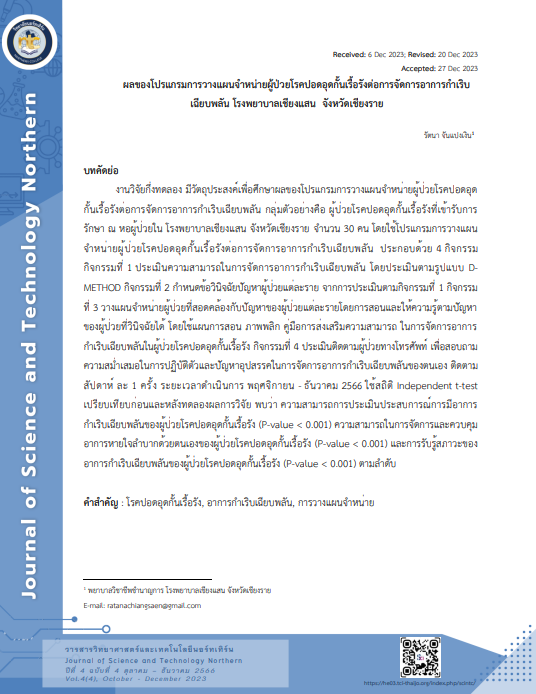
This Quasi-experimental research aimed to study the effectiveness of discharge planning program for Chronic Obstructive Pulmonary Disease on acute exacerbation management, Chiang Saen Hospital. Population in this study consisted of 30 participants. This discharge planning program for Chronic Obstructive Pulmonary Disease on acute exacerbation management, Chiang Saen Hospital; composed of 4 activities and assessment within 4 weeks. The instrument used for data collection by questionnaire and data analyzed to test research hypothesis by independent t-test. The result showed that the variables had average scores increased with statistic significantly including, ability to assess the acute exacerbation experiences of patients with chronic obstructive pulmonary disease (P-value < 0.001), ability to independently manage and control breathing difficulties in patients with chronic obstructive pulmonary disease (P-value < 0.001), and the perception of the state of acute exacerbation symptoms in patients with chronic obstructive pulmonary disease (P-value < 0.001), respectively.
References
กนก พิพัฒน์เวช และศิริพร อุปจักร. (2564). ความสัมพันธ์ระหว่างการสัมผัสฝุ่นละออง PM2.5 กับอาการกำเริบของผู้ป่วยโรคปอดอุดกั้นเรื้อรังในโรงพยาบาลน่าน. วารสารวิชาการสาธารณสุข. 30(4): 645-653.
กนกวรรณ อนุศักดิ์, รัตนนุช มาธนะสารวุฒิ, โภคิณ ศักรินทร์กุล, และวิชุดา จิรพรเจริญ. (2564). ปัจจัยที่มีความสัมพันธ์ต่อการเกิดอาการกำเริบเฉียบพลันในผู้ป่วยโรคปอดอุดกั้นเรื้อรังที่มารับการรักษาที่ห้องฉุกเฉิน โรงพยาบาลลำพูน. วารสารกรมการแพทย์. 46(4): 67 – 73.
กองการพยาบาล กระทรวงสาธารณสุข.(2539). แนวทางการวางแผนจำหน่ายผู้ป่วย.กรุงเทพมหานคร: มหาวิทยาลัยธรรมศาสตร์.
งานศูนย์คุณภาพโรงพยาบาลเชียงแสน. (2566). สถิติผู้รับบริการผู้ป่วยในโรงพยาบาลเชียงแสน. เชียงราย: โรงพยาบาลเชียงแสน.
นุชรัตน์ จันทโร. (2561). ผลของโปรแกรมสนับสนุนนการจัดการตนเองต่อความสามารถในการจัดการอาการและอาการหายใจลำบากของผู้ป่วยโรคปอดอุดกั้นเรื้อรัง. ปริญญาโทมหาวิทยาลัยสงขลานครินทร์, สงขลา.
พนาวรรณ บุญพิมล, สุภาภรณ์ ด้วงแพ และวัลภา คุณทรงเกียรติ. (2558). ปัจจัยทำนายอาการกำเริบเฉียบพลันในผู้ป่วยโรคปอดอุดกั้นเรื้อรัง. วารสารคณะพยาบาลศษสตร์ มหาวิทยาลัยบูรพา. 23(1): 26-39.
วิภาณี คงทน, ดวงรัตน์ วัฒนกิจไกรเลิศ, คะนึงนิจ พงศ์ถาวรกมล, และนัฐพล ฤทธิ์ทยมัย. (2562). ปัจจัยที่มีอิทธิพลต่ออาการกำเริบเฉียบพลันในผู้ป่วยโรคปอดอุดกั้นเรื้อรัง: การศึกษาไปข้างหน้า. วารสารสภาการพยาบาล. 34(3): 76 – 90.
สถิติสุขภาพคนไทย. (2564). โรคปอดอุดกั้นเรื้อรัง. https://www.hiso.or.th/thaihealthstat.
อาดีละห์ สะไร. (2559). ผลของโปรแกรมการบูรณาการการวางแผนจำหน่ายร่วมกับประสบการณ์อาการต่อความสามารถในการจัดการอาการและสภาวะอาการหายใจลำบากในผู้ป่วยโรคปอดอุดกั้นเรื้อรัง. ปริญญาโท, มหาวิทยาลัยสงขลานครินทร์, สงขลา.
Dodd, M., Janson, S., Facione, N., Faucett, J., Froelicher, E. S., Humphreys, J., & Taylor, D. (2001). Advancing the science of symptom management. Journal of Advanced Nursing. 33(5), 668-676.
Reis, A. J., Alves, C., Furtado, S., Ferreira, J., Drummond, M., & Robalo-Cordeiro, C. (2018). COPD exacerbations: Management and hospital discharge. Pulmonology. 24(6), 345–350.
World Health Organization. (2023). Chronic obstructive pulmonary disease (COPD). https://www.who.int/news-room/fact-sheets/detail/chronic-obstructive-pulmonary-disease-(copd).
Downloads
Published
How to Cite
Issue
Section
License

This work is licensed under a Creative Commons Attribution-NonCommercial-NoDerivatives 4.0 International License.