
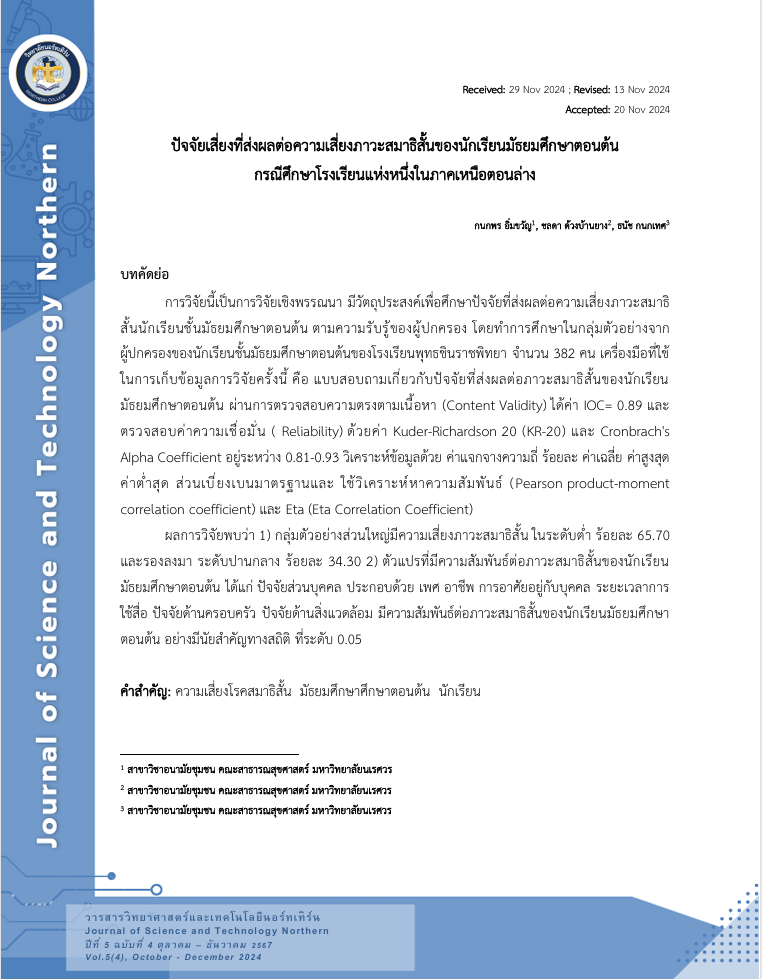
Factors that affect the risk of Attention deficit hyperactivity disorder in Junior high school students. A case study of a school in lower northern region, Thailand
Keywords:
attention deficit hyperactivity disorder risk, secondary school, studentAbstract
Abstract
The following is a description of the research conducted in this study. The purpose of this study
was to determine the Risk factors affecting Attention Deficit Hyperactivity Disorder (ADHD) in middle
school students According to the perception of parents. The study was conducted on a sample of 382
parents of lower secondary school students at Budhachinnaraj Pittaya School. The instrument used to
collect data for this research was a questionnaire regarding factors affecting attention deficit hyperactivity
disorder among secondary school students. content validity check with an IOC = 0.89 and checked for
reliability with Kuder-Richardson 20 (KR-20) and Cronbrach's AIpha Coefficient between 0.81-0.93.
Analyze the data as well. Frequency distribution values, percentage, average, maximum, minimum,
standard deviation and Used to analyze the relationship (Pearson product-moment correlation
coefficient) and Eta (Eta Correlation Coefficient).
The results of the research were as follows: 1) Most of the sample had ADHD, 65.70%, at a low
level, followed by 34.30% at a moderate level. 2) Variables that are related to ADHD in middle school
students include personal factors, including gender, occupation, and living with people. Media usage
time, Family and environmental factors are related to ADHD in middle school students. Statistically
significant at the 0.05 level.
References
เอกสารอ้างอิง
ขวัญจิต เพ็งแป้น. (2560). การป้องกันปัญหาภาวะสุขภาพของเด็กติดเกมออนไลน์. วารสารราชธานีนวัตกรรมทาง
วิทยาศาสตร สุขภาพ,1(1), 16-32.
บุรฉัตร ศักดิ์ศรีทวี, เอกรัฐ จันทร์วันเพ็ญและธารินทร์ เพ็ญวรรณ, 2562). การศึกษาเชิงวิเคราะห์ ตามขวางของ
ปัจจัยที่ส่งผลต่อโรคสมาธิสั้นในเด็กวัยเรียน ผู้รับบริการ แผนกผู้ป่วยนอก คลินิกจิตเวชเด็ก โรงพยาบาล
สิชล. Region 11 Medical Journal, 33(2), 327-338.
ณกรณ์ วัฒสิทธินพคุณ ไกรสร อัมมวรรธน์ และ มนฤดี กีรติพรานนท์. (2556). ความสัมพันธ์ของ พฤติกรรมการ
เสพติดสมาร์ตโฟนกับภาวะสมาธิสั้นในประชากรเจเนอเรชันวาย. วารสารวิจัย ราชภัฎพระนครสาขาวิทยาศาสตร์
และเทคโนโลยี, 18(2), 52
ณัทธร พิทยรัตน์เสถียร, ธันวรุจน์ บูรณะสุขสกุล, ดุษฎี จึงศิรกุลวิทย์, และทรงภูมิ เบญญากร. (2557). คุณสมบัติ
ของแบบคัดกรองโรคสมาธิสั้นชื่อ Swanson, Nolan, and Pelham IV Scale (SNAP - IV) และ
Strengths and Difficulties Questionnaire ส่วนที่เกี่ยวข้องกับ พฤติกรรมอยู่ไม่นิ่ง/สมาธิสั้น (SDQ -
ADHD) ฉบับภาษาไทย. วารสารสมาคมจิตแพทย์แห่ง ประเทศไทย, 59(2), 97 - 110.
ธนศักดิ์ จันทศิลป์ มานิกา วิเศษสาธร และ ปิยพงศ์ แซ่ตั้ง (2562). ความสัมพันธ์ระหว่างภาวะเสพ ติดเกม ภาวะ
ซึมเศร้า ภาวะสมาธิสั้น และภาวะย้ำคิดย้ำทำของนักเรียนชั้นมัธยมศึกษาตอน ปลายที่มีภาวะเสพติดเกม
ออนไลน์ พื้นที่กรุงเทพมหานคร. Rajapark Journal, 13(30), 279-291.
ธนิดา ทีปะปาล และคณะ. (2565). โรคสมาธิสั้นและปัจจัยที่มีความสัมพันธ์ต่อปัญหาพฤติกรรมสมาธิสั้นในเด็กวัย
เรียน:การทบทวนวรรณกรรม. วารสารวิจัยและนวัตกรรมทางสุขภาพ, 5(2), 30-41. https://he02.tci
thaijo.org/index.php/jhri/article/view/259880/177711
พีรนุช พันธุ์ภักดี. (2564). ปัจจัยทำนายความเสี่ยงโรคสมาธิสั้นของนักเรียนชั้นประถมศึกษาตอนต้น
ตามการ
รับรู้ของผู้ปกครอง (วิทยานิพนธ์พยาบาลศาสตรมหาบัณฑิต, มหาวิทยานเรศวร).
สำนักงานพัฒนาธุรกรรมทางอิเล็กทรอนิกส์. (2565). รายงานผลการสํารวจพฤติกรรมผู้ใช้อินเทอร์เน็ตในประเทศ
ไทย ปี 2565. กรุงเทพมหานคร: กระทรวงดิจิทัลเพื่อเศรษฐกิจและสังคม.
Goleman, D. (1996). Emotional intelligence. Why it can matter more than IQ. Learning, 24(6), 49-50.
Rajanagarindra Institute of Child Development. (2017). Knowledge of ADHD and and the role of teachers in
caring for children with ADHD, Siampimnana: Chiangmai. (in Thai)
Sirirutraykha, T. (2022). Attention Deficit Hyperactivity Disorders. Retrieved October 8,2022, from
https://www.happyhomeclinic.com/sp03-adhd.htm
Sakboonyarat, B., Chokcharoensap, K., Sathuthum, N., Chutchawalanon, S., Khamkaen, C., Sookkaew, W., . . .
Rangsin, R. (2018). Prevalence and associated factors of attention deficit hyperactivity disorder (ADHD)
in a rural community, central Thailand: A mixed methods study. Global Journal of Health Science,
, 60. doi: 10.5539/gjhs.v10n3p60
Frank, Y. (2024). Attention deficit hyperactivity disorder. Pediatric behavioral neurology, 179-202.
Downloads
Published
How to Cite
Issue
Section
License

This work is licensed under a Creative Commons Attribution-NonCommercial-NoDerivatives 4.0 International License.