
Effectiveness of health behavior change programs with the process participation of the diabetes risk group in Sri Nakhon Hospital Sukhothai Province.
Keywords:
health behavior change program, participatory process, diabetes risk groupAbstract
Abstract
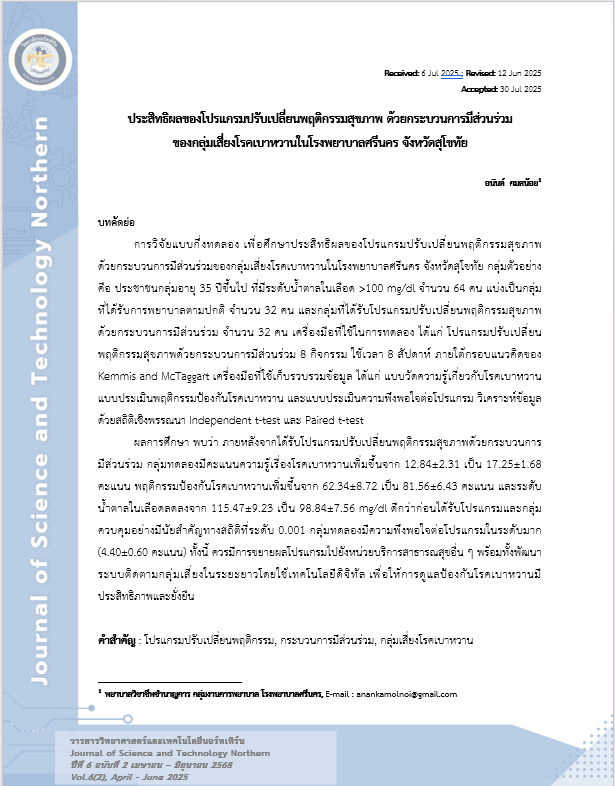
A quasi-experimental research study was conducted to examine the effectiveness of a health behavior change program with participatory process for diabetes risk groups at Sri Nakhon Hospital, Sukhothai Province. The sample consisted of 64 individuals aged 35 years and above with blood glucose levels >100 mg/dl, divided into a control group receiving routine nursing care (n=32) and an experimental group receiving the health behavior change program with participatory process (n=32). The intervention tool was an 8-activity health behavior change program with participatory process implemented over 8 weeks, based on Kemmis and McTaggart's framework. Data collection instruments included a diabetes knowledge assessment questionnaire, a diabetes prevention behavior evaluation form, and a program satisfaction assessment questionnaire. Data were analyzed using descriptive statistics, Independent t-test, and Paired t-test.
Results showed that after receiving the health behavior change program with participatory process, the experimental group demonstrated significantly improved diabetes knowledge scores from 12.84±2.31 to 17.25±1.68 points, diabetes prevention behavior scores from 62.34±8.72 to 81.56±6.43 points, and reduced blood glucose levels from 115.47±9.23 to 98.84±7.56 mg/dl, all significantly better than pre-intervention and control group outcomes at the 0.001 level. The experimental group expressed high satisfaction with the program (4.40±0.60 points).
Therefore, the program should be expanded to other public health service units, along with developing long-term follow-up systems for at-risk groups using digital technology to ensure effective and sustainable diabetes prevention care.
References
เอกสารอ้างอิง
กองโรคไม่ติดต่อ. (2562). รายงานประจำปี 2561: สถานการณ์โรคไม่ติดต่อเรื้อรังของประเทศไทย. นนทบุรี: กรมควบคุมโรค กระทรวงสาธารณสุข.
ชาคริต เขื่อนสุวงค์. (2560). จิตวิทยาแรงจูงใจ. กรุงเทพฯ: สำนักพิมพ์แห่งจุฬาลงกรณ์มหาวิทยาลัย.
ศูนย์เทคโนโลยีสารสนเทศและการสื่อสาร. (12 ธันวาคม 2567). ระบบคลังข้อมูลด้านการแพทย์และสุขภาพ กระทรวงสาธารณสุข HDC. เข้าถึงได้จาก https://hdc.moph.go.th/center/public/kpi/1/2025
สุรชัย โชคครรชิตไชย, สมชาติ สุจริตรังสี และวรัญญาภรณ์ พุ่มคุ้ม. (2567). ผลกระทบของโรคเบาหวานต่อค่าใช้จ่ายและคุณภาพชีวิตของผู้ป่วยในประเทศไทย. วารสารวิชาการสาธารณสุข, 33(1), 45–56.
สมพิศ เกณฑ์สาคู. (2563). ประสิทธิผลโปรแกรมปรับเปลี่ยนพฤติกรรมสุขภาพกลุ่มเสี่ยงโรคเบาหวาน อำเภอโพธิ์ชัย จังหวัดร้อยเอ็ด. มหาสารคาม: วิทยานิพนธ์ปริญญามหาบัณฑิต, มหาวิทยาลัยราชภัฏมหาสารคาม.
สมาพันธ์เบาหวานนานาชาติ. (12 ธันวาคม 2560). IDF Diabetes Atlas (8th ed.). เข้าถึงได้จาก https://diabetesatlas.org
สำนักงานหลักประกันสุขภาพแห่งชาติ. (2561). แนวทางการดูแลผู้ป่วยเบาหวานสำหรับบุคลากรสาธารณสุข. กรุงเทพฯ: สำนักงานหลักประกันสุขภาพแห่งชาติ.
สำนักงานหลักประกันสุขภาพแห่งชาติ. (12 ธันวาคม 2561). รายงานผลการดำเนินงานการควบคุมโรคเบาหวานและความดันโลหิตสูงในระบบหลักประกันสุขภาพถ้วนหน้า. เข้าถึงได้จาก https://www.nhso.go.th
Anderson L. M., Thomas, J. B., & Carter, R. D. (2019). Participatory learning in health promotion: A practice-based approach. Health Promotion Press.
Bandura. (1986). Social foundations of thought and action: A social cognitive theory. Prentice-Hall.
Bernard. (2000). Two Decades of Research and Development in Transformational Leadership. Eueopean Journal of World and Organizational Psychologist, 8, 1.
Bloom. (1971). Taxonomy of Education. New York: David McKay Company Inc.
Garcia M. J., & Lee, H. S. (2022). The effects of integrated participatory programs on glycemic control among high-risk populations. Journal of Health Behavior, 44(2), 101–112.
Martinez P. L., & Kim, Y. H. (2022). Empowering health behavior through knowledge-based engagement programs: A quasi-experimental study. International Journal of Behavioral Medicine, 29(4), 423–432.
Wilson & Chen. (2021). Community-based participatory health behavior programs and their impact on lifestyle changes. Preventive Health Reports, 8(1), 55–63.
Downloads
Published
How to Cite
Issue
Section
License

This work is licensed under a Creative Commons Attribution-NonCommercial-NoDerivatives 4.0 International License.