
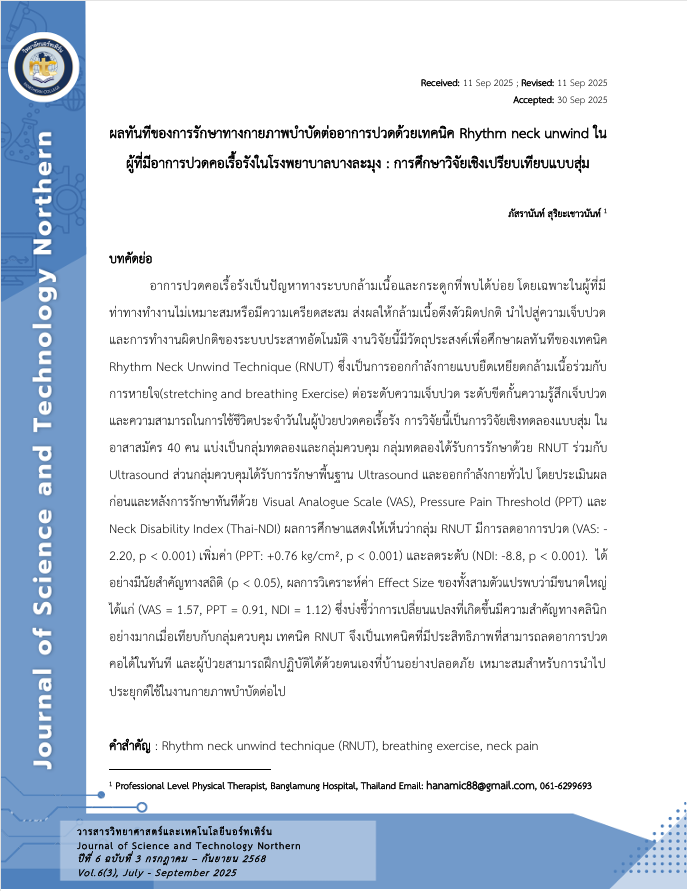
The immediate Effects of physical therapy using a modified Rhythm neck unwind Technique in Patients with Neck pain : A Randomized Controlled Trial
Keywords:
Rhythm neck unwind technique (RNUT), breathing exercise, neck painAbstract
Abstract
Chronic neck pain is a common musculoskeletal disorder often linked to poor posture, prolonged
computer uses and stress. These factors can cause muscular imbalance, ischemia and autonomic dysfunction.
Physical therapy combined with stretching exercises and breathing techniques has been shown to reduce pain
and enhance muscle relaxation.To investigate the immediate effects of the Rhythm Neck Unwind Technique
(RNUT) a stretching exercise integrated with controlled breathing on pain intensity, pressure pain threshold
(PPT), and Neck Disability Index (Thai-NDI) in patients with chronic neck pain. This randomized controlled trial
involved 40 participants with chronic neck pain, divided into an RNUT group (n=20) and a control group
(n=20). The RNUT group received ultrasound therapy combined with the RNUT technique protocol, while the
control group received ultrasound and general exercises. Participants were assessed pre and post intervention
using the Visual Analogue Scale (VAS), Pressure Pain Threshold (PPT), and the Thai version of the Neck
Disability Index (Thai-NDI). Data were analyzed using independent and paired t-tests. The RNUT group showed
significantly greater improvements than the control group. Post intervention, there was a significant reduction
in pain intensity (VAS: -2.20, p < 0.001), increased PPT (+0.76 kg/cm², p < 0.001), and decreased disability
scores (NDI: -8.8, p < 0.001). Effect sizes were large for all variables (VAS = 1.57, PPT = 0.91, NDI = 1.12),
indicating clinical relevance. The Rhythm Neck Unwind Technique effectively reduces pain and functional
disability immediately in chronic neck pain patients. It is a simple, non-invasive technique suitable for self
practice and a promising physical rehabilitation intervention.
References
เอกสารอ้างอิง
Amjed, K. S., Harinad, M., Michelle, G., Sheila, S., & Forough, F. (2013). Is low-level laser therapy in
relieving neck pain effective? Systematic Review and Meta-analysis, 1.
Binder, A. (2007). The diagnosis and treatment of nonspecific neck pain and whiplash. Eura
Medicophys, 43, 79–89.
Bijur, P., Wendy, S., & John, G. (2001). Reliability of the Visual Analog Scale for measurement of
acute pain. Academic Emergency Medicine, 8, 1153–1157.
Boonprakob, Y., Phadungkit, S., Nongharnpitak, S., Srijessadarak, T., Supasatean, W., & Nakhengrit,
C. (2016). Trigger point: Curable or palliative symptoms. Bulletin of Chiang Mai Association
of Medical Sciences, 49(1), 155–166.
Boyraz, I., Yildiz, A., Koc, B., & Sarman, H. (2015). Comparison of high-intensity laser therapy and
ultrasound treatment in the patients with lumbar discopathy. BioMed Research
International, Article ID 304328, 6 pages.
Buttagat, V., Eungpinichpong, W., Chatchawan, U., & Kharmwan, S. (2011). The immediate effects
of traditional Thai massage on heart rate variability and stress-related parameters in
patients with back pain associated with myofascial trigger points. Journal of Bodywork and
Movement Therapies, 15(1), 15–23.
Cagnie, B., Danneels, L., Van Tiggelen, D., De Loose, V., & Cambier, D. (2013). Effect of stretching
and strengthening exercises on neck pain in female office workers: A randomized
controlled trial. Clinical Rehabilitation, 27(9), 823–832.
https://doi.org/10.1177/0269215512456380
Fields, H. L. (2004). State-dependent opioid control of pain. Nature Reviews Neuroscience, 5(7),
–575.
Gross, A. R., Paquin, J. P., Dupont, G., Blanchette, S., Lalonde, P., Cristie, T., et al. (2016).
Exercises for mechanical neck disorders: A Cochrane review update. Manual Therapy, 24,
–45.
Jaipakdee, J., Udol, K., Satitvipawee, P., & Ketumarn, P. (2014). Effects of deep breathing and
muscle relaxation on blood pressure and stress in hypertensive patients. GRC, MMP64,
–1649.
Jasper, D., Wendy, G. B., Bart, S., et al. (2018). Clinical practice guideline for physical therapy
assessment and treatment in patients with nonspecific neck pain. Verhagen, 1–3.
Joseph, A. E., Barman, R. A., Moman, R. N., et al. (2022). Effects of slow deep breathing on acute
clinical pain in adults: A systematic review and meta-analysis of randomized controlled
trials. Journal of Evidence-Based Integrative Medicine, 27, 1–10.
Luksanapruksa, P., Wathana-apisit, T., Wanasinthop, S., et al. (2012). Reliability and validity study
of a Thai version of the Neck Disability Index in patients with neck pain. Journal of the
Medical Association of Thailand, 95(5), 681–688.
Martin, S. L., Kerr, K. L., Bartley, E. J., et al. (2012). Respiration-induced hypoalgesia: Exploration
of potential mechanisms. The Journal of Pain, 13(8), 755–763.
Melzack, R., & Wall, P. D. (1965). Pain mechanisms: A new theory. Science, 150(3699), 971-979.
Orhan, K., & Adham, M. (2010). A model for occupational injury risk assessment of musculoskeletal
discomfort and their frequencies in computer users. Safety Science, 48(7), 868–877.
Rohrig, B., Baptist, J., Wachtlin, D., Kwiecien, R., & Blettner, M. (2010). Sample size calculation in
clinical trials. Deutsches Ärzteblatt International, 107(31–32), 552–556.
Simons, D. G., Travell, J. G., & Simons, L. S. (1999). Travell & Simons’ myofascial pain and
dysfunction: Upper half of body. Philadelphia: Lippincott Williams & Wilkins.
Streeter, C. C., Gerbarg, P. L., Saper, R. B., Ciraulo, D. A., & Brown, R. P. (2012). Effects of yoga on
the autonomic nervous system, gamma-aminobutyric acid, and allostasis in epilepsy,
depression, and post-traumatic stress disorder. Medical Hypotheses, 78(5), 571–579.
Ylinen, J. (2007). Pressure algometry. Australian Journal of Physiotherapy, 53(3), 207.
Zautra, A. J., Fasman, R., Davis, M. C., & Craig, A. D. B. (2010). The effects of slow breathing on
affective responses to pain stimuli: An experimental study. Pain, 149(1), 12–18.
สมชาย รัตนทองคำ. (2544). ไฟฟ้าแสงเสียงและแม่เหล็กไฟฟ้าทางกายภาพบำบัด. ขอนแก่น:
ภาควิชากายภาพบำบัด มหาวิทยาลัยขอนแก่น.
Downloads
Published
How to Cite
Issue
Section
License

This work is licensed under a Creative Commons Attribution-NonCommercial-NoDerivatives 4.0 International License.