
Effects of a Dietary Behavior Modification Program Based on the DASH Approach Combined with Self-Efficacy Theory and Social Support Among Hypertensive Patients at Srinakorn Hospital, Sukhothai Province.
Keywords:
DASH program, Self-efficacy, Social support, Hypertension, Dietary behaviorAbstract
Abstract
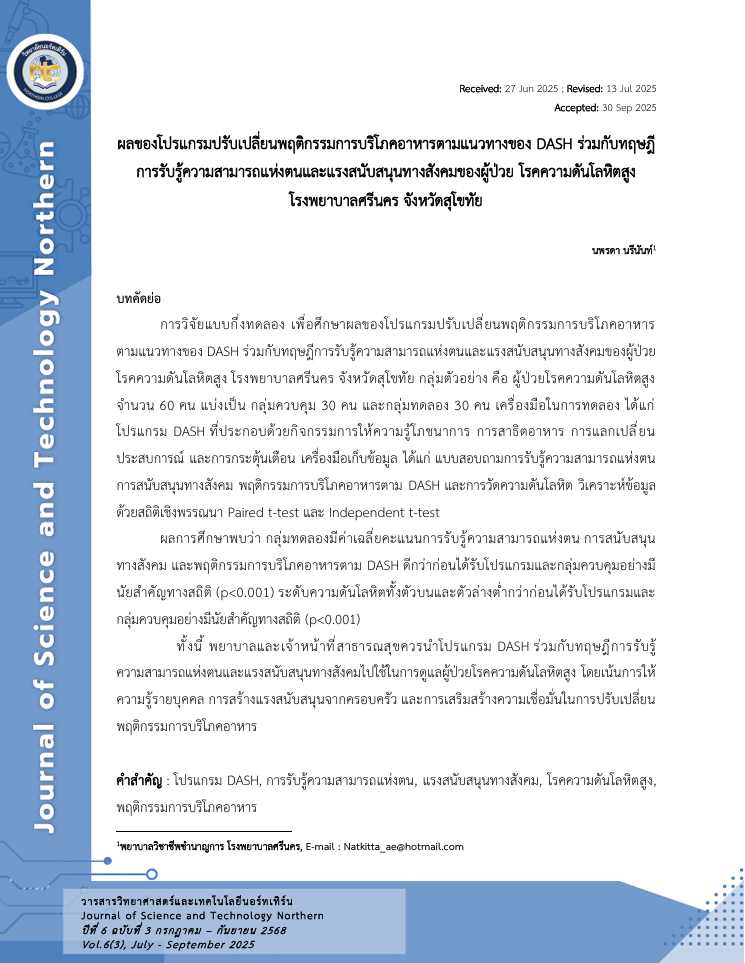
A quasi-experimental research study was conducted to examine the effects of a dietary
behavior modification program based on the DASH approach combined with self-efficacy theory
and social support among hypertensive patients at Srinakorn Hospital, Sukhothai Province. The
sample consisted of 60 hypertensive patients divided into a control group (30 patients) and an
experimental group (30 patients). The intervention tool included the DASH program comprising
nutritional education activities, food demonstrations, experience sharing, and reminder activities.
Data collection instruments included questionnaires on self-efficacy regarding DASH dietary
behavior, social support, DASH dietary behavior, and blood pressure measurements. Data were
analyzed using descriptive statistics, paired t-test, and independent t-test.
The results showed that the experimental group had significantly higher mean scores for
self-efficacy, social support, and DASH dietary behavior compared to pre-intervention and the
control group (p<0.001). Both systolic and diastolic blood pressure levels were significantly lower
than pre-intervention and compared to the control group (p<0.001).
Therefore, nurses and public health personnel should implement the DASH program
combined with self-efficacy theory and social support in caring for hypertensive patients,
emphasizing individualized education, creating family support, and building confidence in dietary
behavior modification.
References
เอกสารอ้างอิง
กองโรคไม่ติดต่อ กรมควบคุมโรค. (2566). รายงานสถานการณ์โรคไม่ติดต่อเรื้อรังประเทศไทย ปี 2565.
กรุงเทพฯ: กรมควบคุมโรค กระทรวงสาธารณสุข.
ธีทัต ศรีมงคล, อารีวรรณ นพเกตุและ ทัศนีย์ วานิชกร. (2560). ผลของโปรแกรมปรับเปลี่ยนพฤติกรรมการบริโภค
อาหารที่ประยุกต์ทฤษฎีแรงจูงใจในการป้องกันโรคต่อพฤติกรรมการบริโภคอาหารของกลุ่มเสี่ยงโรคความ
ดันโลหิตสูง. วารสารวิจัยสาธารณสุขศาสตร์ มหาวิทยาลัยบูรพา, 11(2), 6.
ทินณรงค์ เรทนู. (2562). ผลของโปรแกรมการปรับเปลี่ยนพฤติกรรมที่ประยุกต์แนวคิดทฤษฎีการเปลี่ยน
พฤติกรรมต่อความดันโลหิตของผู้ป่วยโรคความดันโลหิตสูง. ชลบุรี: [วิทยานิพนธ์พยาบาลศาสตรมหา
บัณฑิต, มหาวิทยาลัยบูรพา].
บุญใจ ศรีสถิตธ์นรากูร. (2553). ระเบียบวิธีการวิจัยทางพยาบาลศาสตร์ (พิมพ์ครั้งที่ 5). กรุงเทพฯ: ยูแอนด์ไอ
อินเตอร์ มีเดีย.
ปิยพร ศรีพนมเขต. (2565). ผลของโปรแกรมการปรับเปลี่ยนพฤติกรรมการบริโภคอาหารตามแนวทาง DASH
ร่วมกับทฤษฎีการรับรู้ความสามารถตนเอง ต่อพฤติกรรมการบริโภคอาหารของผู้ป่วยโรคความดันโลหิต
สูง. ขอนแก่น: [วิทยานิพนธ์สาธารณสุขศาสตรมหาบัณฑิต, มหาวิทยาลัยขอนแก่น].
พิชามญช์ ภู ่เจริญ. (2550). ความสัมพันธ์ระหว่างการรับรู้ความสามารถตนเองในการบริโภคอาหารกับพฤติกรรม
การบริโภคอาหารของผู ้ป่วยโรคความดันโลหิตสูง โรงพยาบาลพระพุทธบาท จังหวัดสระบุรี. สระบุรี:
[วิทยานิพนธ์พยาบาลศาสตรมหาบัณฑิต, มหาวิทยาลัยมหิดล].
นริศรา คงแก้ว, วิจิตรา ปานบุญและ สมพร กลัดเจริญ. (2565). ผลของแรงสนับสนุนทางสังคมร่วมกับโปรแกรม
DASH ต่อการมีส่วนร่วมของผู ้ป่วยโรคความดันโลหิตสูงในคลินิกโรคเรื ้อรัง. วารสารพยาบาลกระทรวง
สาธารณสุข, 32(3), 28–39.
สุนทรีย์ คำเพ็ง และอรธิรา บุญประดิษฐ์. (2551). ปัจจัยเสี่ยงต่อการเกิดโรคความดันโลหิตสูงในผู้ใหญ่ตอนต้น.
วารสารสาธารณสุขและการพัฒนา, 6(2), 1–12.
เสาวลักษณ์ มูลสารและ เกษร สำเภาทอง. (2559). วารสารการพยาบาลและสุขภาพ, 10(2). ผลของโปรแกรม
ปรับเปลี ่ยนพฤติกรรมการบริโภคอาหารตามแนวทาง DASH ร่วมกับทฤษฎีการรับรู้ความสามารถตนเอง
ต่อความเชื่อมั่นในการบริโภคอาหารของผู้ป่วยโรคความดันโลหิตสูง, 20–31.
Albert & Bandura. (1997). Self-efficacy: The exercise of control. New York: W.H. Freeman and
Company.
Bloom B. S. (1975). Taxonomy of education. . David McKay Company Inc.
Sacks F. M., Svetkey, L. P., Vollmer, W. M., Appel, L. J., Bray, G. A., Harsha, D., ... & Cutler, J. A.
(2001). Effects on blood pressure of reduced dietary sodium and the Dietary Approaches
to Stop Hypertension (DASH) diet. The New England Journal of Medicine, 344(1), 3–10.
Thoits P. A. (1995). Stress, coping, and social support processes: Where are we? What next? .
Journal of Health and Social Behavior, 35(Extra Issue), , 53–79.
Whelton P. K., Carey, R. M., Aronow, W. S., Casey Jr, D. E., Collins, K. J., Dennison Himmelfarb, C.,
... & Wright Jr, J. T. (2018). Guideline for the Prevention, Detection, Evaluation, and
Management of High Blood Pressure in Adults: A Report of the American College of
Cardiology/American Heart Association Task Force on Clinical Practic Guidelines. Journal
of the American College of Cardiology, 71(19), e127–e248.
Downloads
Published
How to Cite
Issue
Section
License

This work is licensed under a Creative Commons Attribution-NonCommercial-NoDerivatives 4.0 International License.