
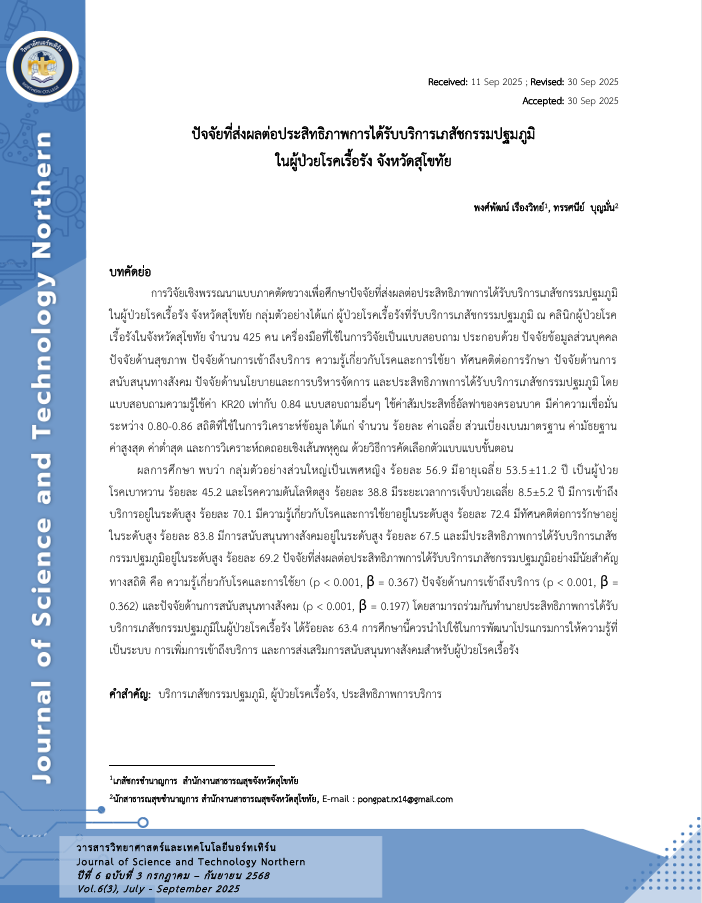
Factors Affecting the Effectiveness of Primary Pharmaceutical Care Services Among Chronic Disease Patients in Sukhothai Province.
Keywords:
Primary pharmaceutical care services, Chronic disease patients, Service effectivenessAbstract
ABSTRACT
A cross-sectional descriptive research study was conducted to examine factors affecting the effectiveness of primary pharmaceutical care services among chronic disease patients in Sukhothai Province. The sample consisted of 425 chronic disease patients receiving primary pharmaceutical care services at chronic disease clinics in Sukhothai Province. The research instruments were questionnaires comprising personal demographic factors, health factors, service accessibility factors, knowledge about disease and medication use, attitudes toward treatment, social support factors, policy and management factors, and effectiveness of primary pharmaceutical care services. The knowledge questionnaire used KR20 reliability coefficient of 0.84, while other questionnaires used Cronbach's alpha reliability coefficients ranging from 0.80-0.86. Statistical analyses included frequency, percentage, mean, standard deviation, median, maximum, minimum values, and stepwise multiple linear regression analysis.
The results showed that the majority of participants were female (56.9%) with a mean age of 53.5±11.2 years. The predominant conditions were diabetes mellitus (45.2%) and hypertension (38.8%), with an average illness duration of 8.5±5.2 years. High levels were observed for service accessibility (70.1%), knowledge about disease and medication use (72.4%), attitudes toward treatment (83.8%), social support (67.5%), and effectiveness of primary pharmaceutical care services (69.2%). Factors significantly affecting the effectiveness of primary pharmaceutical care services were knowledge about disease and medication use (p < 0.001, β = 0.367), service accessibility factors (p < 0.001, β = 0.362), and social support factors (p < 0.001, β = 0.197). These factors together predicted 63.4% of the variance in the effectiveness of primary pharmaceutical care services among chronic disease patients. This study should be applied to develop systematic knowledge-providing programs, enhance service accessibility, and promote social support for chronic disease patients.
References
เอกสารอ้างอิง
กระทรวงสาธารณสุข. (2563). รายงานสถิติสาธารณสุขประจำปี 2563. นนทบุรี: สำนักงานปลัดกระทรวงสาธารณสุข.
ทรงวุฒิ สารจันทึก. (2564). ความคาดหวังกับการรับรู้คุณภาพการบริการเภสัชกรรมปฐมภูมิในผู้ป่วยเบาหวานชนิดที่ 2 ในจังหวัดสระบุรี. เชียงรายวารสาร, 13(3), 17-32.
สำนักงานสาธารณสุขจังหวัดสุโขทัย. (2563). รายงานข้อมูลสุขภาพจังหวัดสุโขทัย ปี 2563. สุโขทัย: สำนักงานสาธารณสุขจังหวัดสุโขทัย.
สำนักงานสาธารณสุขจังหวัดสุโขทัย. (2566). แผนยุทธศาสตร์การพัฒนาระบบบริการสุขภาพระดับปฐมภูมิ จังหวัดสุโขทัย ปีงบประมาณ 2566. สุโขทัย: สำนักงานสาธารณสุขจังหวัดสุโขทัย.
Bloom. (1968). Taxonomy of Education. New York: David McKay Company Inc.
Bender D. E., & Ewbank, D. (1994). The focus group as a tool for health research: Issues in design and analysis. Health Transition Review, 4(1), 63–80.
Daniel. (1995). Biostatistics: A foundation for analysis in the health sciences. New York: Wiley & Sons.
Greer N., Bolduc, J., Geurkink, E., Rector, T., Olson, K., Koeller, E., ... & Wilt, T. J. (2016). Pharmacist-led chronic disease management: A systematic review of effectiveness and harms compared with usual care. Annals of Internal Medicine, 165(1), 30-40.
Lindlof T. R. (1995). Qualitative communication research methods. Thousand Oaks: SAGE Publications.
Liu Y., Zhang, M., Luo, Q., & Shen, Y. (2022). Effects of pharmacist-led interventions on medication adherence in patients with type 2 diabetes mellitus and hypertension:
A randomized controlled trial using WeChat. BMC Health Services Research, 22, 1025.
Minhat H. S. (2015). Determinants for effective primary healthcare delivery: A review. International Journal of Public Health Research, 5(1), 1–7.
Ridde V., Pérez, D., & Robert, E. (2020). Primary health care: A strategic framework for health system strengthening. Geneva: World Health Organization.
Smith F. J., Khan, T. M., & Sheikh, A. (2019). Role of pharmacists in primary health care. Journal of Pharmaceutical Health Services Research, 10(2), 123–130.
Sookaneknun P., Saramunee, K., & Suksaeree, J. (2010). Economic analysis of screening services in community pharmacies compared to public primary care settings in Thailand. Value in Health Regional Issues, 1(1), 118–122.
Smith S. M., Wallace, E., O’Dowd, T., & Fortin, M. (2015). Interventions for improving outcomes in patients with multimorbidity in primary care and community settings. Cochrane Database of Systematic Reviews, 3, 650.
Sleath B., Rubin, R. H., Campbell, W., Gwyther, L., & Clark, T. (2000). Physician–patient communication about over-the-counter medications. Social Science & Medicine, 50(4), 567–576.
Wagner E. H., Austin, B. T., & Von Korff, M. (2001). Improving chronic illness care: Translating evidence into action. Health Affairs, 20(6), 64–78.
World Health Organization. (2021). Active Aging:A policy framework. เข้าถึงได้จาก https://iris.who.int/bitstream/handle
Xie W., Wang, Y., Wang, X., & Lu, Q. (2017). Effects of pharmaceutical care on clinical outcomes of outpatients with type 2 diabetes mellitus. Patient Preference and Adherence, 11, 1193–1199.
Downloads
Published
How to Cite
Issue
Section
License

This work is licensed under a Creative Commons Attribution-NonCommercial-NoDerivatives 4.0 International License.