
The Effectiveness of Behavior Modification Program to Prevent and Control Dengue Fever among Head of Household in Sukhothai Thanee Municipality, Sukhothai Province
Keywords:
Behavioral Modification Program, Dengue Fever Prevention and Control, Household HeadsAbstract
Abstract
This quasi-experimental study employed a one-group pretest–posttest design.
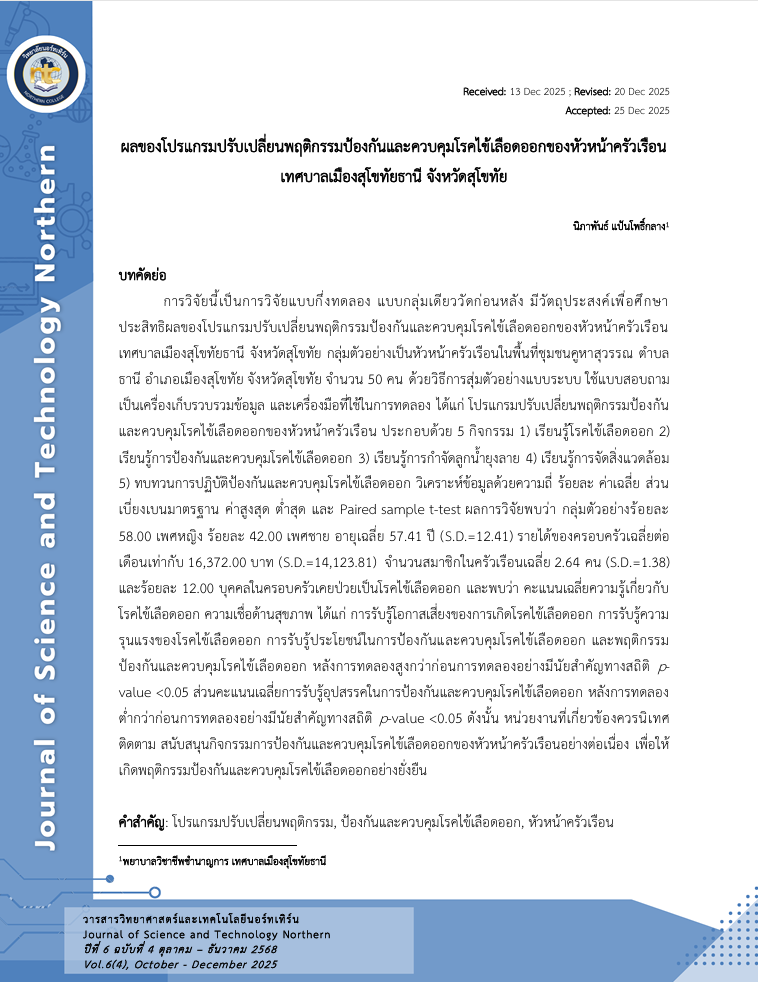
The objective was to examine the effectiveness of a behavioral modification program for the prevention and control of dengue fever among household heads residing in Sukhothai Thani Municipality, Sukhothai Province. The sample consisted of 50 household heads living in the Kuhasuwan community, Thani Subdistrict, Mueang Sukhothai District, selected through systematic sampling. Data were collected using a questionnaire. The experimental tool was the behavioral modification program for dengue fever prevention and control among household heads. The program consisted of five activities: 1) Learning about dengue fever 2) Learning about dengue prevention and control 3) Learning about Aedes larval elimination 4) Learning about environmental management and 5) Reviewing dengue prevention and control practices. Data were analyzed using descriptive statistics and paired sample t-test. The results showed that 58.00% of the participants were female and 42.00% were male. The average age was 57.41 years (S.D. = 12.41). The mean monthly household income was 16,372.00 baht (S.D. = 14,123.81). The average household size was 2.64 members (S.D. = 1.38), and 12.00% reported that a family member had previously been infected with dengue fever. The findings revealed that the mean scores for dengue fever knowledge, health beliefs including perceived susceptibility, perceived severity, and perceived benefits of dengue prevention and control and dengue prevention and control behaviors were significantly higher after the intervention than before (p-value < 0.05). Conversely, the mean score for perceived barriers to dengue prevention and control was significantly lower after the intervention (p-value < 0.05). Therefore, relevant agencies should continuously monitor, supervise, and support dengue prevention and control activities among household heads to promote sustainable preventive behaviors.
References
เอกสารอ้างอิง
เกตุศิริ จันทนูศร. (2565). โปรแกรมเสริมสร้างแรงจูงใจต่อพฤติกรรมการป้องกันและควบคุมโรคไข้เลือดออกของประชาชน ตำบลทุ่งใหญ่ อำเภอโพธิ์ประทับช้าง จังหวัดพิจิตร. วิทยานิพนธ์สาธารณสุขศาสตรมหาบัณฑิต มหาวิทยาลัยนเรศวร.
กรมควบคุมโรค. (2565). รายงานพยากรณ์โรคไข้เลือดออก ปี 2565. สืบค้นเมื่อ 7 มกราคม 2567 จาก https://ddc.moph.go.th/dvb/forecast_detail.php?publish=12129.
กรมควบคุมโรค. (2566). สรุปรายงานเหตุการณ์ที่สำคัญทางระบาดวิทยา ประจำสัปดาห์ที่ 46 ระหว่างวันที่ 22 – 28 ตุลาคม 2566. สืบค้นเมื่อ 7 มกราคม 2567 จากhttps://ddc.moph.go.th/uploads/publish/1499920231120022443.pdf.
จินดาพร จันทร์เทศ. (2565). ประสิทธิผลของโปรแกรมการประยุกต์ใช้ทฤษฎีแรงจูงใจเพื่อป้องกันโรค ต่อพฤติกรรมการ ป้องกันโรคไข้เลือดออกของนักเรียนชั้นประถมศึกษาตอนปลาย อำเภอเมือง จังหวัดพิจิตร. วิทยานิพนธ์สาธารณสุขศาสตรมหาบัณฑิต มหาวิทยาลัยนเรศวร.
นิพิฐพนธ์ สนิทเหลือ วัชรีพร สาตร์เพ็ชร์ และญาดา นภาอารักษ์. (2562). การคำนวณขนาดตัวอย่างด้วยโปรแกรมสำเร็จรูป G*POWER. วารสารวิชาการสถาบันเทคโนโลยีแห่งสุวรรณภูมิ, 5(1) : 496-506.
นิรุจน์ แก้วกรี. (2568). ประสิทธิผลโปรแกรมการป้องกันและควบคุมโรคไข้เลือดออกของอาสาสมัครสาธารณสุขประจำ หมู่บ้านในเขตโรงพยาบาลส่งเสริมสุขภาพตำบลวังแดง จังหวัดอุตรดิตถ์. วารสารวิทยาศาสตร์และเทคโนโลยีนอร์ทเทิร์น, 6(1), 100-116.
ปรรณพัชร์ วงศ์ธีราพงษ์. (2565). ประสิทธิผลของโปรแกรมปรับเปลี่ยนพฤติกรรมป้องกันและควบคุมโรคไข้เลือดออกของประชาชนในพื้นที่สวนมะม่วง ตำบลวังทับไทร อำเภอสากเหล็ก จังหวัดพิจิตร. วิทยานิพนธ์สาธารณสุขศาสตรมหาบัณฑิต มหาวิทยาลัยนเรศวร.
ศิรินันท์ คำสี. (2559). พฤติกรรมการป้องกันโรคไข้เลือดออกของประชาชนในเขตพื้นที่รับผิดชอบของ โรงพยาบาลส่งเสริมสุขภาพตำบลบ้านเทพนิมิต จังหวัดจันทบุรี. วารสารสหเวชศาสตร์ มหาวิทยาลัยราชภัฏสวนสุนันทา, 63(8), 63-68.
ศิริวรรณ เกาะกัณหา อังคณา ทองโกมุทและนิธิพงศ์ ศรีเบญจมาศ. (2564). ผลของโปรแกรมการป้องกันโรคไข้เลือดออกโดยการมีส่วนร่วมของชุมชนตำบลบ้านนา อำเภอวชิรบารมี จังหวัดพิจิตร.วารสารวิชาการมหาวิทยาลัยอีสเทิร์นเอเชียฉบับวิทยาศาสตร์และเทคโนโลยี, 15(1), 142-154.
สมาคมโรคติดเชื้อในเด็กแห่งประเทศไทย. (2566). สถานการณ์การระบาดและเสียชีวิตจากโรคไข้เลือดออก สืบค้นเมื่อ 7 มกราคม 2567 จาก https://www.pidst.or.th/A1271.html.
สุภาภรณ์ สุดหนองบัว ปราโมทย์ วงสวัสดิ์ ชูชาติ ดีมั่น อัจฉราพร เคราะห์ดี และพงษ์ศักดิ์ อ้นมอย. (2559). ปัจจัยที่มีความสัมพันธ์กับการปฏิบัติตนในการป้องกันโรคไข้เลือดออกของประชาชน ตำบลทับยายเชียง อำเภอพรหมพิราม จังหวัดพิษณุโลก. วารสารการพยาบาลและสุขภาพ, 10(1), 153-162.
สำนักงานสาธารณสุขจังหวัดสุโขทัย. (2565). รายงานประจำปี 2564. สุโขทัย : สำนักงานสาธารณสุขจังหวัดสุโขทัย.
Best, John W. (1977). Research in education. (3rd ed.). New Jersey : Prentice Hall.
Bloom BS. (1971). Handbook on formation and Summative Evaluation of Student Learning. New York: McGraw-Hill Book Company.
Rosenstock, I. M., Strecher, V. J., & Becker, M. H. (1988). Social learning theory and the health belief model. Health Education Quarterly, 15, 175-183. doi:10.1177/109019818801500203.
Siddiqui, T. R., Ghazal, S., Bibi, S., Ahmed, W., & Sajjad, S. F. (2016). Use of the health belief model for the assessment of public knowledge and household preventive practices in karachi, pakistan, a dengue-endemic city. PLoS neglected tropical diseases, 10(11), e0005129.
Wong, L. P., & AbuBakar, S. (2013). Health beliefs and practices related to dengue fever: A focus group study. PLoS neglected tropical diseases, 7(7), e2310.
Downloads
Published
How to Cite
Issue
Section
License

This work is licensed under a Creative Commons Attribution-NonCommercial-NoDerivatives 4.0 International License.