
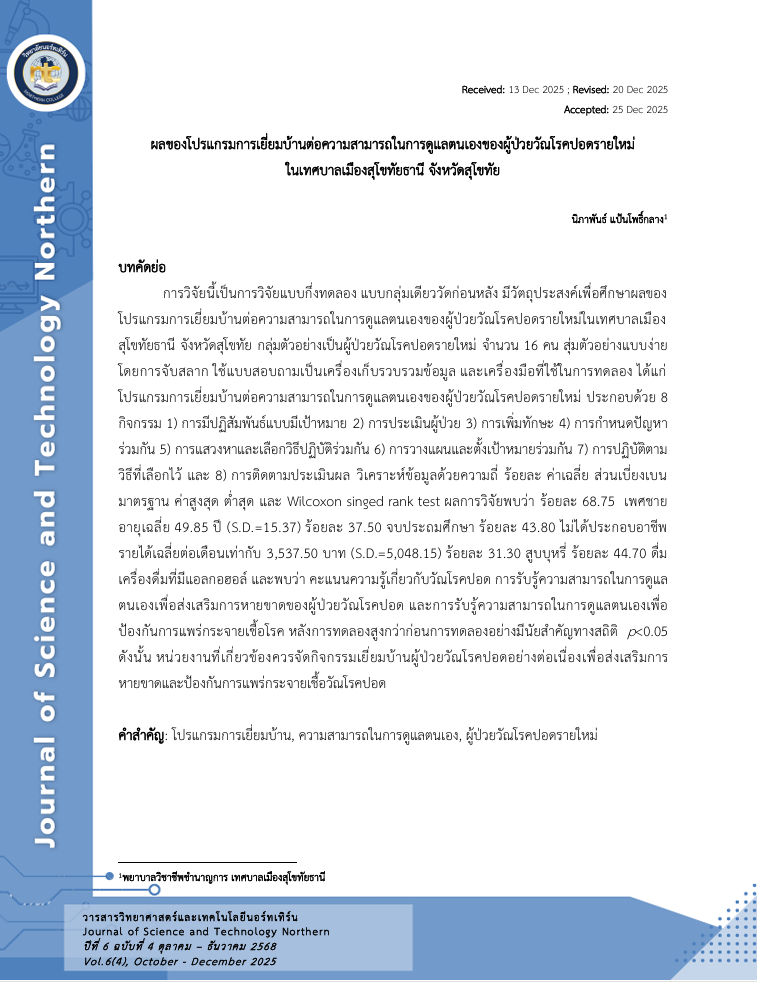
The Effectiveness of Home Visit Program for Enhancing Self Care Capabilities among New case of Pulmonary Tuberculosis Patients in Sukhothai Thanee Municipality, Sukhothai Province
Keywords:
Home-visit program, Self-care ability, Newly diagnosed pulmonary tuberculosis patientsAbstract
Abstract
This quasi-experimental research employed a one-group pretest–posttest design to examine the effects of a home-visit program on self-care ability among newly diagnosed pulmonary tuberculosis patients in Sukhothai Thani Municipality, Sukhothai Province. The sample consisted of 16 newly diagnosed pulmonary tuberculosis patients selected through simple random sampling. Data were collected using a structured questionnaire, and the intervention consisted of a home-visit program designed to enhance self-care ability. The program comprised eight activities: (1) goal-oriented interaction, (2) patient assessment, (3) skills enhancement, (4) joint problem identification, (5) collaborative exploration and selection of practices, (6) joint planning and goal setting, (7) implementation of selected practices, and (8) follow-up and evaluation. Data were analyzed using frequency, percentage, mean, standard deviation, minimum and maximum values, and the Wilcoxon signed-rank test. Results showed that 68.75% of participants were male, with a mean age of 49.85 years (SD = 15.37). Of the participants, 37.50% had completed primary education, 43.80% were unemployed, and the average monthly income was 3,537.50 Baht (SD = 5,048.15). Additionally, 31.30% reported smoking and 44.70% reported alcohol consumption. After the intervention, participants demonstrated significantly higher scores in knowledge about pulmonary tuberculosis, perceived self-care ability related to promoting recovery, and perceived self-care ability related to preventing disease transmission compared to pre-intervention scores (p<0.05). These findings suggest that continuous home-visit programs should be implemented by relevant agencies to promote recovery and prevent the transmission of pulmonary tuberculosis.
References
เอกสารอ้างอิง
กรมควบคุมโรค. (2559). ผลการดำเนินงานควบคุมวัณโรคประเทศไทย พ.ศ.2552-2558.
กรุงเทพฯ : สำนักวัณโรค กรมควบคุมโรค กระทรวงสาธารณสุข.
กรมควบคุมโรค. (2564). รายงานสถานการณ์และการเฝ้าระวังวัณโรคประเทศไทย ปีงบประมาณ พ.ศ.2564. สืบค้นเมื่อ 17 พฤษภาคม 2567 จาก https://www.tbthailand.org/download/form.
จุฬาวรรณ จิตดอน, วนิดา ดุรงฤทธิชัยและกมลทิพย์ ขลังธรรมเนียม. (2560). การพัฒนาแนวทางการเยี่ยมบ้านผู้ป่วยวัณโรคปอดที่รักษาด้วยระบบยาระยะสั้น อำเภอเมือง จังหวัดสมุทรปราการ. วารสาร มฉก.วิชาการ, 20(40) : 1-11.
นิพิฐพนธ์ สนิทเหลือ, วัชรีพร สาตร์เพ็ชร์, และญาดา นภาอารักษ์. (2562). การคำนวณขนาดตัวอย่างด้วยโปรแกรมสำเร็จรูป G*POWER. วารสารวิชาการสถาบันเทคโนโลยีแห่งสุวรรณภูมิ, 5(1) : 496-506.
ประดิษฐ์ ปฐวีศรีสุธา. (2564). ผลของโปรแกรมการให้ความรู้และการรักษาภายใต้การสังเกตโดยตรง โดยใช้แอปพลิเคชันไลน์ต่อการรับประทานยาอย่างต่อเนื่องในผู้ป่วยวัณโรคปอด.วารสารวิจัยและพัฒนาระบบสุขภาพ, 14(2) : 301-309.
ไพรัช ม่วงศรี. (2555). ประสิทธิผลของการเยี่ยมบ้านภายใต้ทฤษฎีการพยาบาลของโอเรมต่อความสามารถในการดูแลตนเองของผู้ป่วยวัณโรคปอดเสมหะพบเชื้อรายใหม่. วิทยานิพนธ์พยาบาลศาสตรมหาบัณฑิต มหาวิทยาลัยหัวเฉียวเฉลิมพระเกียรติ.
สายชล ศรีสวัสดิ์. (2562). ผลของการเยี่ยมบ้านต่อการดูแลตนเองของผู้ป่วยวัณโรค. วารสารการพยาบาลชุมชน, 11(2), 152-164.
สำนักงานป้องกันควบคุมโรคที่ 2. (2562). สรุปผลการดำเนินงานวัณโรค ปี 2562 เขตสุขภาพที่ 2 พิษณุโลก :สำนักงานป้องกันควบคุมโรคที่ 2.
สำนักวัณโรค. (2561). แนวทางการดำเนินงานควบคุมวัณโรคแห่งชาติ พ.ศ.2561. นนทบุรี : กรมควบคุมโรค กระทรวงสาธารณสุข.
Amuha, M.G., Kutyabami P., Kitutu, F.E., OdoiAdome, R., Kalyango, J.N. (2009). Non-adherence to anti-TB drugs among TB/HIV co-infected patients in Mbarara Hospital Uganda: Prevalence and associated factors. African HealthSciences. 9(2), 8-15.
Bandura, A. (1988). Self-efficacy: Toward a unifying theory of behavioral change. Psychological Review. 84(2), 191-215.
King, I. M. (1981). A Theory for Nursing: Systems, Concept, Process. New York: A Wiley Medical Publication.
Munro, S. A., Lewin, S. A., Smith, H. J., Engel, M. E., Fretheim, A., & Volmink, J. (2007). Patient adherence to tuberculosis treatment: A systematic review of qualitative research. PLoS Medicine, 4(7), 1230–1245. https://doi.org/10.1371/journal.pmed.0040238
Orem, D. E. (2001). Nursing: Concepts of Practice. (6th ed.) St. Louis: Mosby.
Wang, L., Zhang, H., Lu, W., Wang, X., Lu, J., & Cheng, S. (2019). Home-visit interventions for improving TB treatment outcomes: A systematic review and meta-analysis. The International Journal of Tuberculosis and Lung Disease, 23(3), 360-372.
World Health Organization. (2020). Global tuberculosis report 2020. Retrieved September, 2, 2023, from https://www.who.int/publications/i/item/9789240013131.
World Health Organization. (2023). Global tuberculosis report 2023. World Health Organization. https://www.who.int/publications/i/item/9789240083851.
Downloads
Published
How to Cite
Issue
Section
License

This work is licensed under a Creative Commons Attribution-NonCommercial-NoDerivatives 4.0 International License.