
Effectiveness of a mental strengthening program for depression prevention among elderly people
Keywords:
mental strengthening program, depression, elderlyAbstract
ABSTRACT
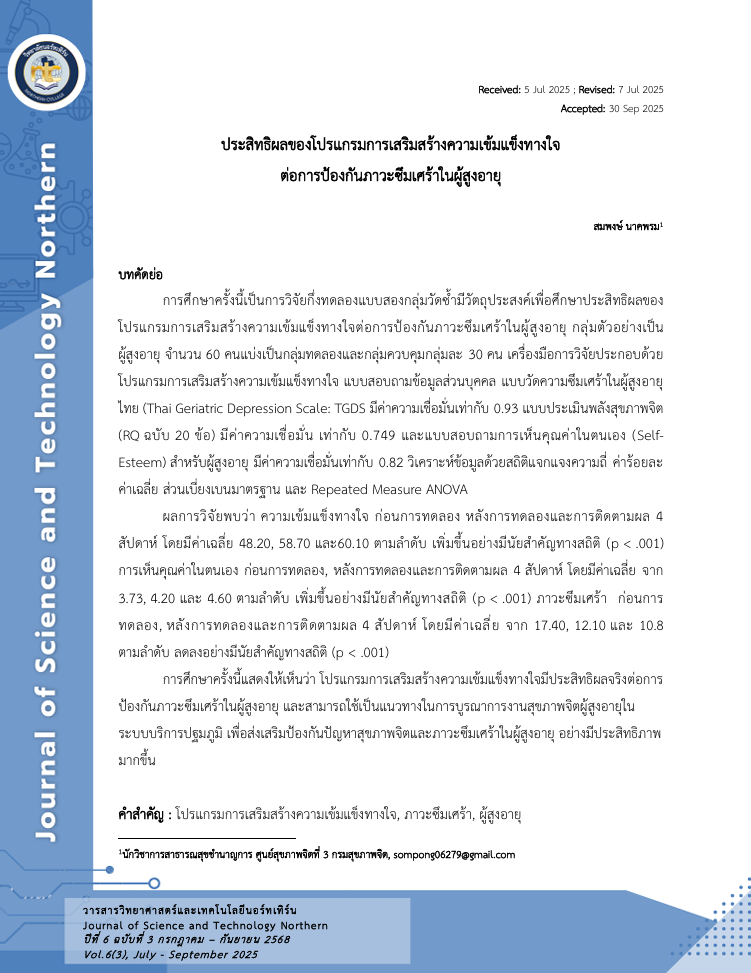
This quasi-experimental research with a two-group pretest-posttest design aimed to study the Effectiveness of a mental strengthening program for depression prevention among elderly people. Participants were 60 elderly people. Participants were randomized to the experimental group (n=30) and the control group (n=30). The research instruments comprised the mental strengthening program, the personal information questionnaire, Thai Geriatric Depression Scale: TGDS with reliability as .93, the Resilience Quotient Questionnaire (RQ 20 items) with reliability as .749, and the self-esteem questionnaire for elderly people with reliability as .82. Data were analyzed by frequency, percentage, mean, standard deviation and Repeated Measure ANOVA.
The research results revealed that. Resilience before the experiment, after the experiment, and at the 4-week follow-up, showed a statistically significant increase (p < .001) with mean scores of 48.20, 58.70, and 60.10, respectively. Self-esteem before the experiment, after the experiment, and at the 4-week follow-up, showed a statistically significant increase (p < .001) with mean scores of 3.73, 4.20 and 4.60, respectively. Depression before the experiment, after the experiment, and at the 4-week follow-up, showed a statistically significant decrease (p < .001) with mean scores of 17.40, 12.10, and 10.80, respectively.
This study suggested that mental strengthening program are effective in preventing depression in elderly people and can be used as a guideline for integrating Mental Health of the Elderly services into primary care systems to more effectively promote and prevent mental health problems and depression in elderly people.
References
เอกสารอ้างอิง
กรมสุขภาพจิต. (2563). หลักสูตรเสริมสร้างพลังใจ อึด ฮึด สู้. สำนักวิชาการสุขภาพจิต. กรมสุขภาพจิต
กระทรวงสาธารณสุข. นนทบุรี.
กลุ่มฟื้นฟูสมรรถภาพสมอง. (2536). แบบทดสอบสมรรถภาพสมองของไทย. สารศิริราช, 45(6), 359-374.
กองตรวจราชการ. (2566). รายงานการตรวจราชการกระทรวงสาธารณสุข ประจำปีงบประมาณ พ.ศ.2566 เขตสุขภาพที่ 3. กระทรวงสาธารณสุข. นนทบุรี.
จุฑารัตน์ ธีรปัญญานนท์. (2561). ผลของโปรแกรมส่งเสริมสุขภาพจิตตามแนวพุทธต่อภาวะซึมเศร้าใผู้สูงอายุ.
วารสารพยาบาลจิตเวชและสุขภาพจิต, 32(2), 14-27.
นวลอนงค์ ผลบุญ, และศศิธร ธรรมพนิช. (2561). ผลของโปรแกรมส่งเสริมความเข้มแข็งทางใจต่อการเห็น
คุณค่าในตนเองของผู้สูงอายุที่มีความเสี่ยงภาวะซึมเศร้า. วารสารสาธารณสุขศาสตร์, 48(2), 123-136.
ระบบคลังข้อมูลด้านการแพทย์และสุขภาพ. (2567). จำนวนและร้อยละผู้ใช้บริการที่มีความผิดปกติทางจิตและพฤติกรรมและผู้ที่ตั้งใจทำร้ายตนเอง จำแนกตามกลุ่มอายุ. เข้าถึงเมื่อ 5 ตุลาคม 2567, จาก https://shorturl.asia/m8e5p
วรลักษณ์ ไพบูลย์, และชโลธร แสงอรุณ. (2562). ผลของโปรแกรมการเสริมสร้างพลังสุขภาพจิตต่อภาวะ
ซึมเศร้าในผู้สูงอายุ. วารสารพยาบาลสาร, 46(3), 45-58.
ศิริกาญจน์ เรืองฤทธิ์. (2562). ปัจจัยทำนายภาวะซึมเศร้าในผู้สูงอายุไทย. วารสารพฤติกรรมศาสตร์, 25(2), 112-125.
ศูนย์เฝ้าระวังป้องกันการฆ่าตัวตาย. (2566). รายงานอัตราการฆ่าตัวตายของประเทศไทย. กรมสุขภาพจิต
กระทรวงสาธารณสุข. นนทบุรี.
ศูนย์สุขภาพจิตที่ 3 กรมสุขภาพจิต. (2566). รายงานผลการดำเนินงานศูนย์สุขภาพจิตที่ 3 ปีงบประมาณ
เข้าถึงเมื่อ 11 ตุลาคม 2567, จาก https://mhc3.dmh.go.th/2566.pdf
สุนีย์ ศรีอุดม. (2563). ผลของกิจกรรมส่งเสริมสุขภาพจิตชุมชนต่อความเข้มแข็งทางใจและภาวะซึมเศร้าใน
ผู้สูงอายุ. วารสารวิจัยสาธารณสุขศาสตร์, 13(1), 23–34.
สมพร สันติวัฒนกุล. (2560). ผลของโปรแกรมฝึกสติแบบกลุ่มต่อความเครียดและภาวะซึมเศร้าในผู้สูงอายุ.
วารสารสุขภาพจิตแห่งประเทศไทย, 25(1), 47-60.
Beck, A. T., Rush, A., Shaw, B., & Emery, G. (1979). Cognitive Therapy of Depression. New York: The Guilford Press.
Coopersmith, S. (1984). SEI : Self-Esteem Inventories. California : Consulting Psychologist Press,Inc
Grotberg, E. H. (1999). Countering depression with the five building blocks of resilience. Reaching
Today Youth, 4(1), 66-72.
Grotberg, E. H. (2003). Resilience for Today: Gaining Strength from Adversity. Greenwood:
Praeger Publishers.
Khuannet, P, Dangdomyout, P., & Upasen, R. (2018). The Effect of Resilience Enhancement
Program onSelf-Esteem Patients with Major Depressive Disorders. Journal of Psychiatric and Mental Health, 32(2), 39-51.
Luthar, S. S., Cicchetti, D., & Becker, B. (2000). The construct of resilience: A critical
evaluation and guidelines for future work. Child Development. 71(3), 543-562
Pliendkerd, P. (2014). Depressive disorder: Nurses role in nursing care. Journal of The Royal
Thai Army Nurses, 15(1), 18-20.
Polit, D. F., & Back, C. T. (2004). Nursing research: Principles and method (7th ed.).
Philadelphia : Lippincott.
Program onSuicidal Ideation in Suicidal Attempter. Journal of Psychiatric and Mental
Health, 28(1), 121-131.
Siriphanich, B. (2016). Situation of The Thai Elderly. Foundation of Thai Gerontology
Researchand Development Institute. Bangkok : Printery Ltd.
Wagnild, G. & Young, H. M. (1993). Development and psychometric evaluation of the
Resilience Scale. Journal of Nursing Measurement, 1(2), 165-178.
World Health Organization. (2018). Depression. Retrieved October 11, 2024, from http://www.emro.who.int/health-topics/depression/index.html
Downloads
Published
How to Cite
Issue
Section
License

This work is licensed under a Creative Commons Attribution-NonCommercial-NoDerivatives 4.0 International License.