
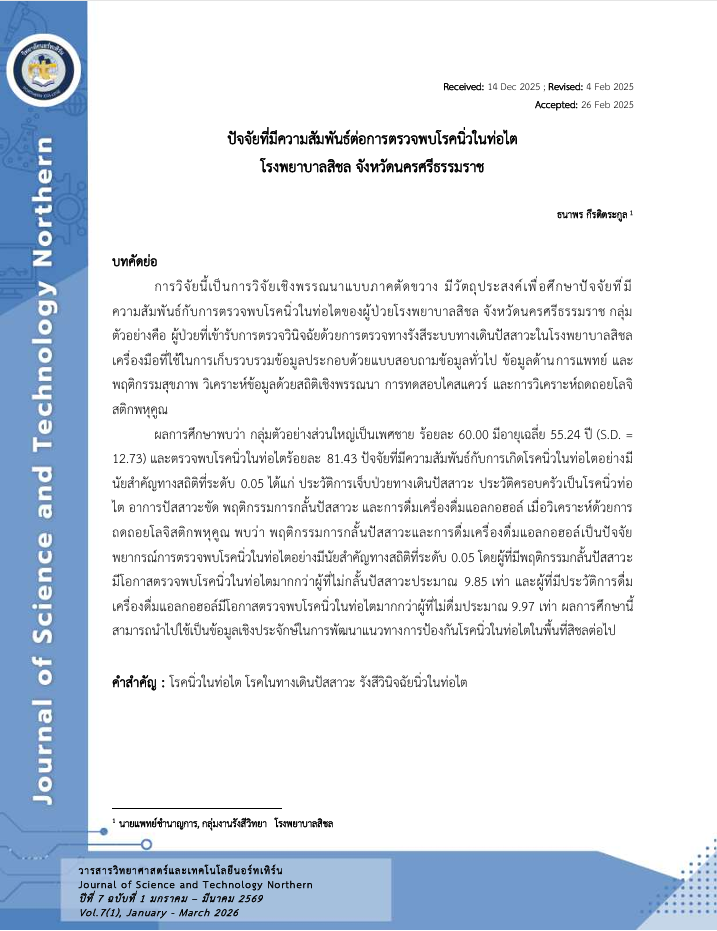
Factors Associated with Ureteral Stone Detection at Sichon Hospital, Nakhon Si Thammarat Province
Keywords:
Ureteral Stone, Urinary Tract Diseases, Radiologic Diagnosis of Ureteral StonesAbstract
Abstract
This study was a descriptive cross-sectional study aimed at examining factors associated with the detection of ureteral stones among patients at Sichon Hospital, Nakhon Si Thammarat Province. The study sample consisted of patients who underwent diagnostic evaluation using urinary tract radiological imaging at Sichon Hospital. The instruments used for data collection included questionnaires on general characteristics, medical information, and health-related behaviors. Data were analyzed using descriptive statistics, the chi-square test, and multiple logistic regression analysis.
The results showed that the majority of the participants were male in 60.00%, with a mean age of 55.24 years (S.D. = 12.73), and 81.43% were diagnosed with ureteral stones. Factors significantly associated with the occurrence of ureteral stones at the 0.05 level included a history of urinary tract disease, a family history of ureteral stones, dysuria, urinary retention behavior, and alcohol consumption. Multiple logistic regression analysis revealed that urinary retention behavior and alcohol consumption were significant predictors of ureteral stone detection at the 0.05 significance level. Patients with urinary retention behavior were approximately 9.85 times more likely to have ureteral stones than those without such behavior, and patients with a history of alcohol consumption were approximately 9.97 times more likely to be diagnosed with ureteral stones than those without alcohol consumption. The findings of this study can be used as empirical evidence to inform the development of preventive strategies for ureteral stone disease in the Sichon district.
References
เอกสารอ้างอิง
กรมการแพทย์. (2565). แนวทางการวินิจฉัยและรักษาโรคนิ่วในระบบทางเดินปัสสาวะ [Guideline]. กรมการแพทย์. https://ddc.moph.go.th/uploads/publish/1308820220905025852.pdf
กรมการแพทย์. (2563). แนวทางการดูแลรักษาโรคนิ่วในระบบทางเดินปัสสาวะ. กระทรวงสาธารณสุข.
กระทรวงสาธารณสุข.(2566.รายงานสถิติการเจ็บป่วยของประชากรไทย พ.ศ. 2562–2566 [Annual morbidity report]. สำนักนโยบายและยุทธศาสตร์, กระทรวงสาธารณสุข. https://apps doe.moph.go.th/boeeng/annual/Annual/Annual_Report_2565.pdf
ชมพูนุช ธงทอง.(2564). ความชุกของโรคนิ่วในท่อไตที่ตรวจด้วยเครื่องเอกซเรย์คอมพิวเตอร์ระบบทางเดินปัสสาวะแบบไม่ใช้สารทึบรังสี ในโรงพยาบาลพระนครศรีอยุธยา. วารสารวิชาการแพทย์และสาธารณสุข เขตสุขภาพที่ 3 18 (3):17-187. https://thaidj.org/index.php/smj/article/view/10536
โรงพยาบาลสิชล. (2566). รายงานสถานการณ์โรคนิ่วในท่อไตในพื้นที่อำเภอสิชล ประจำปี 2566
โรงพยาบาลสิชล. (2567). ข้อมูลบริการผู้ป่วยนิ่วท่อไต ประจำปี 2564-2566
สุนทรา เลี้ยงเชวงวงศ์. (2563). การศึกษาเปรียบเทียบปัจจัยเสี่ยงต่อการเกิดโรคนิ่วไตและอาการเตือนของโรคนิ่วไต และอำนาจการทำนายปัจจัยเสี่ยงต่อการเกิดโรคนิ่วไตในผู้ป่วยโรคนิ่วไตและกลุ่มเปรียบเทียบ. วารสารวิทยาลัยพยาบาลพระปกเกล้า จันทบุรี, 31(2), 138–157
Akram, M., & Somani, B. (2025). Epidemiology and Management of Kidney Stone Disease - Current Insights. Research and reports in urology, 17, 449–459. https://doi.org/10.2147/RRU.S517758
Chen S, Ma X, Guo L, Wang S, Wu J, Wu L,Zhang T and Gao H (2025) The global, regional, and national burden of pediatric stone disease: 1990–2021 and projections for the next two decades.Front. Pediatr. 13:1529407.doi: 10.3389/fped.2025.1529407
European Association of Urology, 2023. EAU Guidelines on Urolithiasis 2023 (full guideline). European Association of Urology. Retrived on 7 December, 2025 from https://d56bochluxqnz.cloudfront.net/documents/full-guideline/EAU-Guidelines-on-Urolithiasis-2023.pdf
Ferraro, P. M., Taylor, E. N., Gambaro, G., & Curhan, G. C. (2017). Alcohol consumption and the risk of kidney stones. The Journal of Urology, 197(2), 405–410. https://doi.org/10.1016/j.juro.2016.08.095
Krejcie, R. V., & Morgan, D. W. (1970). Determining sample size for research activities. Educational and Psychological Measurement, 30(3), 607-610. https://doi.org/10.1177/001316447003000308
Lin, B. B., Lin, M. E., Huang, R. H., et al. (2020). Dietary and lifestyle factors for primary prevention of nephrolithiasis: A systematic review and meta-analysis. BMC Nephrology, 21(267). https://doi.org/10.1186/s12882-020-01925-3
Sorokin, I., Mamoulakis, C., Miyazawa, K., Rodgers, A., Talati, J., & Lotan, Y. (2017). Epidemiology of stone disease across the world. World Journal of Urology, 35(9), 1301–1320. https://doi.org/10.1007/s00345-017-2008-6
Zhao, Z., Ji, Z., Li, Y., & Lin, J. (2023). Insights into risk factors for urolithiasis: A Mendelian randomization study. BMC Urology, 23, Article 1. https://doi.org/10.1186/s12894-023-01243-4
Downloads
Published
How to Cite
Issue
Section
License

This work is licensed under a Creative Commons Attribution-NonCommercial-NoDerivatives 4.0 International License.