
Factor associated with health behavior among Hypertension patients in Khok Pho District, Pattani Province.
Keywords:
Health system efficiency, Sustainability, Non-communicable diseases (NCDs), District health networkAbstract
ABSTRACT :
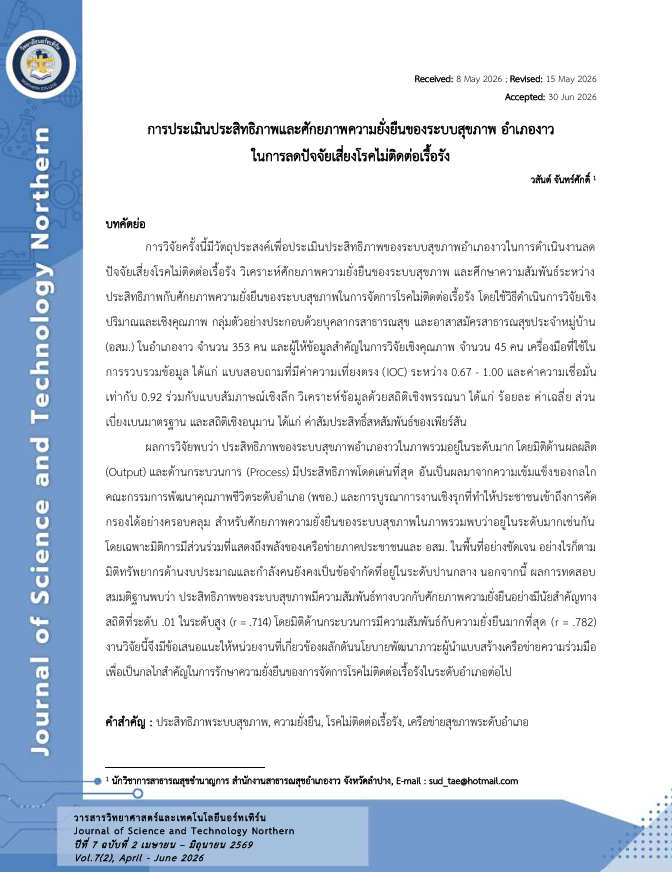
The objectives of this research were: 1) to evaluate the efficiency of the Ngao District Health System in reducing non-communicable disease (NCD) risk factors; 2) to analyze its sustainability potential; and 3) to examine the relationship between health system efficiency and sustainability potential in NCD management. This study employed a mixed-methods research design. The quantitative sample consisted of 353 health personnel and Village Health Volunteers (VHVs) in Ngao District, while 45 key informants participated in the qualitative phase. Data collection instruments included an in-depth interview guide and a questionnaire with an Index of Item-Objective Congruence (IOC) ranging from 0.67 to 1.00 and a Cronbach's alpha coefficient of 0.92. Data were analyzed using descriptive statistics (percentage, mean, and standard deviation) and inferential statistics (Pearson’s Correlation Coefficient).
The results revealed that the overall efficiency of the Ngao District Health System was at a high level. The output and process dimensions demonstrated the most outstanding efficiency, driven by the robust mechanisms of the District Quality of Life Development Committee (DQLDC) and proactive integrated interventions that ensured comprehensive screening coverage. Regarding sustainability potential, the overall level was also found to be high, particularly in the participation dimension, reflecting the strong engagement of the community network and VHVs. However, resources—specifically budget and manpower-remained a moderate constraint. Furthermore, hypothesis testing indicated that health system efficiency had a significant positive correlation with sustainability potential at the .01 level, with a high degree of correlation (r = .714). The process dimension showed the strongest relationship with sustainability (r = .782). This research suggests that relevant agencies should promote policy development for collaborative leadership to serve as a vital mechanism for ensuring the long-term sustainability of NCD management at the district level.
References
เอกสารอ้างอิง
กระทรวงสาธารณสุข. (2567). นโยบายกระทรวงสาธารณสุข พ.ศ. 2567–2568. สืบค้นจาก
จิราภรณ์ กระจายศรี. (2567). ประสิทธิภาพการบริหารจัดการคลินิกโรคไม่ติดต่อเรื้อรังในสถานบริการปฐมภูมิ
ในเขตสุขภาพที่ 1 ตามเกณฑ์ NCD Clinic Plus. วารสารวิชาการสาธารณสุข, 33(1), 45–58.
ธัญญลักษณ์ วงศ์มณี. (2567). ผลของบริการโค้ชสุขภาพโดยภาคีเครือข่ายต่อความรอบรู้สุขภาพและพฤติกรรม
นพพร ศรีผัด และคณะ. (2563). การประเมินคลินิก NCD คุณภาพ เขตสุขภาพที่ 1. เชียงรายเวชสาร, 12(3),
-22.
ประวิทย์ ผสมทรัพย์. (2566). การพัฒนาเครือข่ายสุขภาพอำเภอผ่านกลไกคณะกรรมการพัฒนาคุณภาพชีวิต
ระดับอำเภอ (พชอ.) เพื่อจัดการโรคไม่ติดต่อเรื้อรังในพื้นที่ภาคเหนือ. วารสารสุขภาพภาคประชาชน,
(2), 112–125.
พงษ์สะพรั่ง สุวรรณสว่าง. (2567). ปัจจัยพยากรณ์ความสำเร็จและความยั่งยืนของระบบสุขภาพระดับอำเภอ
ในการจัดการโรคไม่ติดต่อเรื้อรัง. วารสารวิจัยระบบสาธารณสุข, 18(1), 45–60.
วรรณรัตน์ ลาวัลย์ชนะชัย. (2565). นโยบายสาธารณะและการจัดการโรคไม่ติดต่อ: การสร้างความยั่งยืนโดย
ชุมชน. ขอนแก่น: โรงพิมพ์มหาวิทยาลัยขอนแก่น.
ศิริวรรณ เสรีรัตน์. (2566). ทฤษฎีองค์การและการจัดการ. กรุงเทพฯ: ธรรมสาร.
สถาบันวิจัยระบบสาธารณสุข (สวรส.). (2566). รายงานการประเมินผลนโยบายภาษีโซเดียมและพฤติกรรม
สมเกียรติ พลจันทร์ และคณะ. (2566). การประเมินผลการดำเนินงานลดปัจจัยเสี่ยง NCDs ในระดับปฐมภูมิ
ด้วยโปรแกรมอาสาสมัครโค้ชสุขภาพ. วารสารพยาบาลและการดูแลสุขภาพ, 41(4), 1–15.
สมนึก ลิ้มเลิศมนตรี. (2566). การประยุกต์ใช้ทฤษฎีการสะกิดพฤติกรรมเพื่อปรับเปลี่ยนพฤติกรรมการบริโภค
โซเดียมของคนภาคเหนือ. วารสารวิจัยสุขภาพ, 16(3), 89–104.
อมรพรรณ นิพัทธ์ศานต์. (2565). บทบาทของคณะกรรมการพัฒนาคุณภาพชีวิตระดับอำเภอ (พชอ.) ในการ
จัดการทรัพยากรสุขภาพอย่างยั่งยืน. วารสารวิชาการสถาบันพระบรมราชชนก, 9(1), 120–135.
อรพรรณ ประทุม. (2565). ผลของการสนับสนุนทางสังคมจากครอบครัวต่อระดับความดันโลหิตและพฤติกรรม
Bertalanffy, L. von. (1968). General System Theory: Foundations, Development, Applications.
New York: George Braziller.
Nation Thailand. (2025, June 16). Thailand pushes NCDs law as over 1000 die daily from ….
The Nation Thailand. Retrieved from https://www.nationthailand.com
Patton, M. Q. (2015). Qualitative Research & Evaluation Methods (4th ed.). Thousand Oaks,
CA: Sage.
Senge, P. M. (2006). The Fifth Discipline: The Art & Practice of The Learning Organization.
New York: Doubleday Business.
World Health Organization. (2024ก). Noncommunicable diseases (Fact sheet). Retrieved from
https://www.who.int/news-room/fact-sheets/detail/noncommunicable-diseases
Downloads
Published
How to Cite
Issue
Section
License

This work is licensed under a Creative Commons Attribution-NonCommercial-NoDerivatives 4.0 International License.