
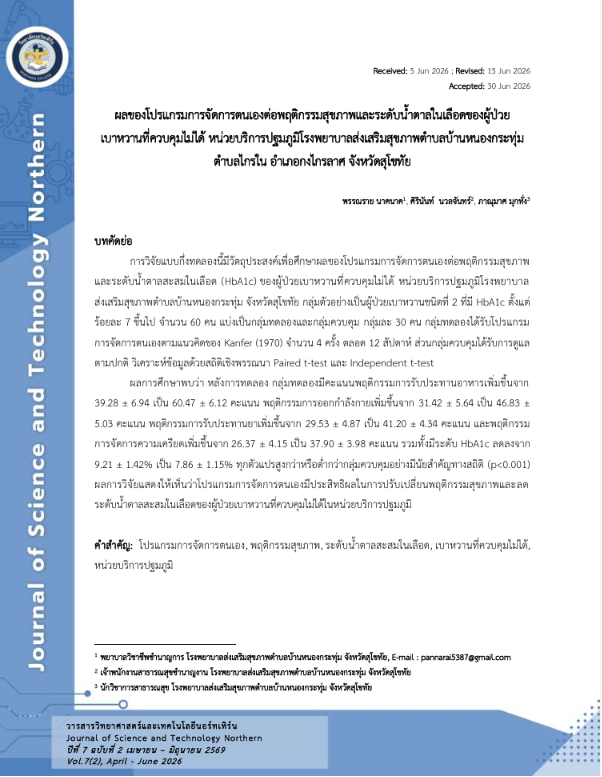
The Effects of a Self-Management Program on Health Behaviors and Blood Sugar Levels in Uncontrolled Diabetic Patients at the Primary Care Unit of Ban Nong Krathum Health Promoting Hospital, Krainai Subdistrict, Kong Krailat District, Sukhothai Province
Keywords:
self-management program, health behaviors, glycated hemoglobin, uncontrolled diabetes, primary care unitAbstract
Abstract
This quasi-experimental research examined the effects of a self-management program on health behaviors and HbA1c levels among uncontrolled type 2 diabetic patients at the Primary Care Unit of Ban Nong Krathum Tambon Health Promoting Hospital, Sukhothai Province. The sample consisted of 60 patients with HbA1c ≥7%, equally divided into experimental and control groups of 30 each. The experimental group received a self-management program based on Kanfer's (1970) theory over four sessions across 12 weeks, while the control group received standard care. Data were analyzed using descriptive statistics, Paired t-test, and Independent t-test.
The results revealed that after the intervention, the experimental group showed statistically significant improvements in eating behavior scores (from 39.28 ± 6.94 to 60.47 ± 6.12), exercise behavior scores (from 31.42 ± 5.64 to 46.83 ± 5.03), medication-taking behavior scores (from 29.53 ± 4.87 to 41.20 ± 4.34), and stress management behavior scores (from 26.37 ± 4.15 to 37.90 ± 3.98), as well as a significant reduction in HbA1c levels (from 9.21 ± 1.42% to 7.86 ± 1.15%), all of which were significantly better than the control group (p<0.001). These findings demonstrated that the self-management program was effective in improving health behaviors and reducing HbA1c levels among uncontrolled diabetic patients in a primary care setting.
Downloads
Published
How to Cite
Issue
Section
License

This work is licensed under a Creative Commons Attribution-NonCommercial-NoDerivatives 4.0 International License.