
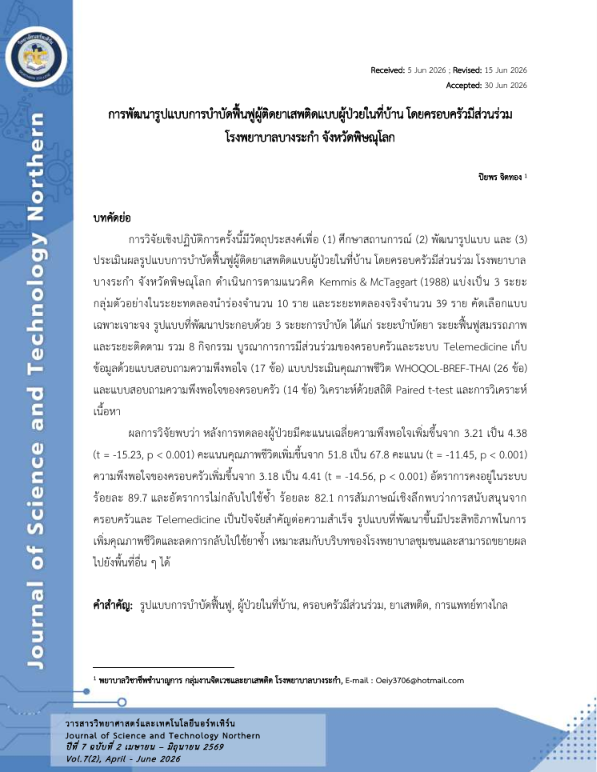
Development of a Home-Based Inpatient Rehabilitation Model with Family Participation for Drug Addiction at Bangrakam Hospital, Phitsanulok Province.
Keywords:
rehabilitation model, home-based treatment, family participation, drug addiction, telemedicineAbstract
ABSTRACT
This action research aimed to: (1) study the situation, (2) develop, and (3) evaluate a home-based inpatient drug rehabilitation model with family participation at Bangrakam Hospital, Phitsanulok Province. The study followed Kemmis & McTaggart's (1988) action research framework across three phases. Pilot study participants were 10 patients, and the main experiment included 39 purposively selected participants. The developed model comprised three treatment phases-detoxification, rehabilitation, and follow-up-encompassing 8 integrated activities with family participation and Telemedicine support. Data were collected using a patient satisfaction questionnaire (17 items), WHOQOL-BREF-THAI quality of life assessment (26 items), and family satisfaction questionnaire (14 items). Analyses included Paired t-test and content analysis.
Results showed significant improvements post-intervention: patient satisfaction increased from 3.21 to 4.38 (t = -15.23, p < 0.001); quality of life scores increased from 51.8 to 67.8 (t = -11.45, p < 0.001); family satisfaction increased from 3.18 to 4.41 (t = -14.56,
p < 0.001). Retention rate was 89.7%, and abstinence rate was 82.1%. In-depth interviews identified family support and Telemedicine as key success factors. The developed model effectively improved quality of life and reduced relapse rates, making it suitable
for community hospital contexts and scalable to other areas.
References
เอกสารอ้างอิง
กรมสุขภาพจิต. (2545). แบบวัดคุณภาพชีวิตขององค์การอนามัยโลก ชุด 26 คำถาม ฉบับภาษาไทย. กระทรวงสาธารณสุข.
บุญชม ศรีสะอาด. (2539). การวิจัยเบื้องต้น (พิมพ์ครั้งที่ 4). สุวีริยาสาส์น.
ปัทมา สุริยะ และคณะ. (2566). ผลของโปรแกรมการบำบัดฟื้นฟูแบบชุมชนบำบัดในผู้ติดยา
เสพติด. วารสารการพยาบาลจิตเวชและสุขภาพจิต, 37(2), 45–62.
ราศรี อาษาจิตร และคณะ. (2566). ประสิทธิผลของโปรแกรมบำบัดผู้ติดสารเสพติดในชุมชน. วารสาร สุขภาพจิตแห่งประเทศไทย, 31(1), 28–41.
สถาบันบำบัดรักษาและฟื้นฟูผู้ติดยาเสพติดแห่งชาติบรมราชชนนี (สบยช.) กรมการแพทย์. (2566). แนว ทางการดูแลผู้ป่วยยาเสพติดในที่บ้าน (Home Ward). กระทรวงสาธารณสุข.
สถาบันบำบัดรักษาและฟื้นฟูผู้ติดยาเสพติดแห่งชาติบรมราชชนนี (สบยช.) กรมการแพทย์. (2567). รายงาน สถิติผู้เข้ารับการบำบัดประจำปี 2567. กระทรวงสาธารณสุข.
สำนักงานคณะกรรมการป้องกันและปราบปรามยาเสพติด. (2567). รายงานการสำรวจสถานการณ์การใช้ยา เสพติดในประเทศไทย ปี 2567. สำนักนายกรัฐมนตรี.
สำนักงานเลขานุการคณะกรรมการบำบัดรักษาและฟื้นฟูผู้ติดยาเสพติด. (2564). แนวทางการบำบัดรักษาและ ฟื้นฟูผู้ติดยาเสพติด. กรมการแพทย์.
สำเนา นิลบรรพ์ และคณะ. (2568). การพัฒนาและประเมินผลรูปแบบการพยาบาลผู้ป่วยยาเสพติดในที่บ้าน. วารสารการพยาบาลและสุขภาพ, 19(1), 112–128.
สุภาพร และคณะ. (2567). ผลกระทบของการใช้สารเสพติดต่อครอบครัวและชุมชน. วารสารสาธารณสุข ชุมชน, 12(3), 67–80.
Barrett, M. E., & de Palo, D. M. (1999). Community-based programs for drug abuse prevention. Journal of Drug Issues, 29(1), 231–258.
Boonruang, J., et al. (2025). Drug addiction and public health in Thailand: Current challenges. Asia-Pacific Journal of Public Health, 37(1), 45–58.
Bowen, M. (1978). Family therapy in clinical practice. Jason Aronson.
Brorson, H. H., et al. (2023). Drop-out from addiction treatment: A systematic review of risk factors. Clinical Psychology Review, 103, 102–118.
Copello, A. G., et al. (2006). Family interventions in the treatment of alcohol and drug problems. Drug and Alcohol Review, 25(4), 369–385.
Cochran, W. G. (1997). Sampling Techniques (3rd ed.). New York: John Wiley & Sons.
Heijdra Suasnabar, J. M., et al. (2020). Effectiveness of community-based substance use prevention programs. Preventive Medicine Reports, 20, 101–112.
Kaewkham, S., et al. (2019). Community-based drug rehabilitation program and self-efficacy. Journal of Health Sciences, 28(4), 789–800.
Kemmis, S., & McTaggart, R. (1988). The action research planner (3rd ed.). Deakin University Press.
Stanton, M. D., & Shadish, W. R. (1997). Outcome, attrition, and family-couples treatment for drug abuse. Psychological Bulletin, 122(2), 170–191.
United Nations Office on Drugs and Crime. (2024). World drug report 2024. United Nations.
United Nations Office on Drugs and Crime. (2025). World drug report 2025. United Nations.
Downloads
Published
How to Cite
Issue
Section
License

This work is licensed under a Creative Commons Attribution-NonCommercial-NoDerivatives 4.0 International License.