
การเปรียบเทียบคุณภาพสมุนไพร ปริมาณฟีนอลิกรวม ปริมาณฟลาโวนอยด์รวม และฤทธิ์ต้านอนุมูลอิสระของสารสกัดเปลือกต้นสะเดาที่เก็บเกี่ยวในช่วงเวลาที่แตกต่างกัน ตามตำราเภสัชกรรมแผนไทย
คำสำคัญ:
เปลือกต้นสะเดา, เก็บยาตามยาม, ฤทธิ์ต้านอนุมูลอิสระ, ปริมาณฟีนอลิกรวม, ปริมาณฟลาโวนอยด์รวมบทคัดย่อ
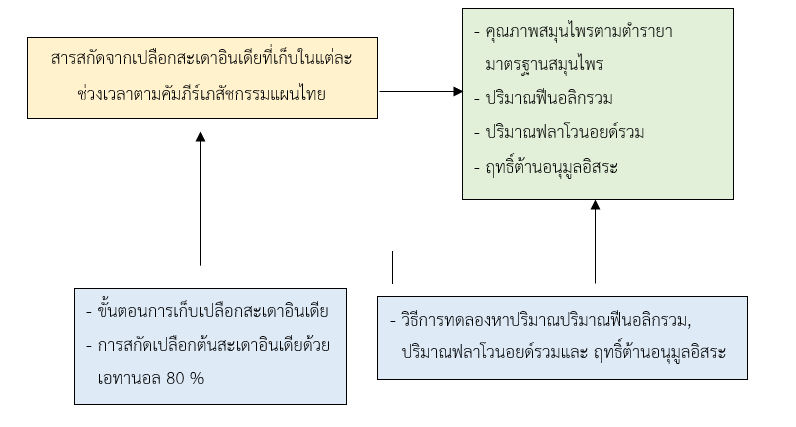
การวิจัยนี้มีวัตถุประสงค์เพื่อเปรียบเทียบคุณภาพสมุนไพรตามมาตรฐานสมุนไพรของ Thai Herbal Pharmacopoeia, ปริมาณฟีนอลิกรวม (Total Phenolic Content ), ปริมาณฟลาโวนอยด์รวม (Total Flavonoids Content) และ ฤทธิ์ต้านอนุมูลอิสระของสารสกัด 80 % เอทานอล ที่เก็บใน 8 ช่วงเวลาด้วยวิธีการควบคุมคุณภาพ แสดงผลลัพธ์โดย mean ± SD วิเคราะห์ความแปรปรวนโดยใช้ one-way ANOVA (p-value < 0.05) ผลการวิจัยพบว่าคุณภาพสมุนไพรในแต่ละช่วงเวลามีคุณภาพเป็นไปตามเกณฑ์, ปริมาณสารประกอบฟีนอลิก N2 (ช่วงเวลา 21.00 - 24.00 น.) มีปริมาณฟีนอลิกรวมมากที่สุดโดยมีค่า 983.41 ± 14.83 mg GAE/g dry extract, ปริมาณสารฟลาโวนอยด์ พบว่า ทั้ง 8 ช่วงเวลา ปริมาณฟลาโวนอยด์ < 20 mg QE/g of dry extract และ ฤทธิ์ต้านอนุมูลอิสระมากที่สุดคือ N1 (ช่วงเวลา 18.00 - 21.00 น.) มีค่า IC50 = 3.99 ± 0.55 ug/mL ซึ่งไม่สอดคล้องกับทฤษฎีแพทย์แผนไทยที่กล่าวว่าการเก็บสมุนไพรในช่วงเวลา 12.00 - 15.00 น. (D3) และ 21.00 - 24.00 น. (N2) เป็นช่วงเวลาที่เหมาะสมในการเก็บเกี่ยวเปลือกสมุนไพร ดังนั้นควรมีการทดสอบฤทธิ์ที่สอดคล้องกับสรรพคุณอื่นๆ เพิ่มเติมต่อไป
เอกสารอ้างอิง
ธีร์ หะวานนท์, & เกียรติสุดา เหลืองวิลัย. (2562). ผลของเวลาเก็บเกี่ยวและฤดูกาลต่อกิจกรรมการต้านอนุมูลอิสระ ปริมาณแอนโทไซยานิน และสารฟีนอลิกทั้งหมดในดอกอัญชัน. วารสารเกษตรพระจอมเกล้า, 37(4), 133-160.
นรินทร์ ท้าวแก่นจันทร์, ภาวิณี อารีศรีสม, เทิดศักดิ์ โทณลักษณ์, วาริน สุทนต์, และ กอบลาภ อารีศรีสม. (2560). ผลของอายุการเก็บเกี่ยวและความเข้มแสงต่อปริมาณสารประกอบฟีนอลและฤทธิ์ต้านอนุมูลอิสระของ ใบเตยหอม. แก่นเกษตร, 45(3), 433-438.
มูลนิธิฟื้นฟูส่งเสริมการแพทย์แผนไทยเดิมฯ โรงเรียนอายุรเวท (ชีวกโกมารภัจจ์). (2548). ตำราเภสัชกรรมไทย (พิมพ์ครั้งที่ 1). พิฆเณศ พริ้นติ้ง เซ็นเตอร์.
Abubakar, A. R., & Haque, M. (2020). Preparation of medicinal plants: Basic extraction and fractionation procedures for experimental purposes. Journal of Pharmacy and Bioallied Sciences, 12(1), 1-10. https://doi.org/10.4103/jpbs.JPBS_175_19
Alzohairy, M. A. (2016). Therapeutic role of Azadirachta indica (Neem) and their active constituents in diseases prevention and treatment. Evidence-Based Complementary and Alternative Medicine,2016, 1-11. https://doi.org/10.1155/2016/7382506
Ashafa, A. O. T., Yakubu, M. T., Grierson, D. S., & Afolayan, A. J. (2012). Toxicological evaluation of the aqueous extract of Azadirachta indica stem bark in Wistar rats. African Journal of Biotechnology, 11(22), 6112-6118. https://doi.org/10.5897/AJB11.4144
Bondet, V., Brand-Williams, W., & Berset, C. L. W. T. (1997). Kinetics and mechanisms of antioxidant activity using the DPPH. free radical method. LWT-Food Science and Technology, 30(6), 609-615. https://doi.org/10.1006/fstl.1997.0240
Department of medical sciences, Ministry of Public Health. (2018). Thai Herbal Pharmacopoeia 2018. The Agriculural Co-operative Federation of Thailand.
Department of Medical Sciences, Ministry of Public Health. (2023). Thai Herbal Pharmacopoeia 2021 Supplement 2023. Bangkok: Author.
Duda, S. C., Mărghitaş, L. A., Dezmirean, D., Duda, M., Mărgăoan, R., & Bobiş, O. (2015). Changes in major bioactive compounds with antioxidant activity of Agastache foeniculum, Lavandula angustifolia, Melissa officinalis and Nepeta cataria: Effect of harvest time and plant species. Industrial Crops and Products, 77, 499-507. https://doi.org/10.1016/j.indcrop.2015.09.045
Folin, O., & Ciocalteu, V. (1927). On tyrosine and tryptophane determinations in proteins. Journal of Biological Chemistry, 73(2), 627-650.
Khan, M. R., Kihara, M., Omoloso, A. D., & Akhtar, S. (2012). Antioxidant activity of different parts of Annona muricata (soursop). Journal of Medicinal Plants Research, 6(31), 4591-4599. https://doi.org/10.5897/JMPR11.1172
Muhammad, H. L., Yusuf, A. M., & Abdulkadir, U. (2020). Phytochemical screening and antioxidant activities of Azadirachta indica bark extract and its fractions. Nigerian Journal of Pharmaceutical Sciences, 19(2), 123-132.
Tristantini, D., & Amalia, R. (2019). Antioxidant activity of plant extracts using DPPH method. IOP Conference Series: Earth and Environmental Science, 299(1), 012021. https://doi.org/10.1088/1755-1315/299/1/012021
Uzzaman, S. (2020). Pharmacological activities of neem (Azadirachta indica): A review. International Journal of Pharmacognosy and Life Science, 1(1): 38-41. https://doi.org/10.33545/27072827.2020.v1.i1a.8.
ดาวน์โหลด
เผยแพร่แล้ว
รูปแบบการอ้างอิง
ฉบับ
ประเภทบทความ
สัญญาอนุญาต
ลิขสิทธิ์ (c) 2025 สถาบันพระบรมราชชนก

อนุญาตภายใต้เงื่อนไข Creative Commons Attribution-NonCommercial-NoDerivatives 4.0 International License.




