
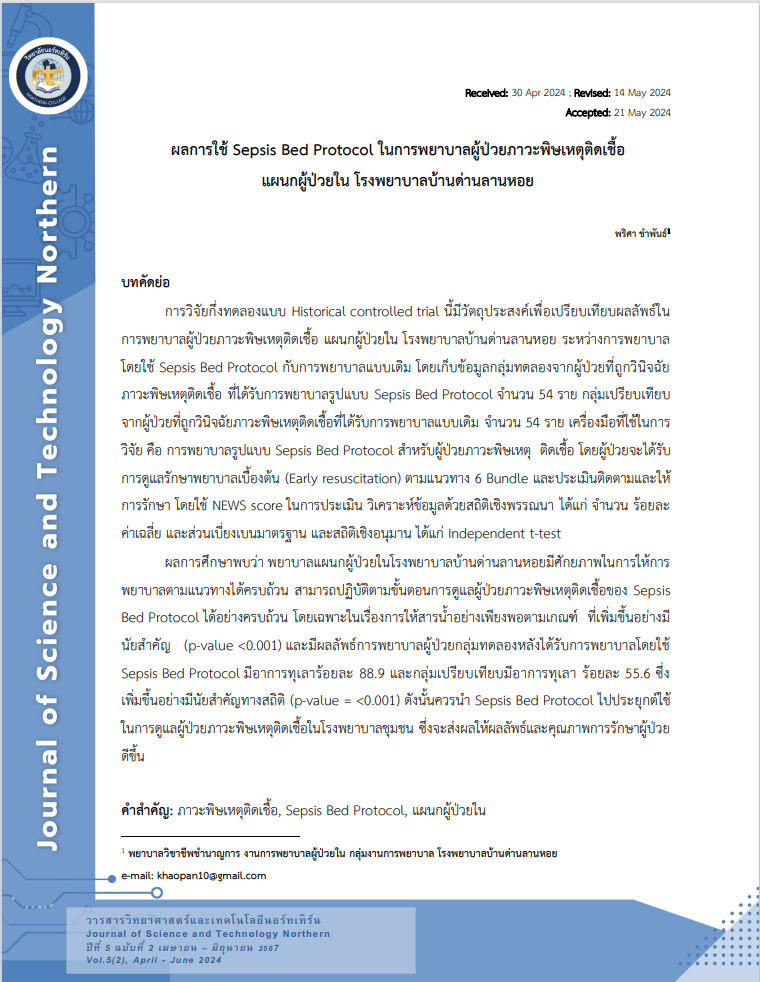
Results of using the Sepsis Bed Protocol in nursing patients with sepsis, Inpatient department, Bandanlanhoi Hospital
Keywords:
Sepsis, Sepsis Bed Protocol, Inpatient departmentAbstract
Abstract
This historical controlled trial aimed to compare outcomes in nursing care for sepsis patients in inpatient department of Bandanlanhoi Hospital between Sepsis Bed Protocol nursing and conventional nursing. Data was collected from 54 patients diagnosed with sepsis who received care according to the Sepsis Bed Protocol, compared with 54 patients who received conventional nursing. The research tool was the Sepsis Bed Protocol nursing for sepsis patients, wherein patients received early resuscitation following the 6-Bundle guidelines and were assessed and treated using NEWS scores. Data analysis included statistical techniques such as percentages, means, standard deviations, and inferential statistics were independent t-test.
The results revealed that nurses in inpatient department of Bandanlanhoi Hospital demonstrated competence in providing comprehensive nursing care according to protocol, particularly in ensuring adequate fluid administration, with a significant increase (p-value <0.001). Post-implementation, patients who received nursing care using the Sepsis Bed Protocol exhibited an 88.9% improvement rate, compared to 55.6% in the control group, indicating a statistically significant improvement (p-value <0.001). Therefore, implementing the Sepsis Bed Protocol in community hospitals is recommended, as it leads to improved patient outcomes and quality of care.
References
เอกสารอ้างอิง
จุฬาลักษณ์ นุพอ, กาจบัณฑิต สุรสิทธิ์, & วรัตม์สุดา สมุทรทัย. (2563). การประเมิน NEWS ณ ห้องฉุกเฉินเพื่อทำนาย อัตราการเสียชีวิตภายใน 24 ชั่วโมงของผู้ป่วยที่มีภาวะติดเชื้อ. วารสารโรงพยาบาลนครพิงค์, 11(1), 28–44.
พัลลภา อินทร์เหลา. (2566). การเปรียบเทียบคะแนน qSOFA, SIRs และ National Early Warning Score เพื่อทำนายการเสียชีวิตของผู้ป่วยที่ติดเชื้อในกระแสเลือด แผนกห้องฉุกเฉินโรงพยาบาลรัตนบุรี จังหวัดสุรินทร์. วารสารการแทพย์โรงพยาบาลศรีสะเกษ สุรินทร์ บุรีรัมย์, 38(3), 879–890.
ภัทรศร นพฤทธิ์, แสงไทย ไตรวงค์, & จรินทร โคตรพรม. (2562). การพัฒนารูปแบบการพยาบาลผู้ป่วยติดเชื้อในกระแสเลือด โรงพยาบาลมุกดาหาร. วารสารการพยาบาลและการดูแลสุขภาพ, 37(1), 221–230.
สมไสว อินทะชุบ, ดวงพร โพธิ์ศรี, & จิราภรณ์ สุวรรณศรี. (2560). ประสิทธิผลการใช้ MEWS (SOS Score) ต่อการเกิด Severe sepsis and Septic shock ในผู้ป่วย Sepsis กลุ่มงานอายุรกรรม โรงพยาบาลอุดรธานี. วารสารการแพทย์โรงพยาบาลอุดรธานี, 25(1), 82–92.
สุณี สุวรรณพสุ, วีรภัทรา ประภาพักตร์, & สุกัญญา พูลทรัพย์. (2564). การศึกษาประสิทธิภาพการใช้สัญญาณเตือนภาวะวิกฤตระบบ Search Out Severity Score และ National Early Warning Score ต่อภาวะใส่ท่อช่วยหายใจหรือการเข้ารับการรักษาในหอผู้ป่วยหนักโดยไม่ได้วางแผนของผู้ป่วยสูงอายุในหอผู้ป่วยอายุรกรรม. วารสารพยาบาลศาสตร์ จุฬาลงกรณ์มหาวิทยาลัย, 33(1), 1–20.
Hanlumyuang, G. (2020). The analysis of contributing factors to septic death in Pakkred Hospital. Journal of Preventive Medicine Association of Thailand, 10(1), 108–117.
Jaruwatthanasunthon, J., Worapratya, P., & Piyasuwankul, T. (2022). Comparison Accuracy in mSIRS, NEWS and qSOFA Score to Triage Sepsis Patients in The Emergency Department at a Hospital in Thailand. Journal of Health Science and Medical Research, 40(5), 487–495.
Prakasit Tensit, Jayanton Patumanond, Sukee Phoblarp, Chalisa Nuntasunti, T. M. (2020). Prognotic factors of early and late mortality rate in community acquired sepsis. Med J Srisaket Surin Buriram Hosp, Vol. 35, pp. 102–109.
Srzić, I., Adam, V. N., & Pejak, D. T. (2022). Sepsis Definition: What’S New in the Treatment Guidelines. Acta Clinica Croatica, 61, 67–72.
World Health Organzization. (2023). Sepsis. Retrieved from https://www.who.int/news-room/fact-sheets/detail/sepsis
Downloads
Published
How to Cite
Issue
Section
License

This work is licensed under a Creative Commons Attribution-NonCommercial-NoDerivatives 4.0 International License.