
The effects of program to prevent peritoneal infection in peritoneal dialysis patients in Sukhothai Hospital.
Keywords:
educational program, peritonitis, peritoneal dialysis, self-efficacy theoryAbstract
ABSTRACT
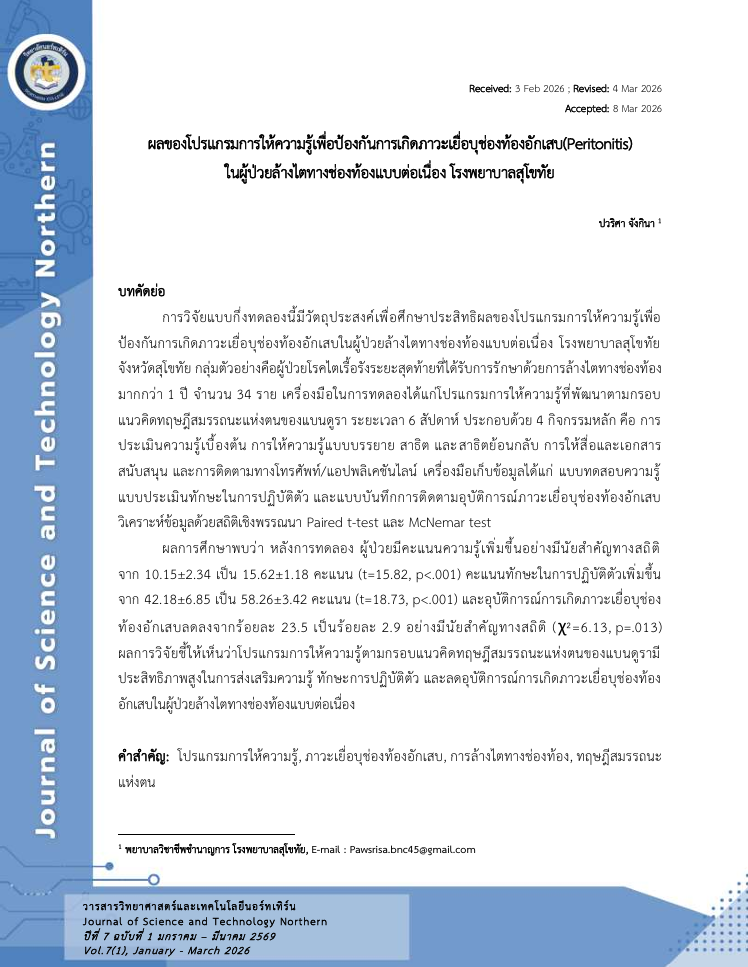
The Effects of an Educational Program to Prevent Peritonitis in Continuous Ambulatory Peritoneal Dialysis Patients at Sukhothai Hospital This quasi-experimental study aimed to examine the effectiveness of an educational program to prevent peritonitis in continuous ambulatory peritoneal dialysis (CAPD) patients at Sukhothai Hospital, Sukhothai Province. The sample consisted of 34 end-stage renal disease patients who had been receiving peritoneal dialysis for more than one year. The intervention tool was an educational program developed based on Bandura's Self-Efficacy Theory, implemented over 6 weeks and comprising four main activities: baseline knowledge assessment, education through lectures with demonstration and return demonstration, provision of supporting media and documents, and follow-up via telephone/LINE application. Data collection instruments included a knowledge test, a self-care practice skills assessment form, and a peritonitis incidence tracking record. Data were analyzed using descriptive statistics, paired t-test, and McNemar test.
The results showed that after the intervention, patients' knowledge scores increased significantly from 10.15±2.34 to 15.62±1.18 (t=15.82, p<.001). Self-care practice skills scores increased from 42.18±6.85 to 58.26±3.42 (t=18.73, p<.001). The incidence of peritonitis decreased significantly from 23.5% to 2.9% (χ²=6.13, p=.013). The findings demonstrated that the educational program based on Bandura's Self-Efficacy Theory was highly effective in enhancing knowledge, self-care practice skills, and reducing the incidence of peritonitis in CAPD patients.
References
เอกสารอ้างอิง
กมลทิพย์ วิจิตรสุนทรกุล. (2565). ระบาดวิทยาและการทบทวนมาตรการป้องกันโรคไตเรื้อรัง. นนทบุรี:
กองโรคไม่ติดต่อ กรมควบคุมโรค.
จุฑามาส พรมใจมั่น. (2563). ผลของโปรแกรมการจัดการตนเองต่อความรู้ พฤติกรรมการจัดการตนเองและการเกิดเยื่อบุช่องท้องอักเสบในผู้ป่วยโรคไตเรื้อรังที่ได้รับการล้างไตทางช่องท้อง. กรุงเทพฯ: วิทยานิพนธ์ปริญญาพยาบาลศาสตรมหาบัณฑิต สาขาวิชาการพยาบาลผู้ใหญ่ มหาวิทยาลัยคริสเตียน .
ชนิดาภา อยู่พงษ์. (2566). ผลของการใช้โปรแกรมการจัดการตนเองต่อความรู้และการดูแลตนเอง ในผู้ป่วยโรคไตเรื้อรังที่ได้รับการล้างไตทางช่องท้อง. เข้าถึงได้จาก https://bkpho.moph.go.th/ssjweb/bkresearch/index.php?fn=detail&sid=230#posted
มงคล วารีย์, นภาลัย แสงโพธิ์, อัญญาณี ฮองต้น และชัญญาวีร์ ไชยวงศ์. (2568). ผลของโปรแกรมการจัดการตนเองต่อสถานะสุขภาพ พฤติกรรมการจัดการตนเองและพฤติกรรมป้องกันเยื่อบุช่องท้องอักเสบกลับซ้ำของผู้ป่วยที่ได้รับการล้างไตทางช่องท้อง. วารสารการพยาบาล สุขภาพ และการศึกษา, 8(1), 25-37.
เวชระเบียนและสถิติ โรงพยาบาลสุโขทัย. (2567). รายงานสถิติผู้ป่วยที่ได้รับการบำบัดทดแทนไตด้วยการล้างไตทางช่องท้องแบบต่อเนื่อง (CAPD) ประจำปี พ.ศ. 2564–2567. สุโขทัย: โรงพยาบาลสุโขทัย .
สำนักงานหลักประกันสุขภาพแห่งชาติ. (2565). รายงานสถานการณ์การให้บริการบำบัดทดแทนไตในระบบหลักประกันสุขภาพแห่งชาติ ปีงบประมาณ 2565. กรุงเทพฯ: สำนักงานหลักประกันสุขภาพแห่งชาติ.
Bandura A. (1997). Self-efficacy: The exercise of control. W. H. Freeman and Company. W. H. Freeman and Company.
Piraino B., Bernardini, J., Brown, E., Figueiredo, A., Johnson, D.W., Lye, W., et al. (2011). ISPD Position Statement on Reducing the Risks of Peritoneal Dialysis-Related Infections. Peritoneal Dialysis International. Journal of the International Society for Peritoneal Dialysis, 31, 614-630.
Bloom. (1975). Taxonomy of Education. New York: David McKay Company Inc.
Davis F. D. (1989). Perceived usefulness, perceived ease of use, and user acceptance of information technology. MIS Quarterly, 13(3), 319–340.
Htay H., Cho, Y., Pascoe, E. M., Darssan, D., Nadeau-Fredette, A. C., Hawley, C. M., & Johnson, D. W. (2017). Center effects and peritoneal dialysis peritonitis outcomes: Analysis of a national registry. American Journal of Kidney Diseases, 69(3), 377–385.
Li H., Jiang, Y. F., & Lin, C. C. (2016). Factors associated with self-management by people undergoing continuous ambulatory peritoneal dialysis: A descriptive study. International Journal of Nursing Studies, 54, 76–83.
Ghali L., et al. (2011). Effects of Fiber Weight Ratio, Structure and Fiber Modification onto Flexural Properties of Luffa-Polyester Composites. Advances in Materials Physics and Chemistry, 1, 78-85.
Troidle L., Gorban-Brennan, N., Kliger, A., & Finkelstein, F. O. (2012). Continuous peritoneal dialysis-associated peritonitis: A review and current concepts. Seminars in Dialysis, 25(4), 407–415.
Nessim S. J., Bargman, J. M., Jassal, S. V., Oliver, M. J., Austin, P. C., & Perl, J. (2013). The impact of transfer from hemodialysis on peritoneal dialysis technique survival. Peritoneal Dialysis International, 33(3), 297–305.
Liyanage T., Ninomiya, T., Jha, V., Neal, B., Patrice, H. M., Okpechi, I., … & Gallagher, M.. (2015). Worldwide access to treatment for end-stage kidney disease: A systematic review. The Lancet, 385(9981), 1975–1982.
Fan X., Huang, R., Wang, J., Ye, H., Guo, Q., & Yi, C. (2014). Self-efficacy and adherence to continuous ambulatory peritoneal dialysis in patients with end-stage renal disease. International Journal of Nursing Practice, 20(5), 505–512.
Cho Y., Johnson, D. W., & Badve, S. V. (2014). Impact of peritonitis on mortality in peritoneal dialysis patients: A systematic review. Clinical Journal of the American Society of Nephrology, 9(12), 2136–2143.
Downloads
Published
How to Cite
Issue
Section
License

This work is licensed under a Creative Commons Attribution-NonCommercial-NoDerivatives 4.0 International License.