
The Effects of the STEMI & Stroke Alert Educational Program on Knowledge of Warning Signs and Actions for Accessing Emergency Medical Services in Acute Myocardial Infarction and Acute Stroke Among High-Risk Cardiovascular Patients at Mae Chan Hospital, Chiang Rai Province
Abstract
Abstract
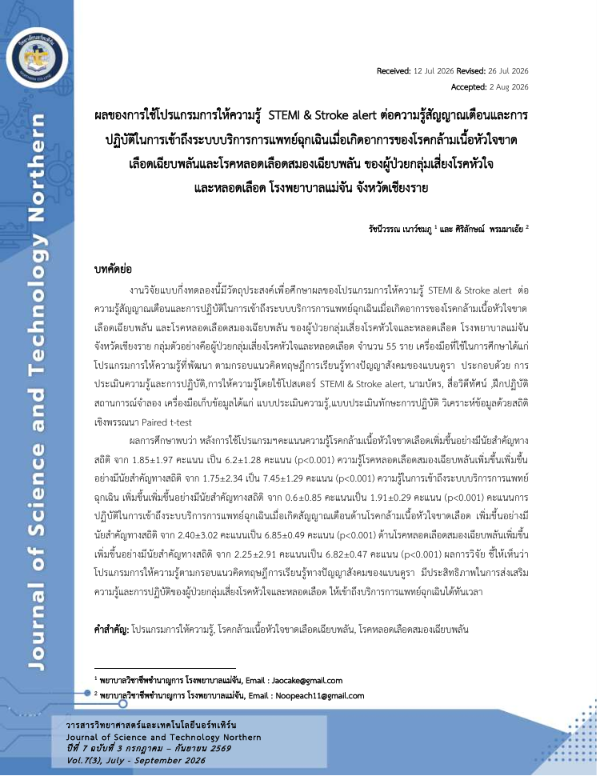
The objective of this quasi-experimental research was to examine the effect of a STEMI and Stroke Alert Educational Program on patients’ knowledge of warning signs and actions for accessing emergency medical services in acute myocardial infarction and acute stroke. The sample comprised 55 high-risk patients with cardiovascular disease (CVD) at Mae Chan Hospital. The research instrument was an educational program developed based on Bandura's social cognitive theory, consisting of knowledge and action assessments, a STEMI & Stroke alert poster, a name card, video media, and simulation-based learning activities. A knowledge assessment form and a performance skills assessment form were used to collect data. Descriptive statistics and a paired t-test were utilized for data analysis.
The research results demonstrated a significant increase in post-test scores for knowledge of acute myocardial infarction (from 1.85±1.97 to 6.2±1.28, p<0.001), acute stroke (from 1.75±2.34 to 7.45±1.29, (p<0.001), access to emergency medical services (from 0.6±0.85 to 1.91±0.29, p<0.001), and actions to access emergency medical services under warning signs of myocardial infarction (from 2.40±3.02 to 6.85±0.49, p<0.001) and acute stroke (from 2.25±2.91 to 6.82±0.47, (p<0.001). The results indicate the effectiveness of the educational program grounded on Bandura's social cognitive theory in promoting knowledge and actions among high-risk CVD patients for timely access to emergency medical services.
References
บรรณานุกรม
กองยุทธศาสตร์และแผนงาน กระทรวงสาธารณสุข. (2568). สถิติสาธารณสุข พ.ศ. 2566.
https://spd.moph.go.th/wp-content/uploads/2025/01/รายงานสถิติสาธารณสุข-
ประจำปี2566.pdf
พัชรินทร์ ชมเมืองมิ่ง. (2564). ประสิทธิผลของการใช้ warning signs card ต่อความรู้สัญญาณเตือนและ
แนวทางปฏิบัติเมื่อเกิดอาการของโรคกล้ามเนื้อหัวใจขาดเลือดเฉียบพลันและสมองขาดเลือดเฉียบพลัน
ของผู้ป่วยกลุ่มเสี่ยง ตำบลบางระกำ จังหวัดพิษณุโลก. วารสารการแพทย์ฉุกเฉินแห่งประเทศไทย, 1(1),
23–33. https://he03.tci-thaijo.org/index.php/Jemst-01JHS/article/view/131
รุจิกาญจน์ สานนท์. (2563). การประยุกต์ใช้ทฤษฎีปัญญาสังคมในการอธิบายพฤติกรรมสุขภาพ. วารสาร
มนุษยศาสตร์และสังคมศาสตร์ มหาวิทยาลัยราชภัฏเลย, 1(1), 23–33.
https://so01.tci-thaijo.org/index.php/husolru/article/view/249057
ลาวัลย์ เวทยาวงศ์. (2560). ผลของโปรแกรมการสื่อสารเตือนภัยต่อความรู้เรื่องหัวใจขาดเลือดและการ
จัดการอาการของประชาชน ตำบลปากหมาก จังหวัดสุราษฎร์ธานี. วารสารเครือข่ายวิทยาลัยพยาบาล
และการสาธารณสุขภาคใต้, 1, 86–101. https://he01.tci-thaijo.org/index.php/scnet /article
/view/74861
สมบัติ มุ่งทวีพงษา. (2564). โรคหลอดเลือดสมองและประสาทวิทยาวิกฤติ. สำนักพิมพ์
มหาวิทยาลัยธรรมศาสตร์. https://digital.library.tu.ac.th/tu_dc/frontend/Info/item/dc:275478
สมาคมแพทย์โรคหัวใจแห่งประเทศไทย ในพระบรมราชูปถัมภ์. (2563). แนวเวชปฏิบัติการดูแลรักษา
ผู้ป่วยภาวะหัวใจขาดเลือดเฉียบพลัน (พิมพ์ครั้งที่ 1). เนคสเตป ดีไซน์
Wangsri, K. (2013). The EMS system in Thailand. Srinagarind Medical Journal, 28(4), 69–73.
https://li01.tcithaijo.org/index.php/SRIMEDJ/article/view/14763
Worakijthamrongchai, T. (2019). Endovascular treatment in acute ischemic stroke. Journal
of Thai Stroke Society, 16(3), 5–13. https://he01.tcithaijo.org/index.php/jtss/article/view/172097
World Health Organization. (n.d.). Cardiovascular diseases overview.
https://www.who.int/health-topics/cardiovascular-diseases#tab=tab_1
World Health Organization. (n.d.). The top 10 causes of death
https://www.who.int/news-room/fact-sheets/detail/the-top-10-causes-of-death
Downloads
Published
How to Cite
Issue
Section
License

This work is licensed under a Creative Commons Attribution-NonCommercial-NoDerivatives 4.0 International License.