
ปัจจัยที่มีความสัมพันธ์กับพฤติกรรมสุขภาพของผู้ป่วยโรคความดันโลหิตสูง ที่รับบริการใน คลินิกโรคเรื้อรัง โรงพยาบาลส่งเสริมสุขภาพตำบลบ้านบกปุย ตำบลลำภี อำเภอท้ายเหมือง จังหวัดพังงา
บทคัดย่อ
Abstract
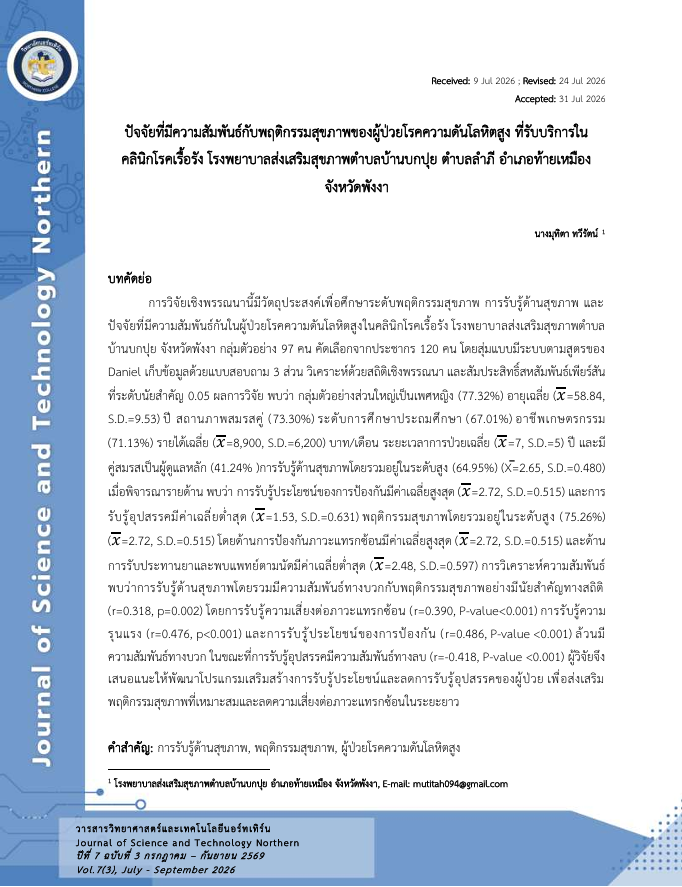
This descriptive research aimed to examine health behavior levels, health perceptions, and associated factors among hypertensive patients at the Chronic Disease Clinic, Ban Bokpui Subdistrict Health Promoting Hospital, Phang Nga Province. A sample of 97 participants was systematically selected from 120 registered patients using Daniel's formula (2010). Data were collected via a three-part questionnaire and analyzed using descriptive statistics, chi-square, and Pearson's correlation coefficient at a significance level of 0.05.The majority of participants were female (77.32%), with a mean age ( =58.84, S.D.=9.53) years. Most were married (73.30%), had primary education (67.01%), worked in agriculture (71.13%), had a mean monthly income ( =8,900, S.D.=6,200) baht, a mean illness duration ( =7, S.D.=5) years, and were primarily cared for by their spouse (41.24%). Overall health perception was at a high level (64.95%) ( ==2.65, S.D.=0.480). Among subscales, perceived benefits of prevention scored highest ( =2.72, S.D.=0.515) and perceived barriers scored lowest ( =1.53, S.D.=0.631). Overall health behaviors were also at a high level (75.26%) ( =2.72, S.D.=0.515), with complication prevention behaviors scoring highest ( =2.72, S.D.=0.515) and medication adherence and appointment-keeping scoring lowest ( =2.48, S.D.=0.597).Correlation analysis revealed that overall health perception had a statistically significant positive relationship with health behaviors (r=0.318,
P-value =0.002). Perceived susceptibility (r=0.390, P-value <0.001), perceived severity (r=0.476, P-value <0.001), and perceived benefits (r=0.486, P-value <0.001) showed significant positive associations, while perceived barriers showed a significant negative association (r=-0.418, P-value <0.001). The researcher recommends developing programs that strengthen perceived benefits and reduce perceived barriers to promote appropriate health behaviors and minimize long-term hypertensive complications.
เอกสารอ้างอิง
เอกสารอ้างอิง
กรมควบคุมโรค กระทรวงสาธารณสุข. (2565). แนวทางการป้องกันและควบคุมโรคไม่ติดต่อเรื้อรัง (NCDs) ในระดับปฐมภูมิ. กระทรวงสาธารณสุข.
กรมควบคุมโรค กระทรวงสาธารณสุข. (2566). แนวทางการป้องกันและควบคุมโรคความดันโลหิตสูง. กระทรวงสาธารณสุข.
กรมอนามัย กระทรวงสาธารณสุข. (2564). แนวทางการส่งเสริมพฤติกรรมสุขภาพผู้ป่วยโรคเรื้อรัง.
กระทรวงสาธารณสุข.
กรมอนามัย กระทรวงสาธารณสุข. (2566). รายงานสถานการณ์โรคความดันโลหิตสูงในประเทศไทย.
กระทรวงสาธารณสุข.
จันทร์เพ็ญ พวงดอกไม้. (2567). ปัจจัยที่มีความสัมพันธ์กับพฤติกรรมการควบคุมความดันโลหิตของผู้ป่วยโรคความดันโลหิตสูงที่ควบคุมระดับความดันโลหิตไม่ได้ ในคลินิกโรคความดันโลหิตสูง โรงพยาบาลส่งเสริมสุขภาพตำบลพญาแมน อำเภอพิชัย จังหวัดอุตรดิตถ์. วารสารวิทยาศาสตร์และเทคโนโลยีนอร์ทเทิร์น, 5(4). https://he03.tci-thaijo.org/index.php/scintc/article/view/3760
จิราภรณ์ อริยสิทธิ์. (2566). ความสัมพันธ์ระหว่างความรอบรู้ด้านสุขภาพกับพฤติกรรมสุขภาพของ
ผู้ป่วยโรคความดันโลหิตสูง. Region 3 Medical and Public Health Journal, 20(3), 117–123. https://thaidj.org/index.php/smj/article/view/13180
เจษฎากร โนอิน, และ นิรัชรา ลิลละฮ์กุล. (2567). ความสัมพันธ์ของปัจจัยส่วนบุคคล ความรู้ และการรับรู้
กับพฤติกรรมการดูแลสุขภาพตนเองของผู้สูงอายุโรคความดันโลหิตสูง. วารสารสหเวชศาสตร์และสุขภาพชุมชน, 1(2). https://he01.tci-thaijo.org/index.php/JAHSCH/article/view/274553
ณิชาภัทร วัดบุญเลี้ยง. (2561). โรคความดันโลหิตสูง: การพยาบาลและการดูแลตนเอง. สำนักพิมพ์มหาวิทยาลัยมหิดล.
เทพพนม เมืองแมน, และ สวิง สุวรรณ. (2540). พฤติกรรมองค์การ (พิมพ์ครั้งที่ 2 ฉบับปรับปรุงใหม่).
ไทยวัฒนาพานิช.
เนตร์พัณณา ยาวิราช. (2547). การจัดการสมัยใหม่ (พิมพ์ครั้งที่ 3). เซ็นทรัลเอ็กซเพรส.
นลินี หนูห่วง. (2566). ความสัมพันธ์ระหว่างความรอบรู้ด้านสุขภาพกับพฤติกรรมการดูแลสุขภาพของผู้ป่วยโรคความดันโลหิตสูง. วารสารสิ่งแวดล้อมศึกษาการแพทย์และสุขภาพ, 8(4). https://so06.tci-thaijo.org/index.php/hej/article/view/268805
ไพบูลย์ เทวรักษ์. (2537). จิตวิทยา: ศึกษาพฤติกรรมภายนอกและภายใน. เอส.ดี.เพรส.
วิรีรัตน์ เวโยบุตร, และ อพิณยา วงศ์พิริยะโยธาร. (2568). The relationships between health beliefs, perceived self-efficacy, and coronary artery disease prevention behaviors among patients with uncontrolled hypertension. Journal of Thailand Nursing and Midwifery Council, 40(2). https://doi.org/10.60099/jtnmc.v40i02.271781
สมาคมความดันโลหิตสูงแห่งประเทศไทย. (2558). แนวทางการรักษาโรคความดันโลหิตสูงในเวชปฏิบัติทั่วไป พ.ศ. 2558. สมาคมความดันโลหิตสูงแห่งประเทศไทย.
สมาคมความดันโลหิตสูงแห่งประเทศไทย. (2562). แนวทางการรักษาโรคความดันโลหิตสูงในเวชปฏิบัติทั่วไป พ.ศ. 2562. สมาคมความดันโลหิตสูงแห่งประเทศไทย.
สมาคมความดันโลหิตสูงแห่งประเทศไทย. (2565). แนวทางการรักษาโรคความดันโลหิตสูงในเวชปฏิบัติทั่วไป พ.ศ. 2565. สมาคมความดันโลหิตสูงแห่งประเทศไทย.
สิทธิโชค วรานุสันติกูล. (2546). จิตวิทยาสังคม: ทฤษฎีและการประยุกต์. ซีเอ็ดยูเคชั่น.
สำนักงานสาธารณสุขจังหวัดพังงา. (2569). รายงานข้อมูลผู้ป่วยโรคความดันโลหิตสูง จังหวัดพังงา ปีงบประมาณ พ.ศ. 2566–2568. สำนักงานสาธารณสุขจังหวัดพังงา.ระบบ Health Data Center (HDC). สืบค้น เมื่อ 10 พฤษภาคม 2569 เข้าจาก https://hdc.moph.go.th/pna/public/standard-report-detail/29eec762c9591d1f8092da14c7462361?subcatalogId=b2b59e64c4e6c92d4b1ec16a599d882b
สำนักงานสาธารณสุขจังหวัดพังงา. (2569). อัตราการป่วยตายด้วยโรคความดันโลหิตสูง. สำนักงานสาธารณสุขจังหวัดพังงา.ระบบ Health Data Center (HDC). สืบค้น เมื่อ 10 พฤษภาคม 2569 เข้าจาก
สำนักโรคไม่ติดต่อ กรมควบคุมโรค กระทรวงสาธารณสุข. (2562). แนวทางการดูแลรักษา
โรคความดันโลหิตสูง. กระทรวงสาธารณสุข.
Bandura, A. (1986). Social foundations of thought and action: A social cognitive theory. Prentice-Hall.
Becker, M. H. (1974). The health belief model and personal health behavior. Health Education Monographs, 2(4), 324–473.
Best, J. W. (1977). Research in evaluation (3rd ed.). Prentice-Hall.
Daniel, W. W. (2010). Biostatistics: Basic concepts and methodology for the health sciences (9th ed.). John Wiley & Sons.
Islam, M. R., Hossain, M. S., Molla, M. M., Zahan, T., Shill, L. K., & Islam, M. A. (2025). Role of the health belief model in the management of hypertension: A systematic review. Cureus, 17(1), e94139. https://doi.org/10.7759/cureus.94139
Joint National Committee. (2003). The seventh report of the Joint National Committee on prevention, detection, evaluation, and treatment of high blood pressure (JNC 7). National Institutes of Health. https://www.nhlbi.nih.gov/files/docs/guidelines/jnc7full.pdf
Nestel, P. J. (2019). Dietary fat and blood pressure. Current Hypertension Reports, 21(2), 17. https://doi.org/10.1007/s11906-019-0918-y
Rosenstock, I. M. (1974). Historical origins of the health belief model. Health Education Monographs, 2(4), 354–386.
World Health Organization. (2023). Hypertension. https://www.who.int/news-room/fact-sheets/detail/hypertension
World Health Organization. (2024). Ageing and health. https://www.who.int/news-room/fact-sheets/detail/ageing-and-health
ดาวน์โหลด
เผยแพร่แล้ว
รูปแบบการอ้างอิง
ฉบับ
ประเภทบทความ
สัญญาอนุญาต

อนุญาตภายใต้เงื่อนไข Creative Commons Attribution-NonCommercial-NoDerivatives 4.0 International License.