
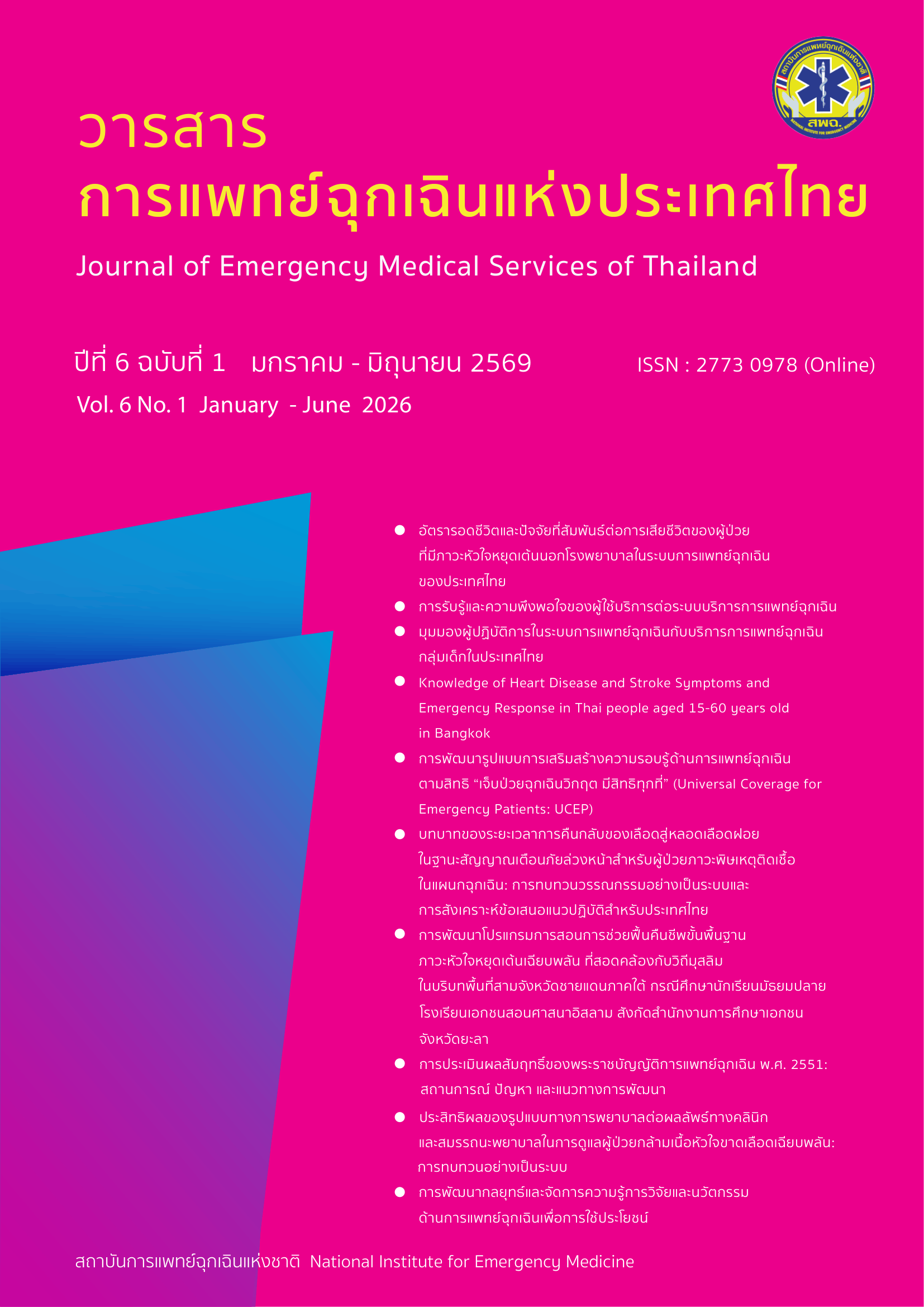
ความรู้เกี่ยวกับอาการโรคหัวใจและโรคหลอดเลือดสมอง รวมถึงการตอบสนองภาวะฉุกเฉิน ของประชาชนไทยอายุ 15-60 ปี ในกรุงเทพมหานคร
คำสำคัญ:
โรคหัวใจและหลอดเลือด, การรับรู้โรคหลอดเลือดสมอง, ความรอบรู้ด้านสุขภาพ, การตอบสนองภาวะฉุกเฉิน, ประเทศไทยบทคัดย่อ
โรคหัวใจและหลอดเลือด (cardiovascular disease: CVD) รวมถึงโรคหัวใจและโรคหลอดเลือดสมอง ยังคงเป็นสาเหตุสำคัญของการเจ็บป่วยและการเสียชีวิตทั่วโลก และมีแนวโน้มเพิ่มขึ้นอย่างต่อเนื่องในประเทศไทย การรับรู้สัญญาณอาการตั้งแต่ระยะเริ่มต้นและการตอบสนองต่อภาวะฉุกเฉินอย่างเหมาะสมเป็นปัจจัยสำคัญในการลดอัตราการเสียชีวิต อย่างไรก็ตาม ยังพบช่องว่างระหว่างความรู้และการนำไปปฏิบัติ โดยเฉพาะในประชากรเขตเมือง การศึกษานี้มีวัตถุประสงค์เพื่อประเมินความรอบรู้ด้านสุขภาพหัวใจและหลอดเลือด (ความรู้เกี่ยวกับอาการของโรคหัวใจและโรคหลอดเลือดสมอง) ประเมินความพร้อมในการตอบสนองต่อภาวะฉุกเฉิน และศึกษาปัจจัยทางประชากรศาสตร์ที่เกี่ยวข้องกับทั้งสองด้านในประชาชนไทยอายุ 15-60 ปี ในเขตกรุงเทพมหานคร การศึกษานี้เป็นการวิจัยเชิงพรรณนาแบบภาคตัดขวาง โดยเก็บข้อมูลจากกลุ่มตัวอย่างจำนวน 1,122 คน ด้วยแบบสอบถามออนไลน์ที่มีโครงสร้างและผ่านการตรวจสอบความตรงและความเชื่อมั่น ความรอบรู้ด้านสุขภาพหัวใจและหลอดเลือดวัดด้วยแบบทดสอบปรนัยจำนวน 20 ข้อ (ช่วงคะแนน 0-20) ขณะที่ความพร้อมในการตอบสนองต่อภาวะฉุกเฉินประเมินด้วยคำถามเชิงสถานการณ์จำนวน 10 ข้อ (ช่วงคะแนน 0-10) วิเคราะห์ข้อมูลด้วยสถิติเชิงพรรณนา การทดสอบ t-test แบบกลุ่มอิสระ การวิเคราะห์ความแปรปรวนทางเดียว (ANOVA) สหสัมพันธ์เพียร์สัน และการวิเคราะห์ถดถอยพหุคูณ โดยกำหนดระดับนัยสำคัญทางสถิติที่ p<0.05 ผลการศึกษาพบว่า กลุ่มตัวอย่างร้อยละ 56.51 มีความรอบรู้ด้านสุขภาพหัวใจและหลอดเลือดอยู่ในระดับดี ร้อยละ 35.83 อยู่ในระดับปานกลาง และร้อยละ 7.66 อยู่ในระดับต่ำ ในขณะที่ความพร้อมในการตอบสนองต่อภาวะฉุกเฉินอยู่ในระดับสูง โดยร้อยละ 91.09 อยู่ในระดับดี อายุ (p<0.05) และรายได้ครัวเรือนต่อเดือน (p<0.05) เป็นปัจจัยที่มีนัยสำคัญในการทำนายความรอบรู้ด้านสุขภาพ และทั้งสองปัจจัยยังสามารถทำนายความพร้อมในการตอบสนองต่อภาวะฉุกเฉินได้อย่างมีนัยสำคัญ (p<0.05) นอกจากนี้ ความรอบรู้ด้านสุขภาพหัวใจและหลอดเลือดยังมีความสัมพันธ์เชิงบวกกับความพร้อมในการตอบสนองต่อภาวะฉุกเฉิน โดยสรุปประชาชนไทยในเขตกรุงเทพมหานครมีระดับความรอบรู้ด้านสุขภาพหัวใจและหลอดเลือดในระดับปานกลางถึงสูง และมีความพร้อมในการตอบสนองต่อภาวะฉุกเฉินในระดับสูง อย่างไรก็ตาม ยังคงพบความเหลื่อมล้ำตามอายุและสถานะทางเศรษฐกิจและสังคม ผลการศึกษานี้ชี้ให้เห็นถึงความสำคัญของการพัฒนาแนวทางส่งเสริมความรอบรู้ด้านสุขภาพควบคู่กับการเสริมสร้างพฤติกรรมการตอบสนอง โดยเฉพาะในกลุ่มประชากรวัยหนุ่มสาวและผู้มีรายได้น้อย เพื่อเพิ่มประสิทธิภาพในการตอบสนองต่อภาวะฉุกเฉินทางหัวใจและหลอดเลือดอย่างทันท่วงที และส่งเสริมการป้องกันโรคอย่างเท่าเทียม
เอกสารอ้างอิง
Aekplakorn W, Suriyawongpaisal P, Sirirassamee B. Assessment of capacity for cardiovascular disease control and prevention in Thailand: a qualitative study. Southeast Asian J Trop Med Public Health [Internet]. 2005 [cited 2025 Jun 19];36(3):741–7. Available from: https://pubmed.ncbi.nlm.nih.gov/16124449/
Swanoski MT, Lutfiyya MN, Amaro ML, Akers MF, Huot KL. Knowledge of heart attack and stroke symptomology: a cross-sectional comparison of rural and non-rural US adults. BMC Public Health 2012;12:283.
Marcelo LC, Payo DP, Muñoz MM, Cisneros RP. Reduced income and its associations with physical inactivity, unhealthy habits, and cardiac complications in the hypertensive population. European J Investig Health Psychol Educ [Internet]. 2024 [cited 2025 May 19];14(8):2300–13. Available from: https://www.mdpi.com/2254-9625/14/8/153
Shahu A, Okunrintemi V, Tibuakuu M, Khan SU, Gulati M, Marvel F, et al. Income disparity and utilization of cardiovascular preventive care services among US adults. American J Prev Cardiol 2021;8:100286.
Quah JLJ, Yap S, Cheah SO, Ng YY, Goh ES, Doctor N, et al. Knowledge of signs and symptoms of heart attack and stroke among Singapore residents. Biomed Res Int [Internet]. 2014 [cited 2025 Jun 29];2014:572425. Available from: https://onlinelibrary.wiley.com/doi/10.1155/2014/572425
Alrawili NKA, Alanazi SN, Alanazi SN, Rikabi HA, Abdulkareem EM, Eltaib L. Public awareness and knowledge of stroke risk factors and symptoms in Saudi Arabia: A cross-sectional study. ARYA Atheroscler [Internet]. 2025 [cited 2025 Jun 29];21(4):26–35. Available from: https://arya.mui.ac.ir/article_32907.html
Dharmasaroja P, Uransilp N. Stroke awareness and knowledge in the at-risk population: a community-based study. Cureus [Internet]. 2024 [cited 2025 Jun 29]; Available from: https://www.cureus.com/articles/238078-stroke-awareness-and-knowledge-in-the-at-risk-population-a-community-based-study.pdf
Chang WW, Fei SZ, Pan N, Yao YS, Jin YL. Incident stroke and its influencing factors in patients with type 2 diabetes mellitus and/or hypertension: a prospective cohort study. Front Cardiovasc Med 2022;9:770025.
Kittiboonthawan P, Yingrengrueng S, Sritunya S. Perception of stroke warning signs among high-risk patients. Nurs J Minist Public Health [Internet]. 2025 [cited 2025 Jul 16];23(3):132–41. Available from: https://he02.tci-thaijo.org/index.php/tnaph/article/view/16637
Bryce TGK. Human Characteristics and School Learning, B. S. Bloom (McGraw-Hill, 1976) pp. xii plus 284, £8.95. Scott Educ Rev 1978;10(2):65–9.
Alyafei A, Carr RE. The health belief model of behavior change [Internet]. 2024 [cited 2025 Jul 16]. Available from: https://www.statpearls.com/point-of-care/161679
Nutbeam D. Health literacy as a public health goal: a challenge for contemporary health education and communication strategies into the 21st Century. Health Promot Int [Internet]. 2000 [cited 2025 Jul 16];15(3):259–67. Available from: https://academic.oup.com/heapro/article/15/3/259/551108
Lundelin K, Graciani A, Puig JG, Castillón PG, Taboada JM, Artalejo FR, et al. Knowledge of stroke warning symptoms and intended action in response to stroke in Spain: A Nationwide Population-Based Study. Cerebrovasc Dis 2012;34(2):161–8.
Bártlová S, Šedová L, Rolantová L, Hudáčková A, Dolák F, Sadílek P. General awareness of stroke in the Czech Republic. Cent Eur J Public Health 2021;29(3):230–5.
Egele VS, Klopp E, Stark R. How Valid Is Bandura’s social cognitive theory to explain physical activity behavior? Eur J Investig Health Psychol Educ [Internet]. 2025 [cited 2025 Aug 5];15(2):20. Available from: https://www.mdpi.com/2254-9625/15/2/20
Ajzen I. The theory of planned behavior. Organizational Behavior and Human Decision Processes 1991;50(2):179–211.
World Health Organization. Social determinants of health [Internet]. 2025 [cited 2025 Aug 5]. Available from: https://www.who.int/health-topics/social-determinants-of-health#tab=tab_1
Alkhawaldeh A, ALBashtawy M, Rayan A, Abdalrahim A, Musa AS, Eshah NF, et al. Application and use of Andersen’s behavioral model as theoretical framework: a systematic literature review from 2012–2021. Iran J Public Health 2023;52(7).
ดาวน์โหลด
เผยแพร่แล้ว
รูปแบบการอ้างอิง
ฉบับ
ประเภทบทความ
สัญญาอนุญาต
ลิขสิทธิ์ (c) 2026 วารสารการแพทย์ฉุกเฉินแห่งประเทศไทย

อนุญาตภายใต้เงื่อนไข Creative Commons Attribution-NonCommercial-NoDerivatives 4.0 International License.



