The Effect of E-learning on Medicine Injection to Learning Outcome and Satisfaction for Second-year Nursing Students Boromarajonani College of Nursing, KhonKean
Abstract
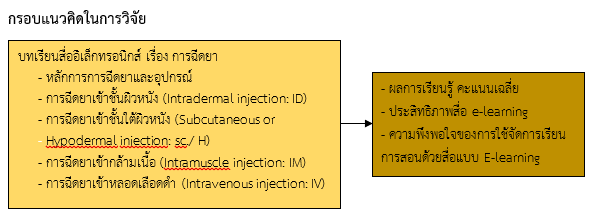
The aim of this quasi-experimental research was to explore the effect of teaching medicine injection technique by using e-learning to learning achievements and satisfaction among second year of nursing students at Boromarajonani College of Nursing, Khon Kaen, There were totally 90 participants studying Principles and Techniques in Nursing subject in first semester of academic year 2017. The participants were randomly divided into two groups: experimental group (n=45) and control group (n=45). Data collection were collected between October and November 2017. The instruments of this study included medicine injection using e-learning, pre-during-post tests, and satisfaction questionnaire. Descriptive data analysis (average and standard deviation), paired t-test, and independent t-test were used in this study.
The results showed that 1) participants in experimental group have significantly higher in all scores of after using e-learning than the control group at p value <0.05. 2) The participants in experimental group has significantly higher score of post-test than the control group. In addition, the effective of e-learning in experimental group found that it was also a higher score than control group: 81.42/80.92 (standard score was 80/80). Moreover, satisfaction score was very good (=3.98, SD=0.68). The results of this study suggest that it is important to promote e-learning in nursing education to encourage life-long learning and promote self-confidence of nursing students in nursing practice.
References
ธัญญลักษณ์ วจนะวิศิษฐ. (2557). การพัฒนาบทเรียนอีเลิร์นนิงรายวิชาเทคโนโลยีสารสนเทศ คณะพยาบาลศาสตร์เกื้อการุณย์. วารสารเกื้อการุณย์. 21(1) มกราคม-มิถุนายน.
นภาภรณ์ ฉัตรมณีรุ่งเจริญ. 2555. การศึกษาการยอมรับการจัดการเรียนรู้แบบอีเลิร์นนิงของอาจารย์และนิสิต มหาวิทยาลัยเกษตรศาสตร์ วิทยาเขตกำแพงแสน. Veridian E-Journal, 5(2), น. 388-402.
นิภา กิมสูงเนิน และสุวรีย์ เพชรแต่ง. 2559. ผลการใช้สื่อการสอนอิเล็กทรอนิกส์ต่อผลสัมฤทธิ์ทางการเรียนของนักเรียนพยาบาลมหาวิทยาลัยรังสิต. วารสารพยาบาลกาชาดไทย, 9(1). น. 63-74.
นาถวดี นันทาภินัย. 2561. การวิจัยและพัฒนาบทเรียนอีเลินนิ่งเพื่อการพัฒนาทักษะการคิดของนักเรียนระดับมัธยมศึกษา. วารสารวิจัยทางการศึกษา คณะศึกษาศาสตร์ มหาวิทยาลัยศรีนครินทรวิโรฒ. 13(2), น.54-69.
ปภาวดี ทวีสุข, เกษร สุวิทยะศิริ และเสาวลักษณ์ หวังชม. 2562. การพัฒนาสื่อวีดิทัศน์ เรื่อง การตรวจครรภ์ สำหรับนักศึกษาพยาบาลศาสตร์ วิทยาลัยพยาบาลบรมราชชนนี กรุงเทพ. วารสารวิทยาลัยพยาบาลบรมราชชนนี กรุงเทพ. 35(1).น. 264-276.
ประยูร ไชยบุตร.2547. การสร้างนวัตกรรม e-Learning เรื่องระบบเครือข่ายคอมพิวเตอร์. มหาวิทยาลัยราชภัฏเพชรบูรณ์. [ออนไลน์].เข้าได้จาก http://dcms.thailis.or.th/tdc.
พิมพ์พัฒน์ จันทร์เทียน, ศุภาพิชญ์ โฟนโบร์แมนน์, & วรรณพร บุญเปล่ง. (2016). ความพร้อมของนักศึกษาพยาบาลใน สังกัดสถาบันพระบรมราชชนกในการเข้าสู่ประชาคมอาเซียน. Nursing Journal of The Ministry of Public Health, 26(1), 134-148.
อรรถวิทย์ ชังคมานนท์ และก่องกาญจน์ ดุลยชัย (2560). การพัฒนารูปแบบทางเลือกสำหรับอีเลินนิ่งในยุคสังคมออนไลน์. วารสารวิชาการมหาวิทยาลัยฟาร์อีสเทอร์น. 11(ฉบับพิเศษ), น.44-55.
Bryn Holmes and John Gardner. 2006. E-Learning: Concepts and practice. Thousand Oaks, CA: Sage Publications.
Clank, R. C. and Mayer, R. E. (2003). E-Learning and the science of instruction. JohnWiley & Sons,Inc, New York.
Eamsiriwong, O. 2008. Computer Science and Information Technology. Bangkok: SE-EDUCATION.
Park, E. H., & Hwang, S. Y. (2011). Development and effects of an e-learning program in operating room nursing for nursing students. Journal of Korean Academy of Nursing, 41(1), 36-46.
Downloads
Published
How to Cite
Issue
Section
License
Copyright (c) 2024 Praboromarajchanok Institute

This work is licensed under a Creative Commons Attribution-NonCommercial-NoDerivatives 4.0 International License.



