Factor Related to Psychological Distress Among Thai Adolescence During covid 19 Pandemic in the Endemic Preparation Phase
Keywords:
Adolescent, Mental Distress, Covid 19Abstract
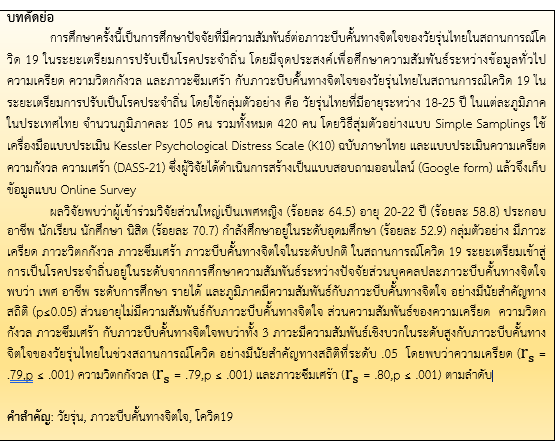
This study aimed to determine the factors related to psychological distress among Thai adolescence during covid 19 Pandemic in the endemic preparation phase. The objectives were to study the relationship between demographic data and psychological distress, and the relationship between stress, anxiety, depression and psychological distress during the endemic preparation phase. Thai teenagers aged 18-25 throughout Thailand were recruited as the participant. G power was used to calculate sample size, resulting 420 cases (105 persons per each region). Research measurement included the Thai version of the Kessler psychological stress scale (K10) and stress and anxiety assessment Sadness (DASS-21). Online survey (google form) was used for data collection. Regarding data analysis, frequency, percentage, mean and standard deviation were used for demographic data. To determine the relationship between factors and psychological distress, chi-square and Pearson correlation were implemented.
The result found that majority of participants were female (64.5%), aged 20-22 years (58.8%), students (70.7%), studying in higher education (52.9%). Regarding mental health distress, participants reported normal level of stress, anxiety, depression and psychological distress during COVID-19. The relationship of demographic factors and psychological distress revealed that gender, occupation, education level, income, and region were significantly related to psychological depress (p≤0.05) while age showed no relationship. Regarding other factors; stress, anxiety and depression, results reported that these 3 factors showed significantly positive relation at high level with psychological distress (p≤0.05), resulting stress (rs = .79, p ≤ .001) anxiety (rs = .79, p ≤ .001) and depression (rs = .80, p ≤ .001) respectively.
References
กฤชกันทร สุวรรณพันธุ์, เสาวลักษณ์ ศรีดาเกษ, ลำพึง วอนอก, สุพัฒน์ อาสนะ, วรรณศรี แววงาม, กุลธิดา กิ่งสวัสดิ์, ภานุชนาถ อ่อนไกล. (2563). ปัจจัยที่มีความสัมพันธ์กับความเครียดต่อการระบาดของโรคติดเชื้อไวรัสโคโรนา2019 (COVID-19) ของนักศึกษาคณะสาธารณสุขศาสตร์และสหเวชศาสตร์ สถาบันพระบรมราชชนก. วารสารวิจัยทางวิทยาศาสตร์สุขภาพ, 14(2), 138-146.
เชาวลิต ศรีเสริม, วิจิตรา จิตรักษ์, บุปผา ใจมั่น, พิชญานิกา เชื้อกาญจน. (2564). ปัจจัยที่มีความสัมพันธ์กับภาวะบีบ คั้นทางจิตใจของนักศึกษาพยาบาลในช่วงที่มีการแพร่ระบาดของโรคติดเชื้อไวรัสโคโรนา 2019.วารสารสุขภาพและการศึกษาพยาบาล, 21(1), 77-88.
ธิดารัตน์ คณึงเพียร, จิรสุดา ทะเรรัมย์. การศึกษาการรับรู้ด้านสุขภาพ ความกังวลต่อไวรัส Covid-19 และภาวะ สุขภาพจิต นักศึกษาพยาบาลศาสตร์. วารสารมหาจุฬาวิชาการ, 9(1), 308-319.
ภัทราภรณ์ ภทรสกุล, ศิริรัตน์ นิตยวัน, สุวิท อินทอง, และราตรี ทองยู (2021). in Rahman, M.A., Islam, S.M.S., Tungpunkom, P. et al. (2021). COVID-19: Factors associated with psychological distress, fear, and coping strategies among community members across 17 countries. Global Health 17, 117: 1-19 https://doi.org/10.1186/s12992-021-00768-3
ยุทธชัย ไชยสิทธิ์, ขวัญประภัสร จันทร์บุลวัชร์, รัตติยา ทองอ่อน, อรอุมา แก้วเกิด. (2564). การวิเคราะห์มโนทัศน์ ภาวะบีบคั้นทางจิตวิญญาณ. วารสารสภาการพยาบาล, 36(2) 5-17
ลัดดา อินไหม, ชัยณรงค์ มากเพ็ง, นันทวุฒิ วงศ์เมฆ, นวรัตน์ เมามีจันทร์, ซอลาฮ เด็งมาซ. (2565). ความชุก และ ปัจจัยที่มีความสัมพันธ์ของความเครียด ความกังวล และภาวะซึมเศร้า ของวัยรุ่นในสถานการณ์การระบาดของเชื้อไวรัสโคโรนา 2019 (COVID-19): กรณีศึกษาโรงเรียนรัษฎา จังหวัดตรัง.วารสารเทคโนโลยีภาคใต้, 15(2), 48-58.
รัตนาภรณ์ ชูทอง, ภควัต วิวัฒนวรเศรษฐ์, ณภัควรรต บัวทอง, ยุพา หนูทอง, ชาตินันท์ อยู่สุข, ณัฐกุล รุ่งเรือง, นพดล หมัดอาหวา, พีระสิทธิ์ แซ่ลิ้ม, แพรนภา ชัยทวี ทรัพย์, ภัทรเนตร ชี้เจริญ, เรณุกา จันทร์สุวรรณ และ องค์อร สรายุทธพิทักษ์ (2562) ภาวะสุขภาพจิต สภาพและการปฏิบัติหน้าที่ของ ครอบครัวในนักศึกษาระดับปริญญาตรีของ มหาวิทยาลัยแห่งหนึ่ง ภาคใต้ของประเทศไทย, วารสารสมาคมจิตแพทย์แห่งประเทศไทย, 64(4), 337-350
วรินทิพย์ สว่างศรี (2564). ความชุกของการรับรู้ความเครียด ภาวะซึมเศร้า และปัจจัยที่เกี่ยวข้องในผู้ป่วยโรคโควิด 19 เขตกรุงเทพมหานคร.สถาบันสุขภาพจิตเด็กและวัยรุ่นราชนครินทร์.
วิศิษฏ์ เนติโรจนกุล. (2563). ความชุกและปัจจัยที่เกี่ยวข้องของปัญหาทางสุขภาพจิตของบุคลากรทางการแพทย์ โรงพยาบาลนครปฐมในยุคการระบาดของโรคติดเชื้อไวรัสโคโรนา 2019 (โควิด-19). วารสารแพทย์เขต 4-5, 39(4), 616-627.
วรดา ปีติยา, พลิศรา ธรรมโชติ. (2565). ปัจจัยที่มีความสัมพันธ์กับผลกระทบด้านอารมณ์และพฤติกรรมในวัยรุ่นจาก สถานการณ์การระบาดโควิด-19. คณะแพทยศาสตร์โรงพยาบาลรามาธิบดี มหาวิทยาลัยมหิดล.
Baloch, G. M., Sundarasen, S., Chinna, K., Nurunnabi, M., Kamaludin, K., Khoshaim, H. B., ... & AlSukayt, A. (2021). COVID-19: exploring impacts of the pandemic and lockdown on mental health of Pakistani students. PeerJ, 9, e10612.
Cohen, J. (1988). Statistical power analysis for the behavioral sciences. (2nd). Hillsdale, NJ: Lawrence Erlbaum Associates, Publishers.
Faul, F., Erdfelder, E., Lang, A. G., & Buchner, A. (2007). G*Power 3: A flexible statistical power analysis program for the social, behavioral, and biomedical sciences. Behavior Research Methods, 39(2), 175-191.
Huckins, J. F., DaSilva, A. W., Wang, W., Hedlund, E., Rogers, C., Nepal, S. K., ... & Campbell, A. T. (2020). Mental health and behavior of college students during the early phases of the COVID-19 pandemic: Longitudinal smartphone and ecological momentary assessment study. Journal of medical Internet research, 22(6), e20185.
Purnama, A., Susaldi, S., Mukhlida, H. Z., Maulida, H. H., & Purwati, N. H. (2021). Mental Health in Health Students during Coronavirus Disease-19: Systematic Review. Open Access Macedonian Journal of Medical Sciences, 9(F), 205-210.
Qiu, J., Shen, B., Zhao, M., Wang, Z., Xie, B., & Xu, Y. (2020). A nationwide survey of psychological distress among Chinese people in the COVID-19 epidemic: Implications and policy recommendations. General Psychiatry, 33(e100213), Retrieved from https://gpsych.bmj.com/content/gpsych/33/2/e100213.full.pdf
Rehman U, Shahnawaz MG, Khan NH, Kharshiing KD, Khursheed M, Gupta K, Kashyap D, Uniyal R. (2021). Depression, Anxiety and Stress Among Indians in Times of Covid-19 Lockdown. Community Mental Health Journal, 57(1), 42-48. doi: 10.1007/s10597-020-00664-x.
Wang, X., Hegde, S., Son, C., Keller, B., Smith, A., & Sasangohar, F. (2020). Investigating mental health of US college students during the COVID-19 pandemic: cross-sectional survey study. Journal of medical Internet research, 22(9), e22817.
Downloads
Published
How to Cite
Issue
Section
License
Copyright (c) 2024 Praboromarajchanok Institute

This work is licensed under a Creative Commons Attribution-NonCommercial-NoDerivatives 4.0 International License.



