Nursing Care for Patients with Fractures Pelvic and Hemothorax
Keywords:
Case study, fracture pelvic, Hemothorax, nursingAbstract
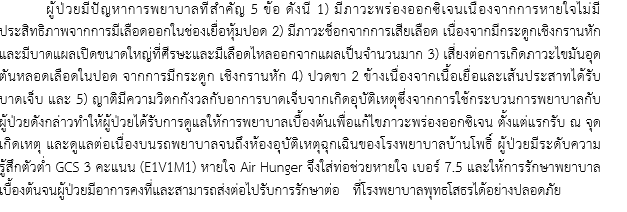
This article aims to provide nursing care for patients with pelvic fractures accompanied by hemothorax in a safe manner, preventing complications, and adhering to professional nursing standards, from the beginning of admission until the patient is transferred to a tertiary hospital for treatment. Pelvic fractures accompanied by hemothorax are considered high-risk conditions for mortality. The pelvis is a major blood reservoir, and fractures in this area can lead to severe blood loss. When hemothorax occurs simultaneously, the lungs may fail to expand fully, potentially resulting in hypoxemia and oxygen deprivation in other organs. This condition requires urgent diagnosis and treatment to prevent fatal outcomes. In a case study of a 51-year-old Thai male patient, Thai nationality, Thai ethnicity, and Buddhist religion, he had an accident while walking on the road and was hit by a truck trailer, causing him to lose consciousness. The Advanced Medical Operation Unit of Ban Pho Hospital received the patient at the scene on May 13, 2024, at 9:00 p.m. The patient was notified and delivered at 9:30 p.m. and arrived at Ban Pho Hospital at 10:36 p.m. The Advanced Medical Operation Unit of Ban Pho Hospital uses the concept of holistic nursing theory to provide nursing care to patients at the scene of the accident. Nursing with a human heart, taking care of all aspects without separation, considering the components of the body, both physical, mental, social, and spiritual, and using Orem's self-care theory to analyze the patient's ability to take care of themselves and organize a system of alternative services that the patient must receive. The analysis found that the patient had multiple injuries, a large wound that caused a lot of blood loss, and was unconscious, which caused abnormal vital signs. He was unable to be aware and help himself in all matters, and he was unable to breathe on his own. This meant that the patient had a deficiency in self-care. The nurse had to use the total replacement nursing system (therapeutic self-care demand) for this patient and diagnose nursing according to the NANDA model.
The results of the study found that the patient had four major nursing problems, as follows: 1) Oxygen deficiency due to chest injury, which reduced the efficiency of breathing to exchange oxygen gas. 2) At risk of shock from blood loss due to a fractured pelvis and a large open wound on the head. 3) at risk of pulmonary embolism from a fractured pelvic bone. 4) Relatives were anxious about the injury from birth. Using the nursing process with the patient resulted in the patient receiving initial nursing care to correct the oxygen deficiency from the first admission at the scene of the accident and continued care on the ambulance to the emergency room of Ban Pho Hospital. The patient had a low level of consciousness, GCS 3 points (E1V1M1), and air hunger. Therefore, a 7.5-inch endotracheal tube was inserted, and initial care was given until the patient was stable and could be safely transferred to Phutthasothon Hospital for further treatment.
References
ดวงกมล สุวรรณ์, วิภา แซ่เซี้ย และประณีต ส่งวัฒนา. (2561). ผลของการใช้รูปแบบการพยาบาลแบบการจัดการรายกรณีต่อผลลัพธ์การดูแลในผู้ป่วยบาดเจ็บหลายระบบ. วารสารสภาการพยาบาล, 33(4), 33-45.
พงศธร ฉันท์พลากร,ชนิกา อังสนันท์สุข,นรเทพ กุลโชติ,ปพน สง่าสูงส่ง,เทพรัตน์ กาญจนเทพศักดิ์. (2562). ตำราการบาดเจ็บทางออร์โธปิดิกส์ Textbook of orthopedic trauma. คณะแพทยศาสตร์โรงพยาบาลรามาธิบดีมหาวิทยาลัยมหิดล.
สมพล ฤกษ์สมถวิล. (2560). การดูแลผู้ป่วยบาดเจ็บช่องท้อง. วารสารสถาบันบำราศนราดูร, 11(3), 1-8.
ไสว นรสาร. (2563). การพยาบาลผู้บาดเจ็บ. ไอเดีย อินสแตนท์.
American Holistic Nurses Association, American Nurses Association. (2007). Holistic nursing: scope and standards of practice. Silver Spring.
Fawley, J. A., Tignanelli, C. J., Werner, N. L., Kasotakis, G., Mandell, S. P., Glass, N. E., et al. (2023). American Association for the Surgery of Trauma/American College of Surgeons Committee on Trauma clinical protocol for management of acute respiratory distress syndrome and severe hypoxemia. Journal of Trauma and Acute Care Surgery, 95(4), 592-602.
Guerado, E., Bertrand, M. L., Valdes, L., Cruz, E., & Cano, J. R. (2015). Suppl 1: M3: resuscitation of polytrauma patients: the management of massive skeletal bleeding. The open orthopaedics journal, 9, 283.
Moore E. E., Feliciano D. V., & Mattox K.L.(Eds.). (2017). Trauma, 8e. McGraw-Hill Education. Retrieved November 2, 2024 from https://accesssurgery.mhmedical.com/content. aspx?bookid=2057§ionid=156210710
North American Nursing Diagnosis Association. (1999). NANDA Nursing Diagnoses: Definitions and classification 1999–2000. Philadelphia.
Orem DE, Taylor SG, Renpenning KM. (2001). Nursing: Concepts of practice (6thed.). Mosby.
Wertheimer, A., Olaussen, A., Perera, S., Liew, S., & Mitra, B. (2018). Fractures of the femur and blood transfusions. Injury, 49(4), 846-851.
Downloads
Published
How to Cite
Issue
Section
License
Copyright (c) 2024 Praboromarajchanok Institute

This work is licensed under a Creative Commons Attribution-NonCommercial-NoDerivatives 4.0 International License.



