Enhancing Access to Emergency Medical Services in Peri-Urban Areas
Keywords:
Emergency Medical Services, Healthcare Access, Rural Area, Plaeng Yao District, Network DevelopmentAbstract
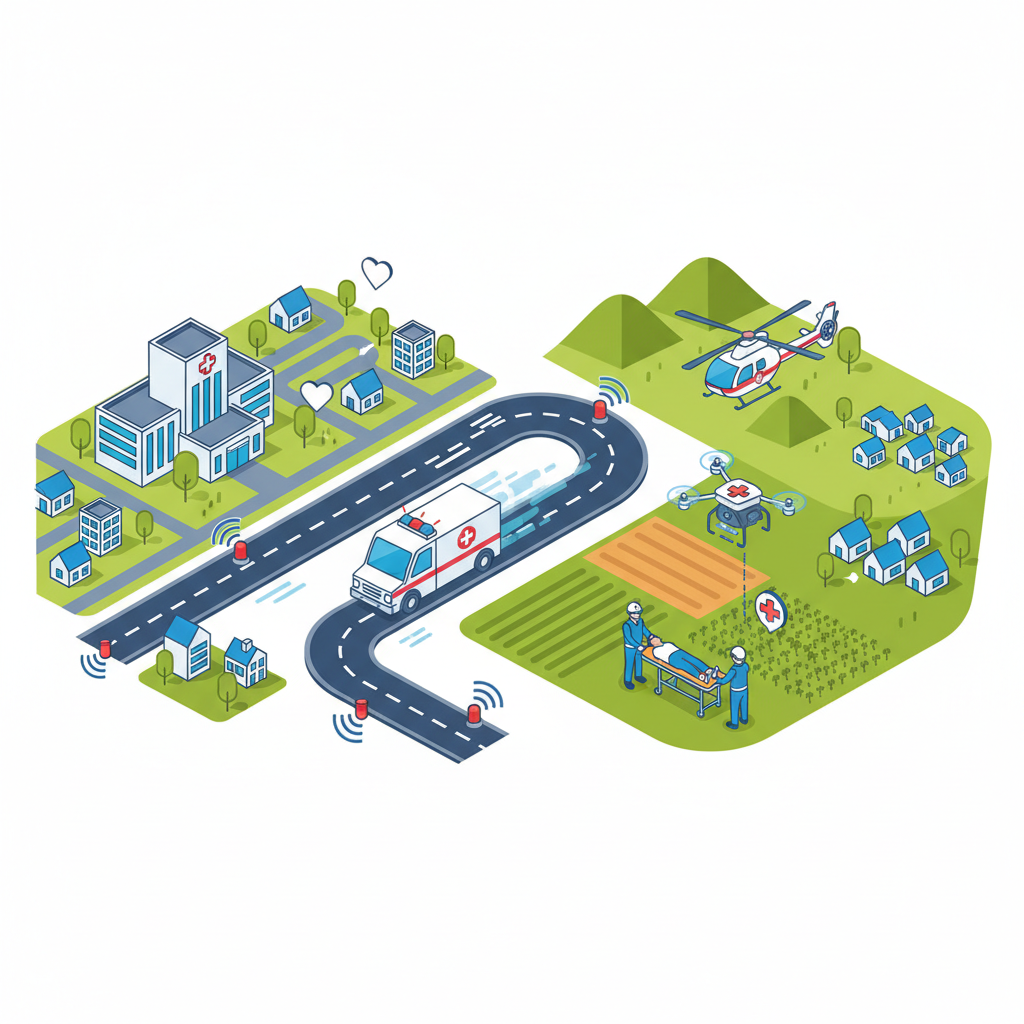
This academic article aims to present guidelines for developing the Emergency Medical Services (EMS) system in Plaeng Yao District, Chachoengsao Province, utilizing a literature review and secondary data analysis from relevant agency reports. Plaeng Yao District possesses a diverse network of EMS providers, encompassing public hospitals, local administrative organizations (LAOs), and private rescue units or foundations. Despite the presence of these varied entities, access to emergency services remains constrained by multi-dimensional challenges. On the human resource front, there is a critical shortage of standard-trained personnel compounded by a lack of continuous development initiatives. Financially, budget constraints within smaller local administrative organizations severely hinder equipment procurement and routine vehicle maintenance. Furthermore, administrative management is obstructed by a lack of unified coordination among agencies, which frequently results in operational redundancies and service gaps. This is exacerbated by a lack of public awareness, as many citizens still misunderstand the functions of the 1669 hotline and harbor anxieties regarding potential service expenses. Lastly, geographical barriers, including remote distances and poor road conditions in certain sectors, continue to obstruct rapid emergency responses. To address these interconnected challenges, this report proposes a comprehensive development framework for the EMS system, structured around five core strategic pillars. First, regarding personnel and standards, the framework focuses on continuously enhancing the capacity of both professionals and volunteers while simultaneously building public trust. Second, to improve management and coordination, it aims to eliminate operational gaps and redundancies through the establishment of a dedicated District EMS Coordination Committee. Third, the strategy advocates for the integration of technology and innovation, utilizing digital tools to overcome spatial and geographical limitations. Fourth, to foster community engagement, the plan emphasizes proactive health literacy through targeted public relations campaigns, ensuring citizens fully understand and utilize the 1669 hotline system. Finally, the framework addresses policy and budget by driving sustainable financial and structural support from government bodies, ensuring the long-term viability of the emergency network.
References
สถาบันการแพทย์ฉุกเฉินแห่งชาติ. (2563). รายงานประจำปี 2563 สถาบันการแพทย์ฉุกเฉินแห่งชาติ. สถาบันการแพทย์ฉุกเฉินแห่งชาติ.
สำนักงานสถิติจังหวัดฉะเชิงเทรา. (2564). รายงานสถิติจังหวัด พ.ศ. 2564. สำนักงานสถิติจังหวัดฉะเชิงเทรา
สำนักงานสาธารณสุขจังหวัดฉะเชิงเทรา. (2565). รายงานประจำปีงบประมาณ 2565. กระทรวงสาธารณสุข. https://cco.moph.go.th/cco24/status/รวมเล่ม%20รายงานประจำปี%202565.pdf
Siriwiwattnakul, A. (2020). The Development of Emergency Medical Service System for STEMI Patients in the Service Plan Area 11. Region 11 Medical Journal, 34(2), 263-274.
Tipayamongkholgul, M. (2021). Health Disparity and Inequity in Thailand. In Equity in Health and Healthcare in Developing Countries (pp. 1-17). Springer, Singapore.
Downloads
Published
How to Cite
Issue
Section
License
Copyright (c) 2026 Praboromarajchanok Institute

This work is licensed under a Creative Commons Attribution-NonCommercial-NoDerivatives 4.0 International License.



