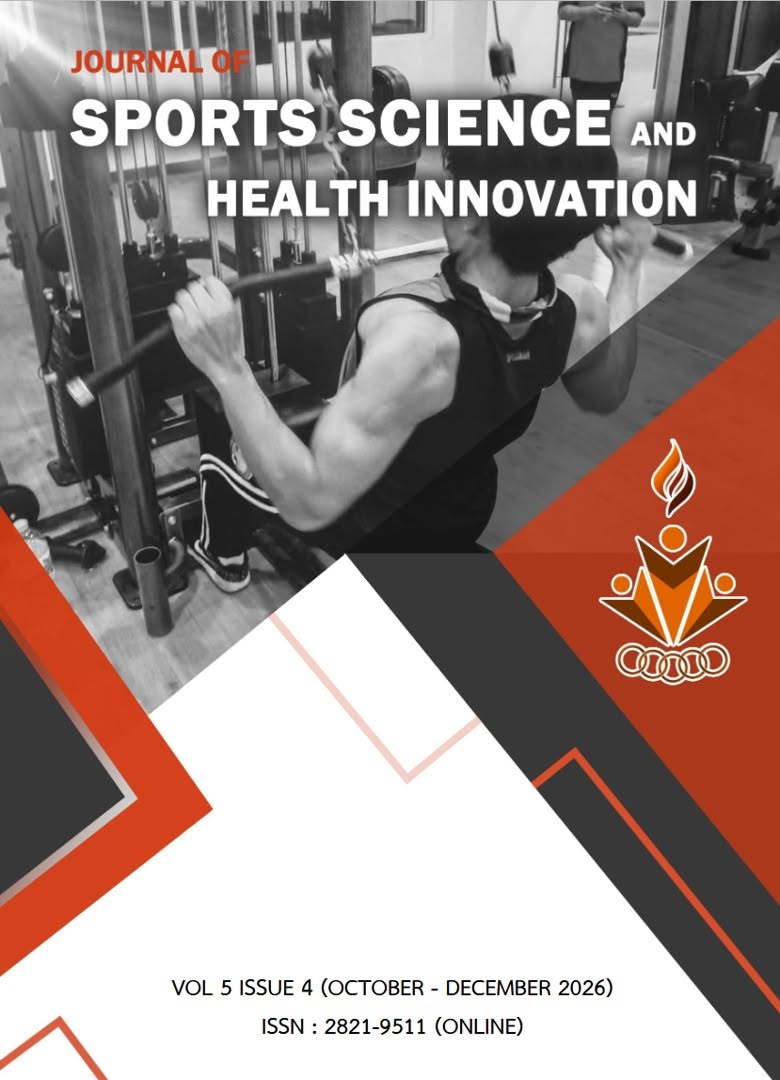
ผลของโปรแกรมการออกกำลังกายแบบแรงต้านที่มีผลต่อสมรรถภาพทางกายเพื่อสุขภาพ ในนักศึกษามหาวิทยาลัยราชภัฏกาญจนบุรี
Article Sidebar
Main Article Content
บทคัดย่อ
งานวิจัยนี้มีวัตถุประสงค์เพื่อ 1) ศึกษาผลของโปรแกรมการออกกำลังกายแบบแรงต้านที่มีต่อสมรรถภาพทางกายเพื่อสุขภาพของนักศึกษามหาวิทยาลัยราชภัฏกาญจนบุรี 2) เพื่อศึกษาผลของปัจจัยด้านเพศที่มีต่อการเปลี่ยนแปลงสมรรถภาพทางกายเพื่อสุขภาพภายหลังเข้าร่วมโปรแกรมการออกกำลังกายแบบแรงต้าน และ 3) ศึกษาปฏิสัมพันธ์ระหว่างโปรแกรมการออกกำลังกายแบบแรงต้านและเพศที่มีต่อสมรรถภาพทางกายเพื่อสุขภาพ ใช้รูปแบบการวิจัยกึ่งทดลอง โดยใช้แบบแผนการทดลองแบบ 2 × 2 factorial design กลุ่มตัวอย่างเป็นนักศึกษามหาวิทยาลัยราชภัฏกาญจนบุรี อายุระหว่าง 18–25 ปี จำนวน 40 คน คัดเลือกด้วยวิธีการคัดเลือกแบบเฉพาะเจาะจง และแบ่งออกเป็น 4 กลุ่ม ได้แก่ กลุ่มทดลองเพศชาย กลุ่มทดลองเพศหญิง กลุ่มควบคุมเพศชาย และกลุ่มควบคุมเพศหญิง กลุ่มทดลองเข้าร่วมโปรแกรมการออกกำลังกายแบบแรงต้านเป็นระยะเวลา 8 สัปดาห์ สัปดาห์ละ 3 ครั้ง เครื่องมือที่ใช้ในการวิจัยประกอบด้วยแบบทดสอบสมรรถภาพทางกายเพื่อสุขภาพ ได้แก่ ดัชนีมวลกาย ความอ่อนตัวของร่างกาย ความแข็งแรงของกล้ามเนื้อและความอดทนของกล้ามเนื้อ และความอดทนของระบบหัวใจและไหลเวียนเลือด วิเคราะห์ข้อมูลด้วยค่าเฉลี่ย ส่วนเบี่ยงเบนมาตรฐาน และสถิติ Two-way analysis of variance (ANOVA) ผลการวิจัยพบว่า โปรแกรมการออกกำลังกายแบบแรงต้านส่งผลให้สมรรถภาพทางกายด้านความอ่อนตัว ความแข็งแรงของกล้ามเนื้อ และความอดทนของระบบหัวใจและหลอดเลือดเพิ่มขึ้นอย่างมีนัยสำคัญทางสถิติที่ระดับ .05 ในขณะที่ดัชนีมวลกายไม่พบความแตกต่างอย่างมีนัยสำคัญ นอกจากนี้ไม่พบความแตกต่างของการเปลี่ยนแปลงสมรรถภาพทางกายระหว่างนักศึกษาเพศชายและเพศหญิง และไม่พบปฏิสัมพันธ์ระหว่างโปรแกรมการออกกำลังกายแบบแรงต้านและเพศ สรุปได้ว่าโปรแกรมการออกกำลังกายแบบแรงต้านสามารถส่งเสริมสมรรถภาพทางกายเพื่อสุขภาพของนักศึกษาได้อย่างมีประสิทธิภาพและครอบคลุมสามารถยืนยันนำไปใช้เป็นมาตรฐานสำหรับนักศึกษาได้โดยไม่ต้องแยกตารางฝึกตามเพศ
Article Details
เนื้อหาและข้อมูลในบทความที่ลงตีพิมพ์ในวารสารวิทยาศาสตร์การกีฬาและนวัตกรรมสุขภาพ กลุ่มมหาวิทยาลัยราชภัฏแห่งประเทศไทย ถือเป็นข้อคิดเห็นและความรับผิดชอบของผู้เขียนบทความโดยตรงซึ่งกองบรรณาธิการวารสาร ไม่จำเป็นต้องเห็นด้วย หรือร่วมรับผิดชอบใด ๆ
บทความ ข้อมูล เนื้อหา รูปภาพ ฯลฯ ที่ได้รับการตีพิมพ์ในวารสารวิทยาศาสตร์การกีฬาและนวัตกรรมสุขภาพ กลุ่มมหาวิทยาลัยราชภัฏแห่งประเทศไทย ถือเป็นลิขสิทธิ์ของคณะวิทยาศาสตร์และเทคโนโลยี มหาวิทยาลัยราชภัฏศรีสะเกษ หากบุคคลหรือหน่วยงานใดต้องการนำทั้งหมดหรือส่วนหนึ่งส่วนใดไปเผยแพร่ต่อหรือเพื่อกระทำการใด จะต้องได้รับอนุญาตเป็นลายลักษณ์อักษรจากวารสารวิทยาศาสตร์การกีฬาและนวัตกรรมสุขภาพ กลุ่มมหาวิทยาลัยราชภัฏแห่งประเทศไทย ก่อนเท่านั้น
เอกสารอ้างอิง
American College of Sports Medicine. (2021). ACSM’s guidelines for exercise testing and prescription (11th ed.). Philadelphia, PA: Wolters Kluwer.
Booth, F. W., Roberts, C. K., & Laye, M. J. (2012). Lack of exercise is a major cause of chronic diseases. Comprehensive Physiology, 2(2), 1143–1211. https://doi.org/10.1002/cphy.c110025
Bull, F. C., Al-Ansari, S. S., Biddle, S., Borodulin, K., Buman, M. P., Cardon, G., & Willumsen, J. F. (2020). World Health Organization 2020 guidelines on physical activity and sedentary behaviour. British Journal of Sports Medicine, 54(24), 1451–1462. https://doi.org/10.1136/bjsports-2020-102955
Department of Physical Education. (2019). Physical fitness test manual for people aged 19–59 years. Bangkok: Department of Physical Education, Ministry of Tourism and Sports. (in Thai)
Grgic, J., Schoenfeld, B. J., Orazem, J., & Sabol, F. (2018). Effects of resistance training on muscle strength in men and women: A systematic review and meta-analysis. Journal of Sports Sciences, 36(16), 1857–1864. https://doi.org/10.1007/s40279-018-0872-x
Huang, Z., Wang, W., Huo, K., Wang, Y., & Tian, K. (2025). Physical fitness status and influencing factors among college students aged 19–22 in Shandong province, China: A cross-sectional study. BMC Public Health, 25, 2105. https://doi.org/10.1186/s12889-025-22350-x
Kenney, W. L., Wilmore, J. H., & Costill, D. L. (2020). Physiology of sport and exercise (7th ed.). Champaign, IL: Human Kinetics.
McArdle, W. D., Katch, F. I., & Katch, V. L. (2015). Exercise physiology: Nutrition, energy, and human performance (8th ed.). Philadelphia, PA: Wolters Kluwer.
Myers, J., McAuley, P., Lavie, C. J., Després, J.-P., Arena, R., & Kokkinos, P. (2015). Physical activity and cardiorespiratory fitness as major markers of cardiovascular risk: Their independent and interwoven importance to health status. Progress in Cardiovascular Diseases, 57(4), 306–314. https://doi.org/10.1016/j.pcad.2014.09.011.
Roberts, B. M., Nuckols, G., & Krieger, J. W. (2020). Sex differences in resistance training: A systematic review and meta-analysis. Journal of Strength and Conditioning Research, 34(5), 1448–1460. https://doi.org/10.1519/JSC.0000000000003521.
Warburton, D. E. R., & Bredin, S. S. D. (2017). Health benefits of physical activity: A systematic review of current systematic reviews. Current Opinion in Cardiology, 32(5), 541–556. https://doi.org/10.1097/HCO.0000000000000437
World Health Organization. (2020). WHO guidelines on physical activity and sedentary behaviour [Online]. Retrieved February 8, 2026, from https://www.who.int/publications/i/item/9789240015128
World Health Organization. (2022). Global status report on physical activity 2022. Geneva: World Health Organization. https://doi.org/10.2471/9789240059153
Yu, X., & Kanchanathaweekul, T. (2023). Effects of cross-training exercise program to improve health-related physical fitness for university students in Guangdong. International Journal of Sociologies and Anthropologies Science Reviews, 3(6), 247–260. https://doi.org/10.60027/ijsasr.2023.3414
