
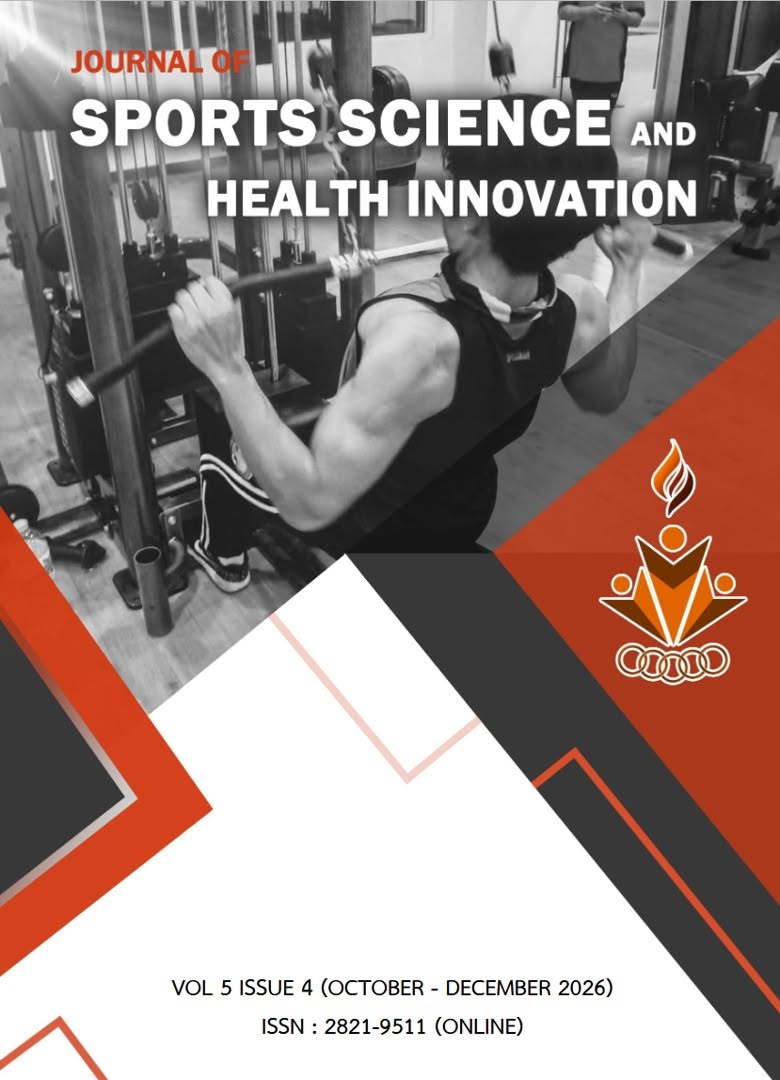
ผลของการฝึกแบบสถานีที่มีต่อสมรรถภาพทางกายของผู้ชาย ที่มีน้ำหนักปกติและผู้ชายที่มีน้ำหนักเกิน
Article Sidebar
Main Article Content
บทคัดย่อ
การวิจัยครั้งนี้มีวัตถุประสงค์เพื่อศึกษาและเปรียบเทียบผลของการฝึกแบบสถานีต่อสมรรถภาพทางกายของผู้ชายที่มีน้ำหนักปกติและน้ำหนักเกิน กลุ่มตัวอย่างเป็นเพศชายอายุ 20–25 ปี จำนวน 60 คน แบ่งออกเป็น 3 กลุ่ม ได้แก่ กลุ่มทดลองน้ำหนักปกติ กลุ่มทดลองน้ำหนักเกิน และกลุ่มควบคุม กลุ่มทดลองเข้าร่วมโปรแกรมการฝึกแบบสถานี สัปดาห์ละ 3 วัน เป็นเวลา 8 สัปดาห์ โดยมี 10 สถานีต่อครั้ง ทำการทดสอบสมรรถภาพก่อนและหลังการฝึก ทำการเปรียบเทียบผลของการฝึกก่อนและหลังภายในกลุ่มตัวอย่างด้วยการทดสอบทีสำหรับสองกลุ่มตัวอย่างที่สัมพันธ์กัน และเปรียบเทียบผลของการฝึกระหว่างกลุมตัวอย่างด้วยสถิติการวิเคราะห์ความแปรปรวนร่วมทางเดียวโดยใช้ LSD post hoc test ผลการวิจัยพบว่า กลุ่มทดลองทั้งสองกลุ่มมีสมรรถภาพทางกายดีขึ้นอย่างมีนัยสำคัญทางสถิติ (p < .05) ในทุกตัวแปร ขณะที่กลุ่มควบคุมไม่พบการเปลี่ยนแปลง ผลการเปรียบเทียบระหว่างกลุ่มพบว่ากลุ่มทดลองมีสมรรถภาพทางกายดีกว่ากลุ่มควบคุมอย่างมีนัยสำคัญ พบขนาดอิทธิพล (effect size) อยู่ในระดับสูง โดยพบว่าการยืนยกเข่าขึ้นลง 3 นาที (η² = .774) และการลุกนั่ง (η² = .635) มีขนาดค่าอิทธิสูงขึ้นมากที่สุด 2 อันดับแรก ข้อมูลจากการวิจัยสามารถสรุปได้ว่า การฝึกแบบสถานีเป็นวิธีการที่มีประสิทธิภาพในการพัฒนาสมรรถภาพทางกายในผู้ชายทั้งกลุ่มน้ำหนักปกติและน้ำหนักเกิน
Article Details
เนื้อหาและข้อมูลในบทความที่ลงตีพิมพ์ในวารสารวิทยาศาสตร์การกีฬาและนวัตกรรมสุขภาพ กลุ่มมหาวิทยาลัยราชภัฏแห่งประเทศไทย ถือเป็นข้อคิดเห็นและความรับผิดชอบของผู้เขียนบทความโดยตรงซึ่งกองบรรณาธิการวารสาร ไม่จำเป็นต้องเห็นด้วย หรือร่วมรับผิดชอบใด ๆ
บทความ ข้อมูล เนื้อหา รูปภาพ ฯลฯ ที่ได้รับการตีพิมพ์ในวารสารวิทยาศาสตร์การกีฬาและนวัตกรรมสุขภาพ กลุ่มมหาวิทยาลัยราชภัฏแห่งประเทศไทย ถือเป็นลิขสิทธิ์ของคณะวิทยาศาสตร์และเทคโนโลยี มหาวิทยาลัยราชภัฏศรีสะเกษ หากบุคคลหรือหน่วยงานใดต้องการนำทั้งหมดหรือส่วนหนึ่งส่วนใดไปเผยแพร่ต่อหรือเพื่อกระทำการใด จะต้องได้รับอนุญาตเป็นลายลักษณ์อักษรจากวารสารวิทยาศาสตร์การกีฬาและนวัตกรรมสุขภาพ กลุ่มมหาวิทยาลัยราชภัฏแห่งประเทศไทย ก่อนเท่านั้น
เอกสารอ้างอิง
Anderson, M., & Perrin, A. (2017). Technology use among seniors. Pew Research Center [Online]. Retrieved January 12, 2026, from https://www.pewresearch.org/internet/2017/05/17/technology-use-among-seniors/
Boonsom, N. (2017). Development of flexibility through muscle stretching. Veridian E-Journal, Silpakorn University (Humanities, Social Sciences and Arts), 10(2), 2173–2190. https://he02.tci-thaijo.org/index.php/Veridian-E-Journal/article/view/103459 (in Thai)
Bouamra, M., Zouhal, H., Ratel, S., et al. (2022). Concurrent training promotes greater gains on body composition and components of physical fitness than single-mode training (endurance or resistance) in youth with obesity. Frontiers in Physiology, 13, Article 869063. https://doi.org/10.3389/fphys.2022.869063
Chung, Y. C., Huang, C. Y., Wu, H. J., Kan, N. W., Ho, C. S., Huang, C. C., & Chen, H. T. (2021). Predicting maximal oxygen uptake from a 3-minute progressive knee-ups and step test. PeerJ, 9, e10831. https://doi.org/10.7717/peerj.10831
Department of Physical Education. (2019). Manual of physical fitness tests and standard criteria for Thai children, youth, and adults. Phra Nakhon Si Ayutthaya: World Expert Co., Ltd. 6,8. (in Thai)
Department of Physical Education. (2019). Physical fitness tests and standard criteria for Thai people aged 19–59 years. Bangkok: Ministry of Tourism and Sports. (in Thai)
Faculty of Medicine Ramathibodi Hospital, Mahidol University. (2025). The Seventh Thai National Health Examination Survey (NHES VII) (2024–2025). Bangkok: Sangchan Printing Limited Partnership. (in Thai)
Garber, C. E., Blissmer, B., Deschenes, M. R., Franklin, B. A., Lamonte, M. J., Lee, I. M., Nieman, D. C., & Swain, D. P. (2011). Quantity and quality of exercise for developing and maintaining cardiorespiratory, musculoskeletal, and neuromotor fitness in apparently healthy adults. Medicine & Science in Sports & Exercise, 43(7), 1334–1359. https://doi.org/10.1249/MSS.0b013e318213fefb
Hu, C., Xia, Y., Zeng, D., Ye, M., & Mei, T. (2024). Effect of resistance circuit training on comprehensive health indicators in older adults: A systematic review and meta-analysis. Scientific Reports, 14, 8823. https://doi.org/10.1038/s41598-024-59386-9
Intrachai, K., & Tiabthong, B. (2020). Effects of using a circuit training activity package to enhance physical fitness for students in the Physical Education Activities for Teachers course. Journal of Education Studies, 48(3), Article 3. https:// doi.org/10.58837/CHULA.EDUCU.48.3.3
Jiratchatakorn, Y. (2023). What are the benefits of circuit training? Faculty of Medicine Siriraj Hospital, Mahidol University [Online]. Retrieved January 12, 2026, from https://www.si.mahidol.ac.th/th/healthdetail.asp?aid=1544
Kim, J.-W., Ko, Y.-C., Seo, T.-B., & Kim, Y.-P. (2018). Effect of circuit training on body composition, physical fitness, and metabolic syndrome risk factors in obese female college students. Journal of Exercise Rehabilitation, 14(3), 460–465. https://doi.org/10.12965/jer.1836194.097
Liguori, G. (Ed.). (2022). ACSM’s guidelines for exercise testing and prescription (11th ed.). Wolters Kluwer.
Pippi, R., Mascherini, G., Izzicupo, P., Bini, V., & Fanelli, C. G. (2022). Effects of a mixed exercise program on overweight and obese children and adolescents: A pilot, uncontrolled study. International Journal of Environmental Research and Public Health, 19(15), Article 9258. https://doi.org/10.3390/ijerph19159258
Son, M., Lee, H., Lee, B. S., Kim, E., Yun, H., Kim, S. J., ... & Eun, S. D. (2022). Effects of resistance circuit training on health-related physical fitness in people with paraplegia: a pilot randomized controlled trial. Annals of Rehabilitation Medicine, 46(2), 87-96. https://doi.org/10.5535/arm.22012
Thailand Health Promotion Foundation. (2023). Thai health report 2023 [Online]. Retrieved January 12, 2026, from https://www.thaihealth.or.th/e-book/thai-health-2023/
World Health Organization. (2020). Noncommunicable diseases country profiles 2020 [Online]. Retrieved January 12, 2026, from https://www.who.int/teams/noncommunicable-diseases/surveillance/data/profiles-ncd
World Health Organization. (2022). Physical activity [Online]. Retrieved January 12, 2026, from https://www.who.int/news-room/fact-sheets/detail/physical-activity
