
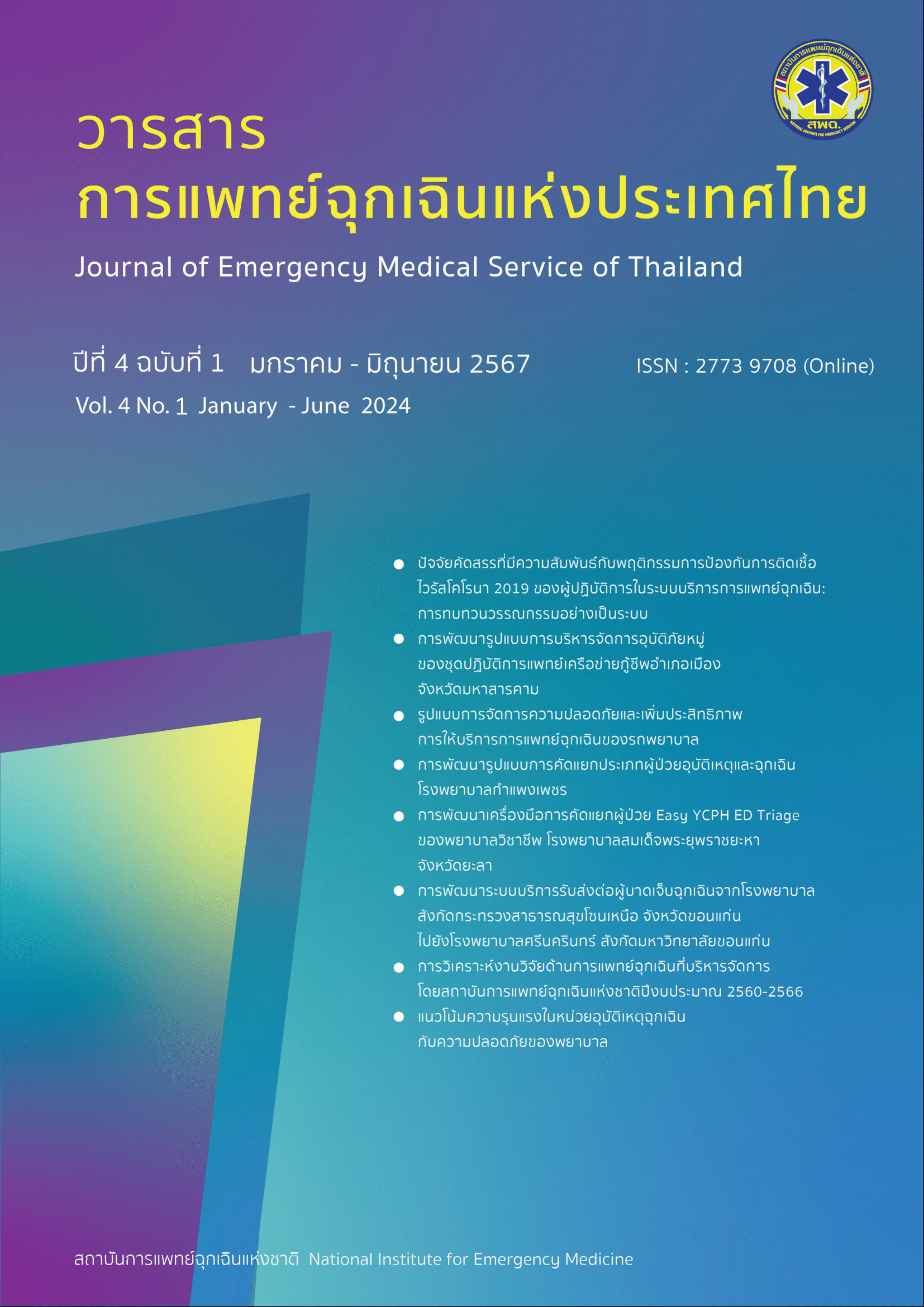
The Analysis of Emergency Medicine Research Management of the National Institute for Emergency Medicine during Fiscal Years 2017-2023
Keywords:
research synthesis, emergency medicine, National Institute of Emergency MedicineAbstract
This study aimed to analyze the emergency medicine research management by the National Institute for Emergency
Medicine (NIEM). A retrospective descriptive study design was employed. Data were collected from 57 research reports
during fiscal year 2017 to 2023. Data were analyzed by using descriptive statistics, including frequencies and percentages.
The results were indicated as follows: (1) the data base on research revealed that most of the budget (57.9%) was provided
by the Science Research and Innovation Fund; and 77.2% was area-based research of which the top 3 were Chiang Mai,
Khon Kaen, and Bangkok. The most common studies of Criteria-Based Dispatch (CBD) were group 6 (cardiac arrest)
covering up to 50.0%. Most of specific target group of the research was the elderly (56.0%). (2) most common
research outputs were the service system development model (36.8%), followed by knowledge (35.1%). (3) For research
issues based on the Emergency Care System (ECS) framework, most studies were on issues of pre-hospital care (61.0%),
followed by prevention (7.3%), in hospital care (4.9%) and mass casualties (2.4%). However, there was no research on
referral system. There were 47.8% of research studies that covered more than one aspect. (4) In terms of research issues
according to the health system framework or six building blocks plus, most studies were focussed on service delivery
(54.4%), followed by technology, tools and medicine (38.6%), health information system (3.5%), workforce and health
financing (1.8%). There was no research targeting leadership, governance, and partnership participation.
References
กัญญา วังศรี. การบริการการแพทย์ฉุกเฉินในประเทศไทย. Srinagarind Medical Journal 2556;28(4):69-73.
พระราชบัญญัติการแพทย์ฉุกเฉิน พ.ศ. 2551. ราชกิจจานุเบกษา เล่มที่ 125, ตอนที่ 44 ก (ลงวันที่ 6 มีนาคม 2551).
สถาบันการแพทย์ฉุกเฉินแห่งชาติ. แผนหลักการแพทย์ฉุกเฉินฉบับที่ 4 พ.ศ.2566-2570 (แผนปฏิบัติการ). นนทบุรี 2566.
ณิชชาภัทร ขันสาคร, ทัศนีย์ ศิลาวรรณ, ทัศนีย์ รวิวรกุล, วิริณธิ์ กิตติพิชัย, และอุมาวดี เหลาทอง. การศึกษาระบบบริการการแพทย์ฉุกเฉินสาหรับผู้สูงอายุ. คณะสาธารณสุขศาสตร์ มหาวิทยาลัยมหิดล, 2559.
ชาติชาย คล้ายสุบรรณ, บรรณาธิการ. คู่มือแนวทางการจัดบริการห้องฉุกเฉินที่เหมาะสมกับระดับศักยภาพสถานพยาบาล.พิมพ์ครั้งที่ 2. นนทบุรี: สามชัย 2017; 2561.
World Health Organization. Monitoring the building blocks of health systems: a handbook of indicators and their measurement strategies. Geneva: World Health Organization; 2010
พระราชบัญญัติสภานโยบายการอุดมศึกษา วิจัยและนวัตกรรมแห่งชาติ พ.ศ. 2562. ราชกิจจานุเบกษา เล่มที่ 136, ตอนที่ 57 ก (ลงวันที่ 1 พฤษภาคม 2562).
สำนักงานคณะกรรมการส่งเสริมวิทยาศาสตร์ วิจัยและนวัตกรรม. คู่มือสำหรับหน่วยรับงบประมาณจากกองทุนส่งเสริมสิทยาศาสตร์ วิจัยและนวัตกรรม ปีงบประมาณ 2563-2565. กรุงเทพฯ: ซีโน พับลิชชิ่ง แอนด์ แพคเกจจิ้ง; 2563.
สำนักวิชาการ สำนักงานเลขาธิการสภาผู้แทนราษฎร. ระเบียงเศรษฐกิจภาคตะวันออก (EEC) ความหวังใหม่เพื่อเศรษฐกิจไทยเติบโตอย่างยั่งยืน [อินเทอร์เน็ต]. [สืบค้นเมื่อ 5 กุมภาพันธ์ 2567]. แหล่งข้อมูล http://www.parliament.go.th/library.
สถาบันการแพทย์ฉุกเฉินแห่งชาติ. การศึกษาความชุก อุบัติการณ์ และสาเหตุของการตายและความพิการ จากการเจ็บป่วยฉุกเฉินของประเทศไทย ปี พ.ศ. 2559-2563. นนทบุรี: สำนักวิจัยและพัฒนาวิชาการ; 2565.
มูลนิธิสถาบันวิจัยและพัฒนาผู้สูงอายุไทย (มส.ผส.). สถานการณ์ผู้สูงอายุไทย พ.ศ. 2563. นครปฐม: สถาบันวิจัยประชากรและสังคม มหาวิทยาลัยมหิดล; 2564.
ทวีศิลป์ วิษณุโยธิน, พรทิพย์ วชิรดิลก, ธีระ สิริสมุด, สุรเดช ดวงทิพย์สิริกุล, ประชุมพร กวีกรณ์, และคณะ. การพัฒนารูปแบบระบบสุขภาพชุมชนสู่ระบบบริการสุขภาพอย่างไร้รอยต่อสำหรับผู้สูงอายุกลุ่มเสี่ยงโรคหลอดเลือดสมองอุดตัน (Stroke) โรคกล้ามเนื้อหัวใจตายเฉียบพลัน ชนิด STEMI และกระดูกสะโพกหัก (Hip fracture) แบบบูรณาการ ในเขตสุขภาพที่ 10. อุบลราชธานี: เขตสุขภาพที่ 10; 2565.
มติชนออนไลน์. สธ.เห็นชอบแนวทาง SMI-V ดูแลผู้ป่วยยาเสพติดเสี่ยงก่อความรุนแรง นำร่อง 30 จว. 2566 [อินเทอร์เน็ต]. [สืบค้นเมื่อ 5 กุมภาพันธ์ 2567]. แหล่งข้อมูล https://www.matichon.co.th/local/quality-life/news_3766987.
Martin-Gill C, Reiser RC. Risk factors for 72-hour admission to the ED. The American journal of emergency medicine. 2004;22(6):448-53.
กล่มข้อมูลข่าวสารสุขภาพ. สถิติสาธารณสุข พ.ศ.2561. นนทบุรี: สำนักนโยบายและยุทธศาสตร์; 2561.
สำนักงานพัฒนานโยบายสุขภาพระหว่างประเทศ. รายงานภาระโรคและการบาดเจ็บของประชากรไทย พ.ศ. 2557. นนทบุรี: เดอะ กราฟิโก ซิสเต็มส์; 2558.
Calvello EJ, Broccoli M, Risko N, Theodosis C, Totten VY, Radeos MS, et al. Emergency care and health systems: consensus‐based recommendations and future research priorities. Academic Emergency Medicine. 2013;20(12):1278-88.
Razzak JA, Kellermann AL. Emergency medical care in developing countries: is it worthwhile? Bulletin of the World Health Organization. 2002;80(11):900-5.
วิทูรย์ อนันกุล. แผนปฏิบัติการด้านการป้องกันและบรรเทาสาธารณภัยทางการแพทย์และการสาธารณสุขพ.ศ. 2563 – 2565. นนทบุรี: สำนักงานปลัดกระทรวงสาธารณสุข; 2564.
Downloads
Published
How to Cite
Issue
Section
License
Copyright (c) 2024 Journal of Emergency Medical Services of Thailand

This work is licensed under a Creative Commons Attribution-NonCommercial-NoDerivatives 4.0 International License.



