
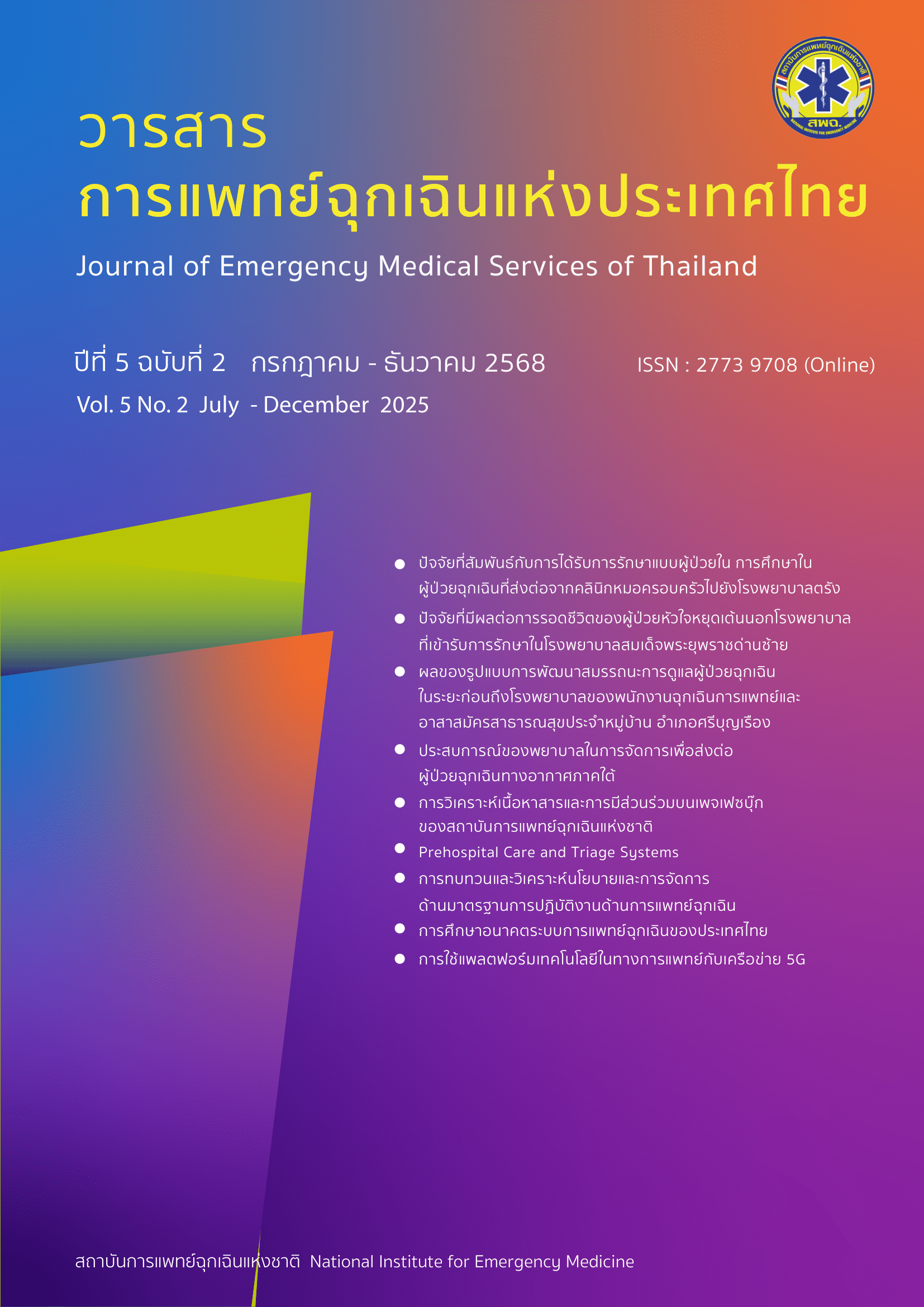
Factors Associated with Inpatient Care Received in Emergency Patient Referred from Primary Care Cluster to Tertiary Care, Trang Hospital
Keywords:
emergency patient, primary care cluster, referral, inpatient care, Thai healthcare systemAbstract
The accessibility of primary care services had led to an increase in emergency patients requiring referral to tertiary care hospitals. Receiving inpatient care indicates the importance of referring patients. The objective of this study was to identify factors associated with the care services among emergency in-patients who were referred from family doctor clinics. The study design was a retrospective analytic study in emergency patient referred from primary care cluster to Trang hospital between February to September 2023. Data collection from electronic medical records then analyzed for correlation with receiving inpatient care by using multivariate logistic regression analysis. Results: A total of 140 patients referred from primary care cluster to Trang hospital were eligible with an average age of 48.8+21.45 years. Females were 1.37 times than males and 106 patients were received inpatient care. Factors that increase the chances of receiving inpatient care were length of stay in emergency department less than 2 hours, history of outpatient care in 7 days, and not having radiology investigation in emergency department (p<0.05). It was also found that not having procedure in emergency department reduced the chances of receiving inpatient care (p<0.05). In conclusion, the development guideline for managing emergency patients in primary care units and referrals is important. Necessary procedures and radiological tests should be performed before referral. This can reduce waiting times in the emergency room and self-visit to the emergency room of the tertiary care hospital for non-critical illnesses. The practice guidelines should be designed to suit each hospital context.
References
โสภณ เมฆธน, ประสิทธิ์ชัย มั่งจิตร, สุภโชค เวชภัณฑ์เภสัช, สันติ ลาภเบญจกุล, ดวงดาว ศรียากูล, สิริชัย นามทรรศนีย์, และคณะ. แนวทางการดำเนินงานคลินิกหมอครอบครัวสำหรับหน่วยบริการ. กรุงเทพมหานคร: ชุมนุมสหกรณ์การเกษตรแห่งประเทศไทย; 2559.
Grumbach K, Selby JV, Damberg C, Bindman AB,Quensenberry CJ, Truman A, et al. Resolving the gatekeeper conundrum: what patients value in primary care and referrals to specialists. JAMA 1999 Jul 21;282(3):261-6.
Kvamme OJ, Olesen F,Samuelsson M. Improving the interface between primary care and secondary care: a statement from the European Working Party on Quality in Family Practice (EQuiP). Quality in Health Care 2001;10:33-39.
World Health Organization. Referral systems-a summary of key processes to guide health services managers. Geneva WHO; 2005.
สำนักสนับสนุนระบบสุขภาพปฐมภูมิ. คู่มือคุณภาพมาตรฐานบริการสุขภาพปฐมภูมิ พ.ศ. 2566. พิมพ์ครั้งที่ 1.กรุงเทพมหานคร: องค์การสงเคราะห์ทหารผ่านศึก; 2566.
Forrest CB, Nutting PA, Starfield B, Schrader SV. Family physicians' referral decisions: results from the ASPN referral study. J Fam Pract [Internet]. 2002 [cited 2023 Aug 5];51(3):215-22. doi: 10.1016/S0163-4453(02)00203-4.
Piterman L, Koritsas S. Part II. General practitioner specialist referral process. Intern Med J [Internet]. 2005[cited 2023 Aug 5];35(8):491-6. Available from: doi:10.1111/j.1445-5994.2005.00860.x.
Rinderknecht AS, Ho M, Matykiewicz P, Grupp-Phelan JM. Referral to the emergency department by a primary care provider predicts severity of illness. Pediatrics [Internet]. 2010 [cited 2023 Aug 5];126(5):917-24. Available from: doi: 10.1542/peds.2010-0844.
Rinderknecht AS, Ho M, Matykiewicz P, Grupp-Phelan JM. Referral to the emergency department by a primary care provider predicts severity of illness. Pediatrics [Intemet]. 2010 [cited 2023 Aug 5];126(5):917-24. Available from: doi: 10.1542/peds.2010-0844.
Bigby J, Dunn J, Goldman L, Adams JB, Jen P, Landefeld CS, Komaroff AL. Assessing the preventability of emergency hospital admissions. A method for evaluating the quality of medical care in a primary care facility. Am J Med [Internet]. 1987 [cited 2023 Aug 5];83(6):1031-6. Available from: doi: 10.1016/0002-9343(87)90938-7.
Thijssen WAMH, Kraaijvanger N, Barten DG, Boerma MLM, Giesen P, Wensing M. Impact of a well-developed primary care system on the length of stay in emergency departments in the Netherlands: a multicenter study. BMC Health Serv Res [Internet]. 2016 [cited 2023 Nov 11];16:149. Available from: doi: 10.1186/s12913-016-1400-z.
Pope I, Bum H, Ismail SA, Harris T, McCoy D. A qualitative study exploring the factors influencing admission to hospital from the emergency department. BMJ Open [Internet]. 2017 [cited 2023 Aug 5];7:e014680. Available from: doi: 10.1136/bmjopen-2016-014680.
Cheng J, Shroff A, Khan N, Jain S. Emergency Department return visits resulting in admission: do they reflect quality of care? American Journal of Medical Quality [Internet]. 2016 [cited 2025 Sept 25];31(6):541-51. Available from: doi: 10.1177/ 10628606166 48369.
Earl-Royal EC, Kaufman EJ, Hanlon AL, Holena DN, Rising KL, Delgado MK. Factor associated with hospital admission after an emergency department treat and release visit for older adults with injuries. Am J Emerg Med 2017;35(9):1252-7.
Nicodemo C, McCormick B, Wittenberg R, Hobbs FR. Are more GPs associated with a reduction in emergency hospital admissions? British Journal of General Practice [Internet]. 2021 [cited 2023 Aug 5];71(705):e287-95. Available from: doi: 10.3399/bjgp21X715193.
Scantlebury A, Adamson J, Salisbury C, Brant H, Anderson H, Baxter H, et al. Do general practitioners working in or alongside the emergency department improve clinical outcomes or experience? A mixed-methods study BMJ Open [Internet] 2022 [cited 2025 Sept 25];12:e063495. Available from: doi: 10.1136/bmjopen-2022-063495
Downloads
Published
How to Cite
Issue
Section
License
Copyright (c) 2025 Journal of Emergency Medical Services of Thailand

This work is licensed under a Creative Commons Attribution-NonCommercial-NoDerivatives 4.0 International License.



