
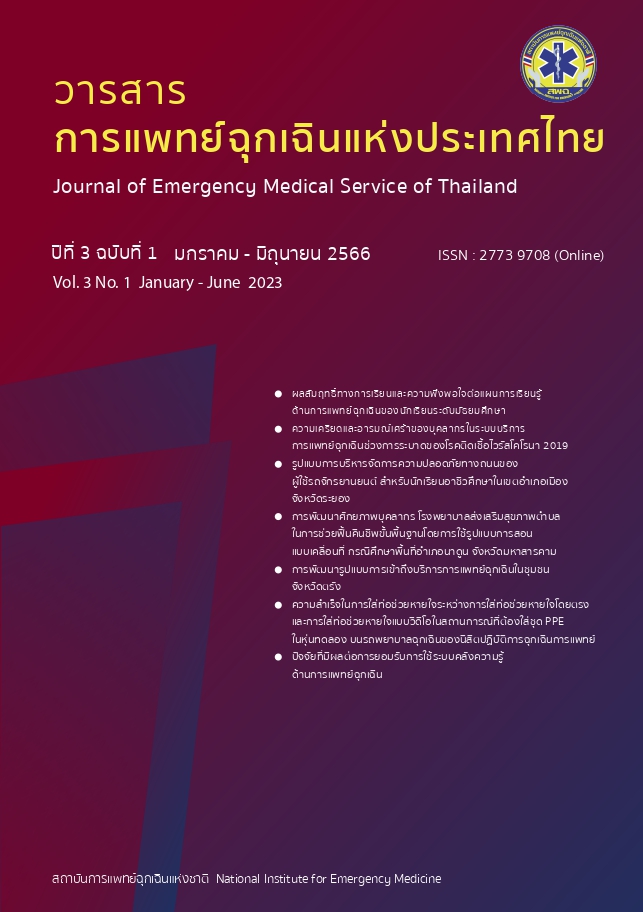
Personnel Potential Development of Sub-district Health Promoting Hospitals for Cardiopulmonary Resuscitation by Using a Mobile Teaching Model: a Case Study in Na Dun District, Maha Sarakham
DOI:
https://doi.org/10.14456/jemst.2023.4Keywords:
potential development, resuscitation; personnel, sub-district health promotion hospital, mobile teachingAbstract
The purpose of this action research was to study the potential development of personnel in sub-district health promoting hospitals for cardiopulmonary resuscitation by using a mobile teaching model; and to assess their knowledge, skills and attitudes on the cardiopulmonary resuscitation. The sample group in this study was 84 personnel of sub-district health promoting hospitals, Na Dun District, Maha Sarakham Province, using a purposive sampling method. Study period was from January - June 2021. Study tools used were the resuscitation knowledge test, a resuscitation operation skills assessment questionnaire, a problem assessment questionnaire, a satisfaction assessment questionnaire, and a cardiopulmonary resuscitation attitude assessment questionnaire. The data were analyzed using descriptive statistics, number, percentage, mean, standard deviation, and using paired-sample t-test for comparing knowledge before after training. The results showed that the problem and situation are the personnel lacked resuscitation skills. Some personnel had never been trained on cardiopulmonary resuscitation. Development of resuscitation potential of the personnel of sub-district health promotion hospital was performed using mobile teaching, consisting of (1) create a training model for personnel, and (2) training workshops on the use of cardiopulmonary resuscitation for all of personnel. A manual was developed on cardiopulmonary resuscitation and automatic defibrillator for the general public and for the use in teaching create a LINE group (Refer cup Nadun). It was found that 100 percent of the sub-district health promoting hospital personnel attended the training. The resuscitation knowledge of the samples before the training had an average score of 5.79 and after the training had an average score of 8.42 out of 10 (p<0.01). Assessment of cardiopulmonary resuscitation skills without an AED and with an AED was found to be completed, 97.62% and 84.52 % of the personnel, respectively. The sample group were most satisfied with the form of mobile training (100%); and with the preparation/distribution of knowledge of the speakers (97.61%). There was a positive attitude toward resuscitation, with the consideration that all citizens should know and be able to do cardiopulmonary resuscitation. From this research, a network of community resuscitation care patients was formed, and a guideline resuscitation practice was developed. Therefore, this training model should be annually utilized, and expanded in order to disseminate such knowledge and skills to a wider range.
References
Bhanji F, Donoghue AJ, Wolff MS, Flores GE, Halamek LP, Berman JM, Sinz EH, Cheng A. Part 14: education: 2015. American Heart Association guidelines update for cardiopulmonary resuscitation and emergency cardiovascular care. J Am Heart Assoc [Internet]. 2015 [cited2018 Jan 2];132:561-73. Available from: https://www.ahajournals.org/journal/jaha
American Heart Association. AHA guidelines update for CPR and ECC [Internet]. 2015 [cited 2018 Jan 2]. Available from: https://www.cercp.org/wp-content/uploads/2015/10/Guidelines-RCP-AHA-2015-Full. pdf
บัวบาน ปักการะโต, สหัศถญา สุขจำนงค์, อนุชิต สิ้วอินท์. การพัฒนารูปแบบการช่วยฟื้นคืนชีพแบบสัญจร โรงพยาบาลนาดูน จังหวัดมหาสารคาม. วารสารการแพทย์ฉุกเฉินแห่งประเทศไทย 2564;1(2):134-145.
สถาบันการแพทย์ฉุกเฉินแห่งชาติ. การช่วยฟื้นคืนชีพขั้นพื้นฐาน [อินเทอร์เน็ต]. 2563 [สืบค้นเมื่อ 22 ต.ค. 2563]. แหล่งข้อมูล: https://www.niems.go.th/1/Ebook?group=115&data_per_page=10&page=1
ปริญญา คุณาวุฒิ, นลินาสน์ ขุนคล้าย, บวร วิทยชำนาญ, บรรณาธิการ. สรุปแนวทางปฏิบัติการช่วยชีวิต ปี ค.ศ. 2015. กรุงเทพมหานคร: ปัญญมิตรการพิมพ์; 2558.
National Health Care Provider Solutions. Advanced cardiovascular life support (ACLS) certification course [Internet]. 2015 [cited 2018 Jan 2]. Available from: https://nhcps.com/lesson/acls-casesventricular-fibrillation-pulseless-ventricular-tachycardia/
Hawkes C, Booth S, Ji C, Brace-McDonnell SJ, Whittington A, Mapstone J, Cooke MW et al. Epidemiology and outcomes from out-of-hospit,al cardiac arrests in England. Resuscitation 2017;110:133-40.
Kemmis S, McTaggart R. The action research planner, 3rded. Geelong, Australia: Deakin University Press; 1998.
Gordon SE. “We Do; Therefore, We Learn” training and development 1993;47:47-52.
จันทร์เพ็ญ นิลวัชรมณี, วิดาพร ทับทิมศรี, ปัญจศิลป์ สมบูรณ์. ผลของการให้ความรู้และทักษะการช่วยฟื้นคืนชีพของนักศึกษาพยาบาลศาสตร์ วิทยาลัยพยาบาลบรมราชชนนี กรุงเทพ. วารสารวิจัยสุขภาพและการพยาบาล 2564;37 (1):180-92.
Downloads
Published
How to Cite
Issue
Section
License
Copyright (c) 2023 Journal of Emergency Medical Services of Thailand

This work is licensed under a Creative Commons Attribution-NonCommercial-NoDerivatives 4.0 International License.



