
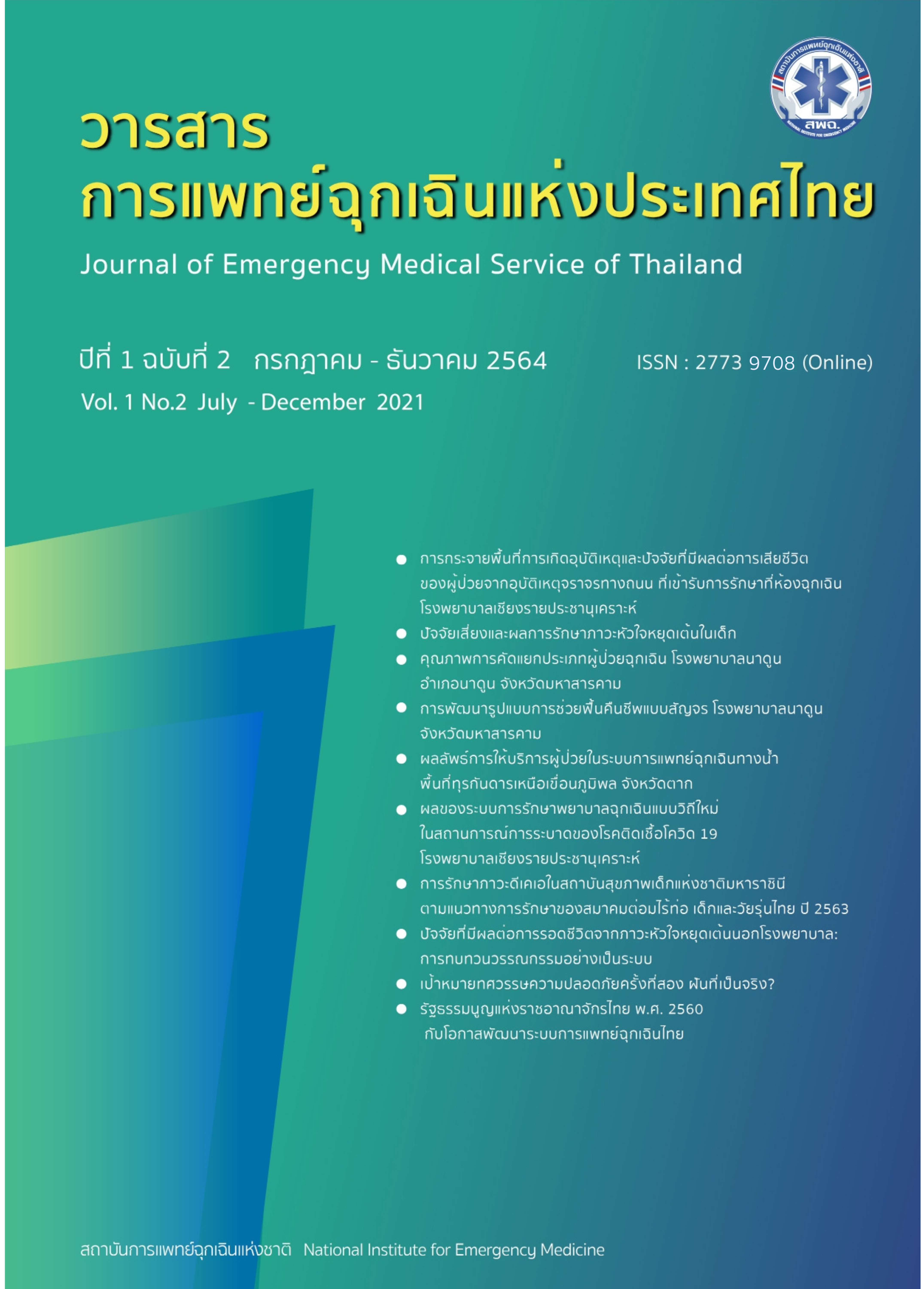
Risk and Outcomes Following Cardiac Arrest in Children: a Single-Centre Thai Study
DOI:
https://doi.org/10.14456/jemst.2021.12Keywords:
in-hospital cardiac arrest, cardiopulmonary resuscitation, hypoxia, ventricular arrhythmiaAbstract
Cardiac arrest (CA) is a life-threatening event which requires immediate and effective resuscitation. CA results from respiratory failure, shock, or both. Immediate diagnosis of cardiac arrest will provide a better outcome. The objective of this study was to determine the incidence, risks, and outcomes of in-hospital cardiac arrest in Queen Sirikit National Institute of Child Health (QSNICH). It was conducted as a retrospective descriptive study of patients between 1- 15 years of age who were diagnosed of in-hospital cardiac arrest and resuscitated with Pediatric Advanced Life Support from AHA guidelines 2010 in QSNICH from 1 January 2012 to 31 December 2016. It was found that 86,003 children (between 1 - 15 years of age) who were admitted from 2012 to 2016 and 214 children (0.25%) received cardiopulmonary resuscitation (CPR). Among them, 112 (52%) were male, and 102 (48%) were female. Most common cause of in-hospital cardiac arrest was hypoxia: 170 children (79%); and 43% of non-survived patients were under 5 years of age. For non-survived patients 74% had underlying diseases which were cardiovascular disease. Electrocardiography mainly showed asystole in 136 children (63%), and ventricular tachycardia (VT) or ventricular fibrillation (VF) in 36 children (17%). However, all patients with ventricular arrhythmia died. We found that the rate of return of spontaneous circulation was 46% but the survival to discharge was 9.8%. Risk factors lead to in-hospital cardiac arrest were cardiovascular disease and ventricular arrhythmias. In conclusion: The rate of survival to hospital discharge was lower than others. Mortality rate was higher in under 4 years old, with underlying cardiac diseases, and related to location (outside ICU). Expanding bed in PICU and set up rapid response team might be useful.
References
Young KD, Seidel JS. Pediatric cardiopulmonary resuscitation:a collective review. Ann Emerg Med 1999;33:195–205.
Young KD, Gausche-Hill M, McClung CD, Lewis RJ. A prospective, population-based study of the epi- demiology and outcome of out-of-hospital pediatric cardiopulmonary arrest. Pediatrics 2004;114:157-64.
Kleinman ME, Chameides L, Schexnayder SM, Samson RA, Hazinski MF, Atkins DL, et al. Part 14: pediatric advanced life support: 2010 American Heart Association guidelines for cardiopulmonary resuscitation and emergency cardiovascular care. Circulation 2010; 122(suppl3):S876–S908.
Slonim AD, Patel KM, Ruttimann UE: Cardiopulmonary resuscitation in pediatric intensive care units. Crit Care Med 1997; 25:1951–5.
Reis AG, Nadkarni V, Perondi MB, Grisi S, Berg RA.A prospective investigation into the epidemiology of in-hospital pediatric cardiopulmonary resuscitation using the international Utstein reporting style. Pediatrics 2002; 109:200–9.
R de Caen A, Maconochie I, Aickin R, Atkins D, Biarent D, Guerguerian A, et al. Part 6: pediatric basic life support and pediatric advanced life support: 2015 International Consensus on Cardiopulmonary Resuscitation and Emergency Cardiovascular Care Science With Treatment
Recommendations (Reprint). Pediatrics 2015; 136(Supplement):88-119.
Nadkarni VM, Larkin GL, Peberdy MA, Carey SM, Kaye W, Mancini ME, et al. National Registry of Cardiopulmonary Resuscitation nvestigators. First documented rhythm and clinical outcome from in-hospital cardiac arrest among children and adults. JAMA 2006; 295:50–7.
Girotra S, Nallamothu B, Spertus J, Li Y, Krumholz H,Chan P. Trends in Survival After In-Hospital Cardiac Arrest. Survey of Anesthesiology 2013; 57(2):73-4.
de Mos N, van Litsenburg RR, McCrindle B, Bohn DJ, Parshuram CS. Pediatric in-intensive-care-unit cardiac arrest: incidence, survival, and predictive factors. Crit Care Med 2006; 34:1209–15.
Samson RA, Nadkarni VM, Meaney PA, Carey SM, Berg MD, Berg RA. American Heart Association National Registry of CPR Investigators. Outcomes of in-hospital ventricular fibrillation in children. N Engl J Med 2006; 354:2328–39.
Lambert V., Matthews A., MacDonell R., Fitzsimons J. Paediatric early warning systems for detecting and responding to clinical deterioration in children: a systematic review. Open BMJ 2017;7:1-13.
Brown SR, Garcia DM, Agulnik S. Scoping Review of Pediatric Early Warning Systems (PEWS) in ResourceLimited and Humanitarian Settings 2019;6:1-9.
Kukreti V., Gaiteiro R., Mohseni-Bod H. Implementation of a pediatric rapid response team: experience of the Hospital for Sick Children in Toronto. Indian Pediatrics 2014;51:11-5.
Downloads
Published
How to Cite
Issue
Section
License
Copyright (c) 2021 National Institute for Emergency Medicine

This work is licensed under a Creative Commons Attribution-NonCommercial-NoDerivatives 4.0 International License.



