
Results of developing a model for promoting the quality and standards of primary healthcare services in primary care units and their networks in Nong Khai Province. Results of developing a model for promoting the quality and standards of primary healthcare services in primary care units and their networks in Nong Khai Province.
Article Sidebar
Main Article Content
Abstract
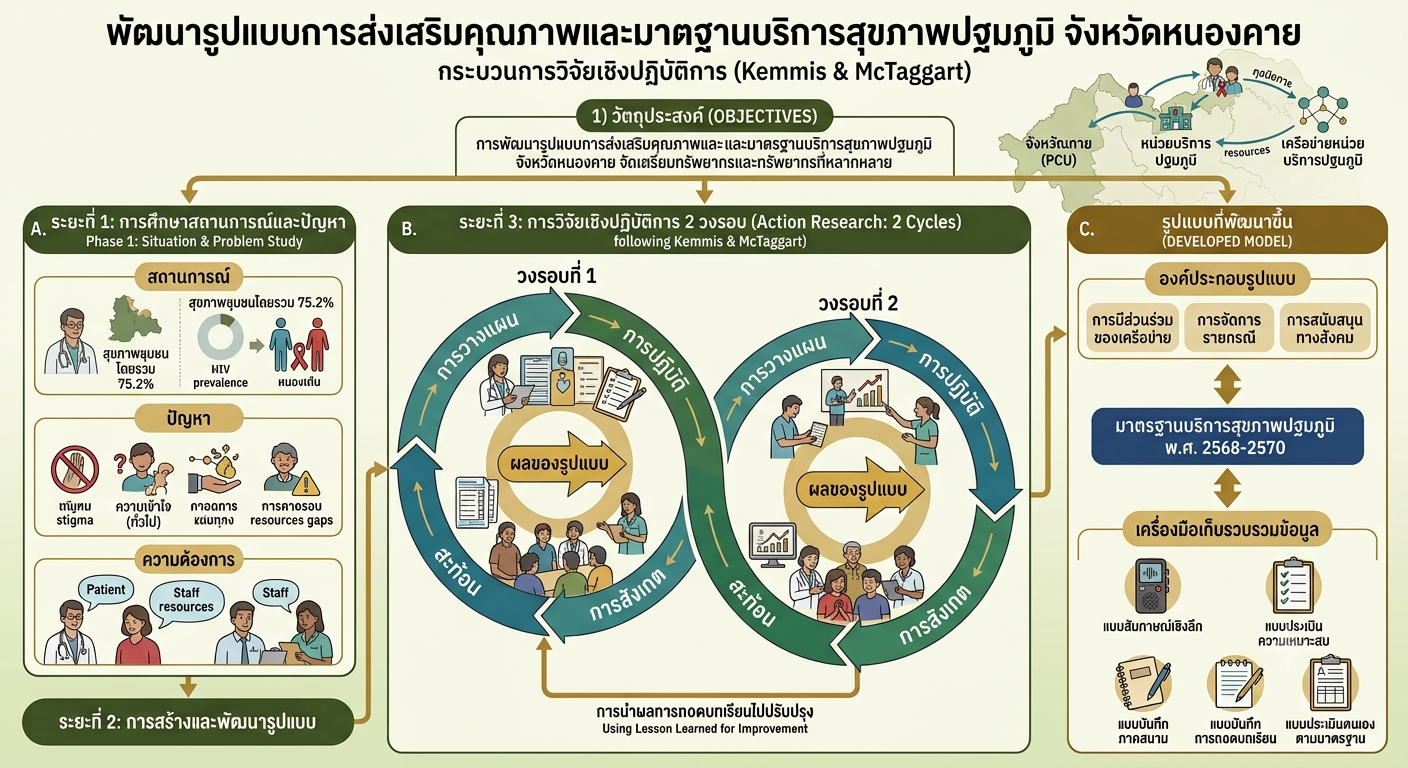
This study employed participatory action research based on the PAOR cycle (Plan, Act, Observe, Reflect) of Kemmis and McTaggart, integrated with a mixed-methods approach. The objectives were: 1) to examine the situation, problems, and needs related to improving the quality and standards of primary health care services in Nong Khai Province; 2) to develop a model for promoting quality and standards of service delivery among primary care units and primary care networks in Nong Khai Province; and 3) to evaluate the outcomes of implementing the developed model. The study was conducted in three phases: 1) situational analysis and problem identification using 20 key informants; 2) model development verified by 5 experts; and 3) model implementation and evaluation. Data collection instruments included in-depth interview guides, a model appropriateness assessment form, field notes, lesson-learned recording forms, a self-assessment form based on the 2025–2027 Primary Health Care Service Standards, and a satisfaction questionnaire. Data were analyzed using descriptive statistics, paired t-tests, and content analysis.
Findings: After completing two rounds of the PAOR cycle, the overall self-assessment scores increased significantly (p < .05), particularly in the areas of infection prevention and control, and laboratory systems. The proportion of service units meeting the standard criteria increased to 96.30%. Practitioners reported greater confidence in performing duties according to the standard criteria (M = 4.90, S.D. = 0.30) and high satisfaction with the support provided by the mentoring team (M = 4.85, S.D. = 0.36). The findings suggest that an empowerment-based participatory process can help cultivate a culture of continuous learning and teamwork among health personnel, thereby further enhancing the quality and standards of primary health care service delivery.
Keywords: primary health care, participatory action research, service quality standards
Article Details
References
สำนักกรรมาธิการ , สำนักงานเลขาธิการวุฒิสภา. รายงานพิเศษการบริการสุขภาพปฐมภูมิ. [อินเตอร์เน็ต]. 2563 [เข้าถึงเมื่อ 15 มีนาคม 2568]. เข้าถึงได้
จาก: https://search-library.parliament.go.th/bib/97748
กองยุทธศาสตร์และแผนงาน สำนักงานปลัดกระทรวงสาธารณสุข. (2567). สถิติสาธารณสุข พ.ศ.2566.นนทบุรี: กระทรวงสาธารณสุข.
กองสนับสนุนระบบสุขภาพปฐมภูมิ สำนักงานปลัดกระทรวงสาธารณสุข. (2568). คู่มือมาตรฐานหน่วยบริการปฐม
พ.ศ. 2568–2570. นนทบุรี: กระทรวงสาธารณสุข.
กระทรวงสาธารณสุข. (2562). พระราชบัญญัติระบบสุขภาพปฐมภูมิ พ.ศ. 2562. กรุงเทพฯ: ราชกิจจา
นุเบกษา.
กองสนับสนุนระบบสุขภาพปฐมภูมิ. คู่มือการดำเนินการตามหน้าที่ของหน่วยบริการปฐมภูมิและเครือข่ายสุขภาพปฐมภูม [อินเตอร์เน็ต]. 2562 [เข้าถึงเมื่อ 20
มีนาคม 2568]. เข้าถึงได้จาก:
https://drive.google.com/file/d/11TASzjwnqQ5zz5eEBIkTkJ47HHGCOJAl/view
สำนักงานสาธารณสุขจังหวัดหนองคาย. (2567). สรุปผลการตรวจราชการและนิเทศงานกรณีปกติ รอบที่ 2 ประจำปีงบประมาณ 2567. หนองคาย: กลุ่มงาน
ยุทธศาสตร์และแผนงาน.
เกรียงศักดิ์ เอกพงศ์ และ วงศา เลาหศิริวงศ์. ปัจจัยที่มีผลต่อประสิทธิผลของหน่วยบริการปฐมภูมิใน
ประเทศไทย. วารสารวิชาการสาธารณสุข 2562 ; 28(3): 119-137.
Kemmis, S., & McTaggart, R. (1988). The action research planner (3rd ed.). Deakin University Press.
สำนักสนับสนุนระบบสุขภาพปฐมภูมิ. คู่มือคุณภาพมาตรฐานบริการสุขภาพปฐมภูมิ พ.ศ. 2566. นนทบุรีโรงพิมพ์ องค์การสงเคราะห์ทหารผ่านศึกในพระบรม ราชูปถัมภ์; 2565. 82 หน้า.
กุนนที พุ่มสงวน. การสร้างเสริมพลังอำนาจทางสุขภาพ: บทบาทที่สำคัญของพยาบาล. วารสารพยาบาลทหารบก 2557; 5(3): 86-90.
Rovinelli, R. J., & Hambleton, R. K. On the use of content specialists in the assessment of
Criterion-referenced test item validity. Dutch Journal of Educational Research.1977; 2:49-60.
สิริมาศ ปิยะวัฒนพงศ์. (2563). การใช้กระบวนการวิจัยเชิงปฏิบัติการในการพัฒนารูปแบบการดำเนินงาน สาธารณสุข. [รายงานการวิจัย].
Gibson, C. H. (1991). A concept analysis of empowerment. Journal of Advanced Nursing.
; 16(3): 354-361.
วราภรณ์ บวรศิริ. (2562). การพัฒนาระบบพี่เลี้ยงเพื่อพัฒนาความสามารถในการผลิตงานวิจัยในชั้นเรียนของอาจารย์วิทยาลัยพยาบาลสังกัดสถาบันพระบรม
ราชชนก กระทรวงสาธารณสุข. วารสารการพยาบาลและการศึกษา 2562; 12(1): 1-13.
สุพัตรา ศรีวณิชชากร. (2566). คุณภาพของระบบบริการสุขภาพปฐมภูมิ และการบริหารจัดการระบบประเมิน คุณภาพในประเทศไทย. วารสารระบบบริการปฐม
ภูมิและเวชศาสตร์ครอบครัว 2566; 6(2): 122-123.
Nonaka, I., & Takeuchi, H. (1995). The knowledge-creating company: How Japanese companies create the dynamics of innovation.
Oxford University Press.
วิชัย เอกพลากร. (2565). การพัฒนาระบบคุณภาพบริการสุขภาพปฐมภูมิ: จากทฤษฎีสู่การปฏิบัติ. กรุงเทพฯ: โรงพิมพ์อักษรสัมพันธ์.
ชวน มุณีแนม. รูปแบบการพัฒนาคุณภาพและมาตรฐานในการให้บริการสุขภาพปฐมภูมิในจังหวัดสงขลา. วารสารวิชาการกรมสนับสนุนบริการสุขภาพ 2568
;21 (3): 62-72.
