
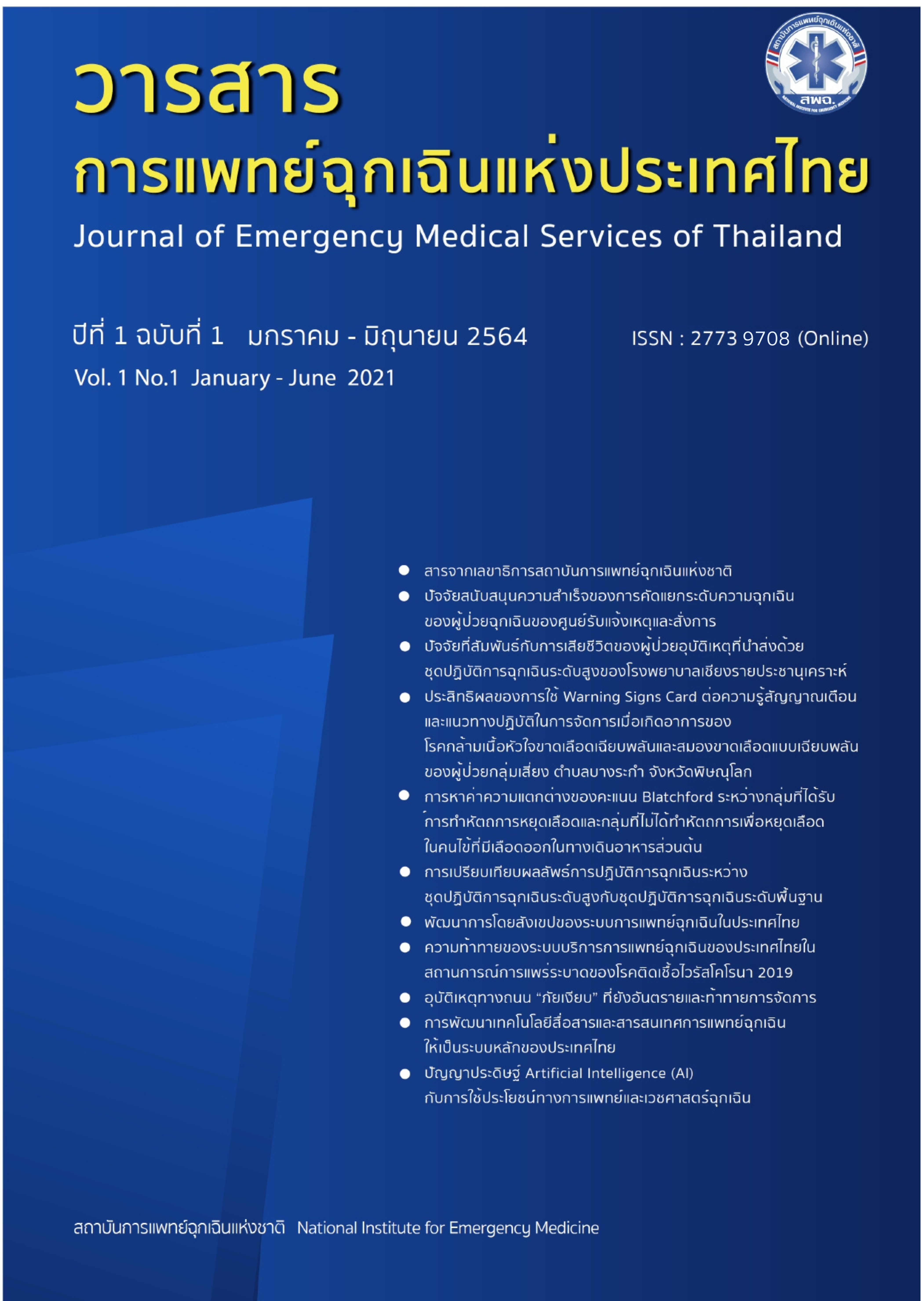
ปัจจัยที่สัมพันธ์กับการเสียชีวิตของผู้ป่วยอุบัติเหตุที่นำส่งด้วยชุดปฏิบัติการฉุกเฉินระดับสูงของโรงพยาบาลเชียงรายประชานุเคราะห์
DOI:
https://doi.org/10.14456/jemst.2021.2คำสำคัญ:
ระบบบริการการแพทย์ฉุกเฉิน, อุบัติเหตุ, เสียชีวิต, emergency severity index ระดับ 1บทคัดย่อ
การศึกษาเชิงวิเคราะห์ย้อนหลัง (retrospective cohort) มีวัตถุประสงค์เพื่อศึกษาปัจจัยที่สัมพันธ์กับการเสียชีวิตของผู้ป่วย อุบัติเหตุที่ได้รับบริการโดยชุดปฏิบัติการฉุกเฉินระดับสูงผ่านศูนย์รับแจ้งเหตุและสั่งการจังหวัดเชียงราย โดยเก็บรวบรวมข้อมูลจาก แฟ้มเวชระเบียนอิเล็กทรอนิกส์ของโรงพยาบาลเชียงรายประชานุเคราะห์ และแบบบันทึกข้อมูลชุดปฏิบัติการแพทย์ฉุกเฉินระดับสูง กลุ่มผู้ป่วยฉุกเฉินวิกฤตอุบัติเหตุที่รับบริการชุดปฏิบัติการฉุกเฉินระดับสูงผ่านศูนย์รับแจ้งเหตุและสั่งการจังหวัดเชียงราย ด้วยอาการนำสำคัญรหัส criteria based dispatch (CBD) 21 ถึง 25 และผ่านการคัดกรอง emergency severity index (ESI) ระดับ 1 โดยศึกษาหาปัจจัยเกี่ยวกับระยะเวลาที่ใช้ในการปฏิบัติการแพทย์ฉุกเฉิน (response time, on scene time, operation time) อายุ เพศ กลไกการบาดเจ็บ แบ่งเป็นกลุ่มที่เสียชีวิต และกลุ่มที่รอดชีวิตถึง 24 ชั่วโมงหลังจากนำส่งโรงพยาบาล ผู้ป่วยฉุกเฉินวิกฤตอุบัติเหตุที่เข้าเกณฑ์การศึกษาทั้งหมด 218 คน แบ่งเป็นกลุ่มที่เสียชีวิต 58 คน (ร้อยละ 26.6) และกลุ่มที่รอดชีวิต 160 คน (ร้อยละ 73.4) ผู้ป่วยกลุ่มที่เสียชีวิตใช้เวลา operation time มากกว่า 40 นาที (ร้อยละ 24.1) มีความสัมพันธ์กับอัตราการเสียชีวิตอย่างมีนัยสำคัญทางสถิติ การใช้เวลา response time ≤ 8 นาที (ร้อยละ 58.6) และ on scene time ≤ 10 นาที (ร้อยละ 12.1) พบว่าไม่มีนัยสำคัญทางสถิติกับความสัมพันธ์ของอัตราการเสียชีวิต ดังนั้นจึงสรุปได้ว่าปัจจัยเรื่องเวลา response time และ on scene time ของการปฏิบัติการแพทย์ฉุกเฉินไม่สัมพันธ์กับการเสียชีวิตในผู้ป่วยวิกฤตอุบัติเหตุ ESI ระดับ 1 แต่ operation time มากกว่า 40 นาที สัมพันธ์ต่ออัตราการเสียชีวิตของผู้ป่วยที่มากขึ้น จึงควรนำส่งผู้ป่วยภายในเวลา 40 นาที การศึกษาครั้งนี้ สามารถ นำไปใช้ในการปรับปรุงคุณภาพในการดูแลผู้ป่วยที่ได้รับอุบัติเหตุของหน่วยปฏิบัติการระดับสูง การกำหนดนโยบาย หรือตัวชี้วัดที่เกี่ยวข้องกับคุณภาพของการดูแลผู้ป่วยอุบัติเหตุ พบว่าเวลาอาจจะไม่ใช่ตัวแปรสำคัญที่มีผลต่อการอดชีวิตของผู้ป่วย แต่อาจจะมีปัจจัยอื่นที่กำหนดคุณภาพของการดูแลรักษาผู้ป่วยที่ยังไม่ได้ศึกษาในครั้งนี้
เอกสารอ้างอิง
กองยุทธศาสตร์และแผนงาน สำนักงานปลัดกระทรวงสาธารณสุข. สถิติสาธารณสุข พ.ศ. 2559 [อินเทอร์เน็ต]. 2562 [สืบค้นเมื่อ 10 ม.ค. 2562]. แหล่งข้อมูลhttp://bps.moph.go.th/new_bps/sites/default/files/health_strategy2559.pdf
สถาบันการแพทย์ฉุกเฉินแห่งชาติ. แผนหลักการแพทย์ฉุกเฉินแห่งชาติ ฉบับที่ 3.1 พ.ศ. 2562–2564 [อินเทอร์- เน็ต]. 2562 [สืบค้นเมื่อ 10 ม.ค. 2562]. แหล่งข้อมูล: https://www.niems.go.th/1/upload/migrate/ file/256112221455115037_GWJdMn5ejp3gVAdc. pdf
โรงพยาบาลนครพิงค์. ระบบรายงานตัวชี้วัด สาขาอุบัติเหตุ และฉุกเฉิน เขตบริการสุขภาพที่ 1 [อินเทอร์เน็ต]. 2562 [สืบค้นเมื่อ 10 ม.ค. 2562]. แหล่งข้อมูล: http://mis.nkp-hospital.go.th/kpi/trauma/
รัฐพงษ์ บุรีวงษ์, สุกรม ชีเจริญ, ศันยวิทย์ พึงประเสริฐ, รุจาพร โคตรนรินทร์, รวีวรรณ ธเนศพลกุล, เกษมสุข โยธาสมุทร. Guideline for ER service delivery. คู่มือแนวทางการจัดบริการห้องฉุกเฉิน [อินเทอร์เน็ต]. นนทบุรี: สำนักวิชาการแพทย์ กรมการแพทย์ กระทรวงสาธารณสุข; 2561 [สืบค้นเมื่อ 10 ม.ค. 2562]. แหล่งข้อมูล: https://www.dms.moph.go.th/backend//Content/Content_File/Population_Health /Attach/25621021104538AM_55.pdf?contentId=18327
Fee C, Hall K, Morrison JB, Stephens R, Cosby K, Fairbanks RTJ, et al. Consensus-based recommendations for research priorities related to interventions to safeguard patient safety in the crowded emergency department. Acad Emerg Med [Internet]. 2011 [cited 2019 Jan 10];18: 1283-8. Available from: https://doi.org/10.1111/j.1553-2712.2011.01234.x
National Association of Emergency Medical Technicians. PHTLS: pre-hospital trauma life support. 8th ed. Clinton, MS: Jones & Bartlett Learning; 2016.
พิมพ์ภา เตชะกลสุข, ศิริวรรณ สันติเจียรสกุล, อรัฐา รังผึ้ง, อนงค์ แสงจันทร์ทิพย์, กาญจนีย์ ดำนาคแก้ว, แสงโฉม เกิด คล้าย. รายงานสถานการณ์การบาดเจ็บรุนแรงและเสียชีวิตจากสาเหตุภายนอก พ.ศ. 2548-2553 [อินเทอร์เน็ต]. นนทบุรี: สำนักระบาดวิทยา; 2556 [สืบค้นเมื่อ 9 ม.ค. 2562]. แหล่งข้อมูล: http://www.boe.moph.go.th/files/report/20140718_44904318.pdf
ไพบูลย์ สุริยะวงศ์ไพศาล, วรสิทธิ์ ศรศรีวิชัย, นิสิต วรรธนัจฉริยา, จารุวรรณ ธาดาเดช, สิริมา มงคลสัมฤทธิ์, เฉลิมพร บุญสิริ, และคณะ. รายงานประเมินนโยบายว่าด้วยวิวัฒนาการระบบการแพทย์ฉุกเฉิน [อินเทอร์เน็ต]. 2562 [สืบค้นเมื่อ 9 ม.ค. 2562]. แหล่งข้อมูล: https://www.hsri.or.th/researcher/research/new-release/detail/5045
ประจักษวิช เล็บนาค, กรองกาญจน์ บุญใจใหญ่, ตรึงตา พูลผลอำนวย, ขนิษฐา ภูสีมุงคุณ, อนุรักษ์ อมรเพชรสถาพร, Henrik Laldell. รายงานการศึกษา ประสิทธิผลและความคุ้ม ค่าของการปฏิบัติการฉุกเฉินอย่างทันท่วงที [อินเทอร์เน็ต]. นนทบุรี: สถาบันการแพทย์ฉุกเฉินแห่งชาติ; 2558 [สืบค้น เมื่อ 9 ม.ค. 2562]. แหล่งข้อมูล: https://www.niems.go.th/pdfviewer/index.html
สถาบันการแพทย์ฉุกเฉินแห่งชาติ. ตัวชี้วัดการดำเนินงาน ของสถาบันการแพทย์ฉุกเฉินแห่งชาติปี 2561 [อินเทอร์เน็ต]. 2562 [สืบค้นเมื่อ 9 ม.ค. 2562]. แหล่งข้อมูล: https://www.niems.go.th/pdfviewer/index.html
Gruen RL, Gabbe BJ, Stelfox HT, Cameron PA. Indicators of the quality of trauma care and the performance of trauma systems. British Journal of Surgery 2012; 99(S1): 97-104.
Pons PT, Markovchick VJ. Eight minutes or less: does the ambulance response time guideline impact trauma patient outcome. Journal of Emergency Medicine 2002; 23: 43-8.
McCoy CE, Menchine M, Sampson S, Anderson C, Kahn C. Emergency medical services out-of-hospital scene and transport times and their association with mortality in trauma patients presenting to an urban level i trauma center. Annals of Emergency Medicine 2013; 61: 167- 74.
Lerner EB, Moscati RM. The golden hour: scientific fact or medical ‘‘urban legend’’? Academic Emergency Medicine 2001; 8:758-60.
Byrne JP, Mann NC, Dai M, Mason SA, Karanicolas P, Rizoli S, et al. Association between emergency medical service response time and motor vehicle crash mortality in the United States. JAMA Surgery 2019 ; 154: 286- 93.
Newgard CD, Schmicker RH, Hedges JR, Trickett JP, Davis DP, Bulger EM, et al. Emergency medical services intervals and survival in trauma: assessment of the “golden hour” in a North American Prospective Cohort. Annals of Emergency Medicine 2010; 55: 253-46.
Lichtveld RA, Panhuizen IF, Smit RBJ, Holtslag HR, van der Werken C. Predictors of death in trauma patients who are alive on arrival at hospital. European Journal of Trauma and Emergency Surgery 2007; 33: 46-51.
Esmaeiliranjbar A, Mayel M, Movahedi M, Emaeiliranjbar F, Mirafzal A. Pre-hospital time intervals in trauma patient transportation by emergency medical service: association with the first 24-hour mortality. Journal of Emergency Practice and Trauma 2016; 2: 37-41.
Sampalis JS, Lavoie Andre, Williams JI, Mulder DS, Kalina M. Impact of onsite care, prehospital time, and level of in-hospital care on survival in severity injured patients. Journal of Trauma 1993; 34: 252-61.
ดาวน์โหลด
เผยแพร่แล้ว
รูปแบบการอ้างอิง
ฉบับ
ประเภทบทความ
สัญญาอนุญาต
ลิขสิทธิ์ (c) 2021 สถาบันการแพทย์ฉุกเฉินแห่งชาติ

อนุญาตภายใต้เงื่อนไข Creative Commons Attribution-NonCommercial-NoDerivatives 4.0 International License.



